
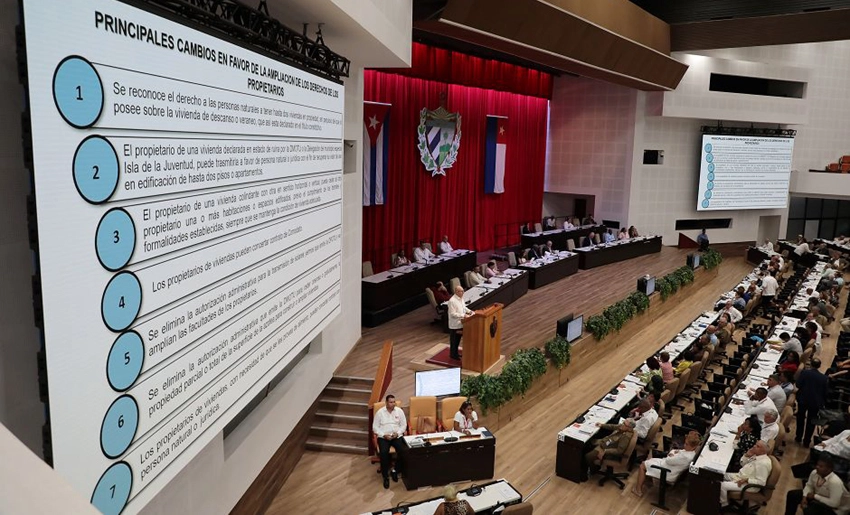
The National Assembly of People’s Power approved the new Housing Law this Thursday. A law that updates the legal framework of the sector, expands the rights of property owners. Incorporates new management methods to address the housing deficit. And strengthens the role of local governments in the development of housing policies.
When presenting the bill to Parliament, the Minister of Construction, René Antonio Mesa Villafaña. He explained that the law is the result of an extensive drafting process. That included a review of international treaties signed by Cuba on housing and habitat, legislation from 15 countries. A set of national laws related to land use planning, administrative procedures, eminent domain, and urban development, among others.
Furthermore, the proposal aligns with public policies related to demographic dynamics, youth services, addressing climate change, and local and territorial development.
The new law is structured into 16 chapters, 190 articles, and three final provisions. Following an extensive expert consultation process that received 10,928 opinions, proposals, and criteria, of which 56% were accepted. The debate also generated more than 158,000 interactions on social media.
Among the principles upheld by the legislation are the State’s responsibility in developing construction programs. To reduce the housing deficit, the protection of vulnerable individuals through subsidies and other benefits. Also the recognition of homeownership as a citizen’s right, and the maintenance of the self-build housing system.
A National Program with New Stakeholders
One of the law’s main contributions is the creation of the National Housing Development Program. Designed with a comprehensive and sustainable approach.
In addition to state entities, the following will participate in its implementation: housing cooperatives, other cooperatives, microbrigades, micro, small, and medium-sized enterprises. Also real estate entities, and other authorized management entities.
The law also establishes that the value of state-owned housing will be determined. According to its cadastral value and allows economic entities to allocate profits to finance construction projects or contribute to the payment of housing assigned to their employees. As a mechanism to promote workforce stability.
Furthermore, when it becomes necessary to develop new urban growth areas. The State and other authorized management entities will be responsible for planning, financing, and implementing the urbanizations and integrating them with existing human settlements.
The legislation also incorporates differentiated treatment for people residing in precarious neighborhoods. Or degraded areas and recognizes young people as part of the priority population for access to adequate housing.
Property Owners’ Rights Expanded
According to the minister’s presentation to the deputies, the bill introduces substantial changes that expand the rights of homeowners. Eliminating administrative hurdles and recognizing new possibilities for the disposal and use of real estate assets.
The new law recognizes the right of individuals to own up to two properties. Without prejudice to the vacation or holiday home declared in the deed of ownership.
Furthermore, the owner of a property declared to be in a state of disrepair by the Municipal Directorate of Territorial Planning and Urban Development (DMOTU). It may transfer it to an individual or legal entity to restore its usable value, in buildings of up to two stories or apartments.
Likewise, the owner of a property adjacent to another, either horizontally or vertically. May transfer one or more rooms or built spaces to the other owner, after completing the necessary procedures. Provided that the property remains suitable for residential use.
Similarly, property owners can enter into loan agreements and, when they require support, contract with individuals or legal entities. The provider of support cannot transfer ownership of the property. During the term of the agreement, as specified in the new legal document.
The administrative authorization previously required for the transfer of vacant lots is eliminated. Expanding the powers of property owners to sell, exchange, donate, lease, subdivide, consolidate, grant surface rights, and transfer ownership upon death. In compliance with existing urban planning regulations.
One of the most significant changes is the repeal of the confiscation of housing upon permanent departure from the country. Representing a major step forward in property rights.
Another benefit is the elimination of the requirement for heirs to notify the Municipal Housing Department. Within one year of the owner’s death that the property allocation process has begun, once the property has been vacated.
New Forms of Organizational Management
The project introduces two key players in housing management:
- Real estate companies, which will be able to invest in the construction of new apartment buildings.Using their own resources, collaboration, or foreign investment.Sell apartments to individuals and legal entities; lease properties with purchase options. Manage leases and administer state or private properties. And offer management and advisory services for sales, donations, and transfers in general.
- Housing cooperatives, established through the collective work of their members.And the effective application of cooperative principles, have rights similar to those of individuals regarding the acquisition of vacant lots.The execution of architectural projects, and must incorporate criteria of climate resilience and energy efficiency.
With information from Cubadebate and the Presidency of Cuba

- Putin states that BRICS has generated over 40 percent of global GDP - 12 de September de 2026
- Between the wind of the tenths and bottled art - 12 de September de 2026
- ETECSA Holguin Hosts Science and Technology Forum - 12 de September de 2026