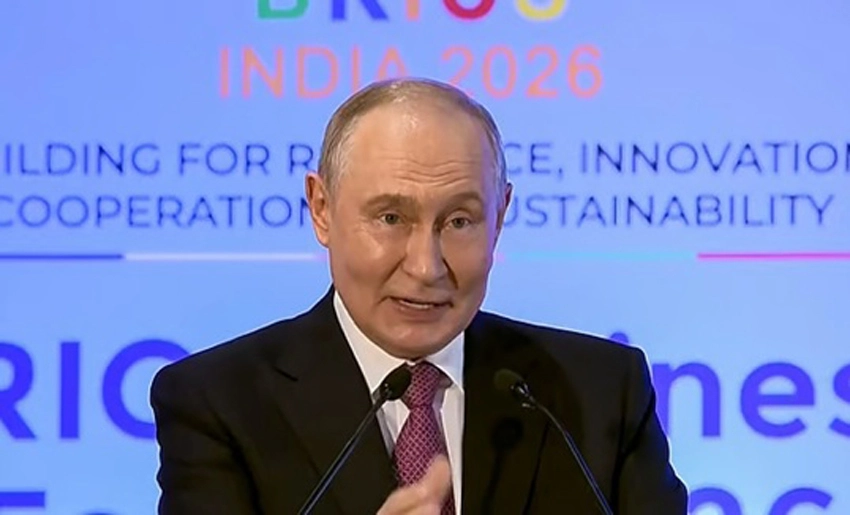
Russian President Vladimir Putin highlighted the economic potential of the BRICS group this Friday. Noting that it contributed nearly half of global growth over the last five years, compared to 18% from the G7.
“When speaking of global economic growth… almost half comes from the countries in this union. Meanwhile, the G7 contributes only 18%,” Putin said while addressing a business forum in New Delhi.
Regarding global Gross Domestic Product, he specified that more than 40% was accounted for by the group led by China, India, and Russia. Whereas the G7’s contribution “was 29%.”
He emphasized that the advantage of BRICS lies in the fact that they impose no restrictions—whether national or corporate—and are willing to cooperate with all their partners, unlike Western powers.
“Our common goal is to develop the potential of BRICS for the benefit of our countries and peoples. We aim to strengthen the mechanism for practical and business cooperation—what is known as business diplomacy,” he underscored.
Meanwhile, he added, industrial production in Eurozone countries has fallen by 8% in recent years—”which is a significant amount for them.”
“The world is undergoing a phase of profound structural changes. This is linked to the fact that new engines of development are emerging to replace the old leaders—let us call them that. Those who were at the forefront of economic growth during the second half of the century,” he noted.
Nevertheless, he denounced that “our Western competitors are attempting to regain their former leadership by any means at their disposal. This competition sometimes takes on improper forms—something our Iranian colleague (Masoud Pezeshkian) also just mentioned. Moreover, these inappropriate methods are manifesting at the state level.”
Among other measures, they proceed to destroy logistics or industrial facilities, as well as gas or oil pipelines. Also they attempt to block transport corridors and seize ships. Imposing sanctions and threats of secondary sanctions, he asserted—in a clear allusion to the Strait of Hormuz. Or the sabotage of the Nord Stream pipeline, which supplied Russian gas to Germany.
In this regard, he highlighted that the Russian economy grew by 10.3% over the last three years—surpassing the global average—. Despite facing more than 30,000 sanctions, “almost twice as many as the rest of the world combined.”
“We have strengthened our national sovereignty and developed ties with reliable and predictable partners. In just four years, the geography of our trade relations has changed radically,” he stated.
With information from Cubadebate

- Putin states that BRICS has generated over 40 percent of global GDP - 12 de September de 2026
- Between the wind of the tenths and bottled art - 12 de September de 2026
- ETECSA Holguin Hosts Science and Technology Forum - 12 de September de 2026