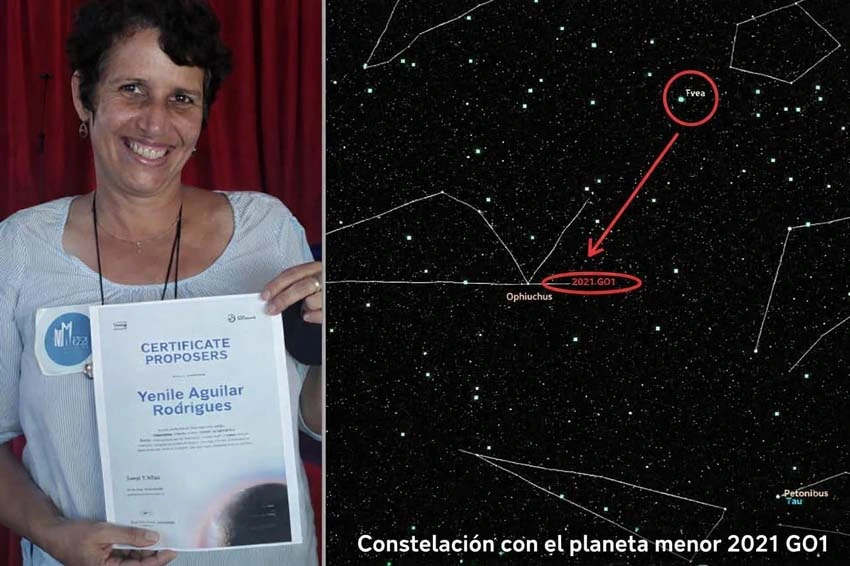
At a point in the universe, visible from Cuba in the constellation Cetus, the Whale. Two names shine today that were not born in telescopes or laboratories, but in the historical memory of a nation. Félix Varela and Finlay no longer inhabit only books: they literally orbit in the sky. And it was a Cuban woman who brought them there.
Yenile Aguilar Rodríguez, a professor at the University of Matanzas, wasn’t seeking the limelight. When she decided to participate in the International Astronomical Union’s global competition. The initiative proposed something deeper than naming stars or exoplanets. It invited reflection on our place in the universe and how Earth would be seen from other civilizations. A scientific question, yes, but also a profoundly human one.
Her answer was to look inward.
With the privilege of naming a star system, Yenile chose to inscribe two essential figures of Cuban history in the cosmos. The star was named after Félix Varela. The priest and thinker who sowed the seeds of independence in the 19th century.
The planet orbiting it was named Finlay, in honor of the doctor from Camagüey. Also who discovered the role of the Aedes aegypti mosquito in the transmission of yellow fever. A discovery that saved millions of lives.
Thus, amidst astronomical coordinates and impossible distances, Cuba left a symbolic mark on the universe.
History takes on a special significance on a date like this. When the world remembers the Tunguska impact and reflects on the real danger posed by asteroids.
Faced with this narrative of threat, Yenile’s experience offers another perspective on the sky: not only as a space of risk, but also of meaning, memory, and belonging.
Because beyond orbital calculations, there is something profoundly cultural about naming. To name is to recognize, to preserve, to project identity. And in this case, it is also to elevate it to a cosmic scale.
From today onward, every time someone observes that point of light in Cetus, they will be, perhaps unknowingly, uttering fragments of Cuban history. And behind that silent gesture lies the legacy of a teacher from Matanzas. Who decided that the universe could also speak in the language of a nation.
By: Miguel David Bruzón Hernández

- Holguin Health Sector Strengthens Ties with Adolescents and Youth - 1 de October de 2026
- Trump’s measures against Cuba: another step toward strangulation - 1 de October de 2026
- Cuba prioritizes respect and care for older adults - 1 de October de 2026