
There is a little-known connection between “strange” sounds and tourism. A link often forged by urban designers as is the case in New York City.
In fact, the British have taken a particular interest in these phenomena. Traveling to this American city to uncover the truth behind them.
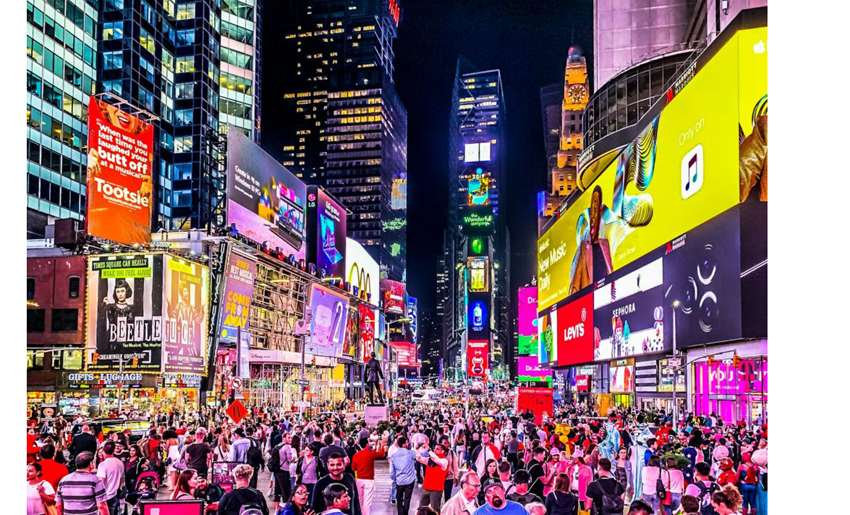
Amidst the most famous visual and auditory chaos on the planet Times Square in New York, there exists a specific sonic phenomenon that tourists and locals alike may notice, yet rarely identify: the “Times Square Hum.”
It is a constant, deliberate hum, emitted from a pedestrian island specifically designed to create this acoustic experience.
Unlike typical urban ambient noise (car horns, engines, voices, digital advertisements), this particular hum possesses a distinct quality that has sparked debate among residents. Is it merely an annoying noise, or an intentional artistic feature?
Research confirms that it is a sound installation, planned as part of urban redesign projects carried out between 2008 and 2012.
The pedestrian island from which the sound emanates is strategically located at the intersection of Broadway and Seventh Avenue. Also where millions of visitors pass by every day.
The system produces a persistent, low-pitched tone that interacts with nearby reflective surfaces. Becoming amplified under certain atmospheric conditions, especially during quiet nights when vehicular traffic subsides.
Acoustic scientists have analyzed the phenomenon, noting that persistent low-frequency sounds can trigger physiological responses in some individuals. Including feelings of unease or temporary disorientation. Other researchers argue that the “hum” serves a positive psychological function. By helping to territorially mark specific public spaces within chaotic urban environments.
For travelers sensitive to intense sensory stimuli, Times Square presents a significant challenge: giant LED screens flicker continuously.
Crowds push in various directions, street vendors shout out their offers, and now this background hum adds yet another layer of auditory stimulation. The site functions as a microcosm of modern metropolitan sensory overload.
Despite its potentially unsettling nature, Times Square remains a must-see tourist destination for a first visit to New York. Its global cultural iconography—appearing in films, photographs, and media imagery—solidifies its status as a universal urban symbol.
Consequently, travelers have compiled accounts of the phenomenon—many of which can be found on *Atlas Obscura*, in the New York City Department of Transportation’s public plaza installation records. Or within acoustic research studies on urban sound environments published between 2020 and 2025.
With information from Prensa Latina

- Cuba Promotes Agricultural Transformations Despite U.S. Blockade - 16 de October de 2026
- Strengthened in Holguin an Alliance Against Skin Cancer - 16 de October de 2026
- Progress on Electrical Infrastructure and Renewable Energy Integration in Holguin - 16 de October de 2026