
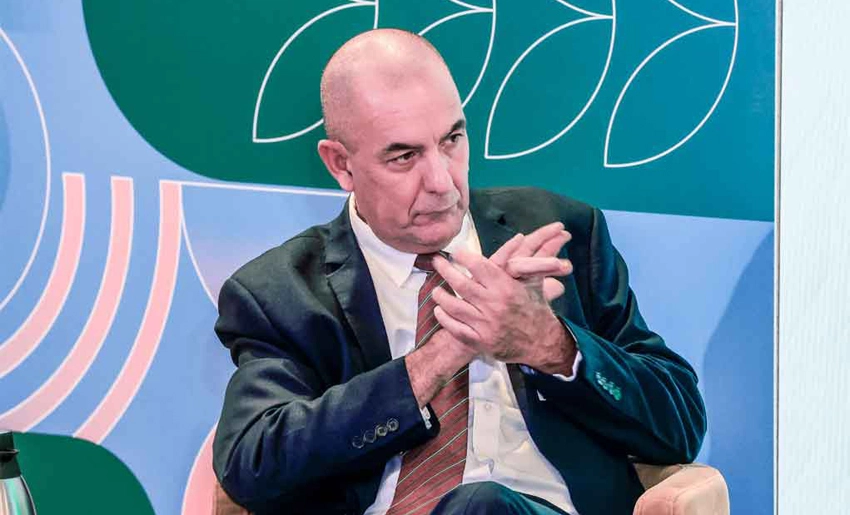
Cuba is advancing agricultural transformations, even within a context marked by resource constraints caused by the U.S. blockade, stated Ydael Pérez Brito, Cuba’s Minister of Agriculture, in Rome.
In an exclusive interview with Prensa Latina following his attendance at the World Food Forum—organized by the FAO. The minister explained that Washington’s unilateral coercive measures against the island have a cross-cutting impact on various sectors of the country’s agrifood systems.
He noted that the Caribbean nation faces difficulties in accessing fuel, fertilizers, seeds, and other essential inputs. While migration from rural areas and a shrinking workforce complicate the effective use of available land.
The economic, commercial, and financial blockade imposed by the United States—exacerbated by energy restrictions—compounds these challenges. By limiting the conditions necessary to produce, preserve, transport, and distribute food, the minister pointed out.
“The lack of fuel is hitting us hard; its impact is pervasive. Producing food today with virtually no fuel is extremely difficult. No matter how much you rely on animal traction or manual labor, you simply cannot operate at a large scale.”
“To lower prices, you need large-scale production—production capable of competing and reaching the market in sufficient volume to drive prices down. These are complex issues.”
Pérez Brito acknowledged that the country has managed to expand the area under cultivation during certain seasons. Also though the shortage of inputs has negatively affected yields.
Consequently, he emphasized the need to combine an increase in cultivated land with greater efficiency, proper animal care, and the comprehensive utilization of available resources.
Among the measures adopted, he highlighted legal reforms aimed at facilitating land access, encouraging investment. Strengthening cooperatives, and broadening opportunities for commercialization and financing. The process encompasses 176 transformations related to the sector, 162 of which pertain directly to agriculture, he stated.
He elaborated that the new framework includes provisions to facilitate the usufruct of agricultural and forestry land, promote contract farming, and foster alliances between producers and other economic actors capable of providing capital and inputs.
The objective, he specified, is for these new possibilities to translate into concrete results for the population. More food, better yields, and greater productive efficiency.
He also underscored the need to revive strategic crops, such as sugarcane, and to make use of land that is currently idle or underutilized. The Cuban official further highlighted the importance of creating greater opportunities for young people. Facilitating their entry into agricultural work, and establishing conditions that allow them to build a life project in the countryside.
Pérez Brito maintained that agricultural recovery requires integrating legal measures with the active participation of producers, as well as financing, science, and innovation. Ensuring that these efforts are reflected on the tables of Cuban families and in the well-being of rural communities.
He insisted that the challenge lies in putting these transformations into practice, overcoming obstacles, and increasing productivity under complex conditions. With the ultimate goal of achieving food sovereignty for the country.
When asked when the Cuban people might begin to feel the results of these transformations in the agri-food sector in their daily lives. The Minister of Agriculture acknowledged that it is a difficult question to answer: “We are optimistic, but we have our feet on the ground; we are realistic,” he admitted.
Providing a specific date would be quite superficial, he remarked, while once again drawing attention to the impact of the U.S. blockade on the Cuban economy. “The issue of the blockade is significant, as is the issue of the energy embargo. However, I can assure you that we are working hard—with great dedication. Alongside producers and the entire agricultural sector, driven by a very strong political will,” he noted.
“But yes, we are moving forward with great optimism, and because we love what we do, we continue to make progress,” he concluded.
With information from Prensa Latina

- Cuba Promotes Agricultural Transformations Despite U.S. Blockade - 16 de October de 2026
- Strengthened in Holguin an Alliance Against Skin Cancer - 16 de October de 2026
- Progress on Electrical Infrastructure and Renewable Energy Integration in Holguin - 16 de October de 2026