
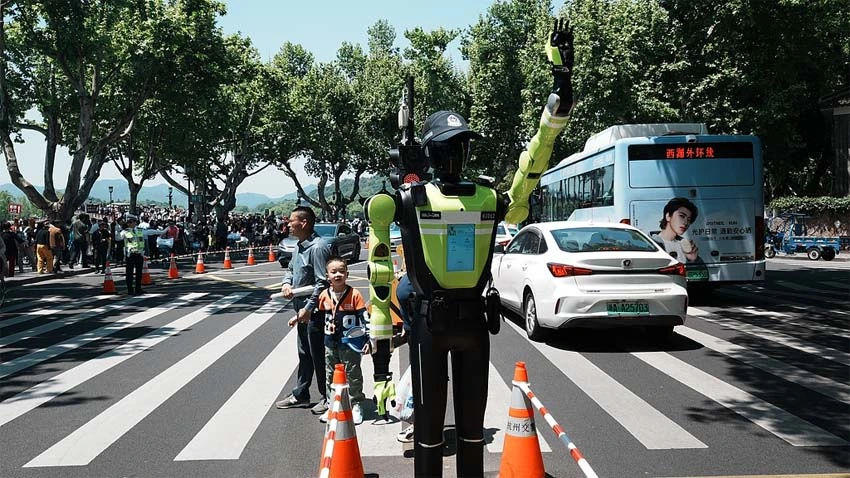
During the evening rush hour at the intersection of Tiyuchang and Yan’an streets in Gongshu District (Hangzhou, Zhejiang Province, China). Chen Sanchuan—deputy chief of the Wulin traffic police squadron—directed traffic on one side of the intersection. While his “new colleague” smoothly coordinated operations on the opposite side.
This robot is part of Hangzhou’s first batch of intelligent traffic management units.
Standing 1.88 meters tall, its design mimics the official uniform of Hangzhou traffic officers.
It wears a black police cap and a fluorescent green-yellow reflective vest, and moves on a four-wheeled mobile chassis. Giving it a distinctly technological appearance.
What exactly can a traffic management robot do?
By pressing the “Talk to me” option on the robot’s touchscreen, pedestrians can initiate a conversation.
“How do I get to West Lake Cultural Plaza?”
“You can take subway line 1 or line 3 from Wulin Square Station. If you tell me your exact destination, I can provide you with a more detailed route.”
According to Chen, the robot operates using a large language model for voice interaction.
It is able to quickly understand user requests and combine real-time traffic conditions with location data to recommend optimal routes.
Information is conveyed through spoken responses as well as text and images on its screen. Making it a useful assistant for both residents and tourists.
As Chen spoke, the robot suddenly issued a clear but friendly reminder:
“Sir, your vehicle has crossed the stop line. Please back up behind the line.” “Thank you for your cooperation.” The driver immediately adjusted his position.
This automated reminder to comply with the rules is one of the robot’s key capabilities.
Thanks to high-performance visual recognition algorithms, it performs intelligent and continuous multi-target surveillance at intersections. Automatically detecting traffic violations, such as non-motorized vehicle drivers stopping beyond the stop line or riding without a helmet.
If the offender does not correct the violation after three warnings, the system archives the relevant data and sends it to an early warning center. Under the traffic management division of the Hangzhou Public Security Bureau.
The robot then moved steadily toward the center of the intersection on its four-wheeled platform.
Thanks to millisecond-level synchronization with traffic lights and an integrated library of traffic control gestures that complies with the Ministry of Public Security’s standards. The robot can accurately execute eight types of traffic-directing movements. Including signals to go straight, stop, and turn left. Each gesture is perfectly synchronized with the traffic lights.
According to Chen, having a robotic partner on duty has significantly facilitated daily traffic management.
“Our new partner can remain on duty continuously for extended periods, taking over much of the routine work,” he said. “This allows police officers to focus more on accident response and emergency response,” he told the People’s Daily.
According to Chen Qihang, an officer in the IT department of the traffic management division of the Hangzhou Public Security Bureau. And a key member of the robot’s development team, research and development began in June of last year.
The team conducted extensive field studies at 28 representative intersections across the city, collecting over 1,200 hours of real-world traffic data. After four rounds of significant technological improvements, the team finalized a design that met the operational requirements.
On May 1st of this year, the first squadron of 15 traffic management robots was officially deployed as a specialized unit. Entering service at key intersections around the West Lake scenic area and in Hangzhou’s major business districts.
Since then, the robots have delivered impressive results. They have accumulated 647.7 hours of operational service. Issued over 25,000 traffic violation warnings, and provided information services to the public on more than 2,000 occasions.
During periods of active service, they have recorded an average of one alert every minute and 43 seconds.
With information from People’s Daily/Prensa Latina

- Stichting Cuba Adelante Foundation Delivers Donation to Schools in Holguin - 3 de October de 2026
- U.S. Coast Guard intercepts oil tanker bound for Cuba - 3 de October de 2026
- Natural medicine: a tradition that can also help in difficult times - 3 de October de 2026