
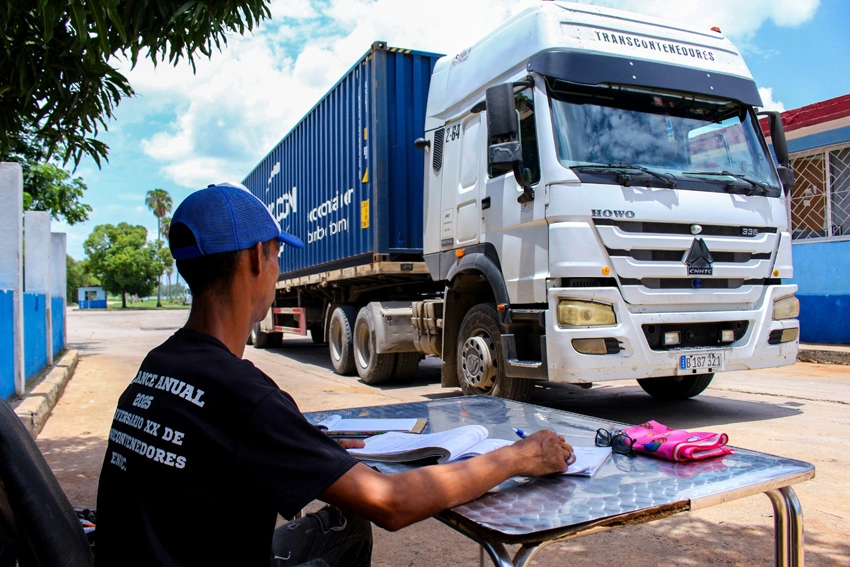
Cuba wakes up each day to the rhythm of engines that bring hope and life to thousands of families. Before the sun rises, Luis Muñoz González is already driving his truck for the National Container Operating Company (ENOC-Transcontenedores).
From the ports, they transport the goods that guarantee the daily sustenance of Cubans. His route carries flour, medicine, and solar panels that will illuminate entire homes.
Muñoz knows the rigors of the road and cherishes experiences of long and difficult journeys. However, some days bring him profound emotions, he told Prensa Latina.
“There were representatives from various organizations, including Education and Public Health, waiting for the donation of solar panels and medical supplies that I was transporting. The reception from the Pioneers at a school was overwhelming. Everyone was very happy.” “That hug when we get off the truck erases the weariness of the route,” he recounted.
In 2025, the company transported 783,000 tons of cargo despite operating with only 64 percent of its allocated fuel. They achieved revenues of over 500 billion pesos, exceeding their plan by 130.5 percent.
They also moved 13,620 tons of flour to guarantee food security in vulnerable provinces. Additionally, they transported 4,160 containers of solar panels as part of the National Energy Matrix Transformation Program.
Also the company’s general manager, Rubicel Rivera Roca, explains the essence of their daily work. ENOC operates in the main national ports, especially Mariel (Western Cuba) and Santiago de Cuba (Eastern Cuba). In the loading and unloading centers throughout the Cuban archipelago.
“We move the basic food basket, including subsidized items like rice, flour, medical supplies, and materials for the education sector, among other activities crucial to the economy. Such as the installation of solar panel modules as part of the government program to transform the energy matrix. Whether they are donations or purchases made by the country, every shipment is vital,” he stated.
This commitment to service has deep roots in the nation’s logistical history. Its origins date back to 1995 with the creation of Servifer, a company linked to the railroads. In 2006, after merging with the trucking company San José, Transcontenedores was born. This led to the country specializing in the transportation and port handling of containers.
For his part, the head of operations, Carlos Alberto Soler, highlighted the impact of this monumental effort across the country. “In 2025 and so far in 2026, we have moved more than 30,000 containers throughout the country.”
In this context, the company managed to ship approximately 15,000 containers of solar panels during the first half of this year. “We ensured their timely arrival to inaugurate a large number of photovoltaic parks. Each panel installed is a victory against the imposed limitations,” he emphasized.
The company operates under the pressure of the US embargo, which exacerbates fuel shortages. To avoid disruption, they have integrated private carriers and optimized every available route. The technical availability coefficient (TAC) exceeded 70 percent. Although fleet obsolescence remains a challenge.
Moreover the quantitative analysis of employment and wage indicators at the end of the period reflects a sustained increase in labor productivity, reaching 14.8 percent. The correlation between the average wage and the return on state investment (ROI) index showed a 93.1 percent compliance rate.
This indicator sets the guidelines for payments under the legally approved systems outlined in the company’s regulations. This ensures a direct link between collective effort, economic efficiency, and fair wages.
Julián Zamora, director of the Trucks 2 Business Unit (UEB)—the company’s largest. It highlights the effective work of its specialists, technicians, mechanics, and drivers. Which reversed the deterioration of its vehicle fleet and raised the maintenance rate to 75 percent.
Of the 33 vehicles registered, 24 are active and providing service to national ports and fulfilling orders for state agencies and the private sector, adds the director. Also who emphasizes the positive impact on the average wage of the workers.
The average wage is 18,500 pesos, thanks to profits from transportation and cooperative businesses with various entities. Including micro, small, and medium-sized enterprises (MSMEs).
Every engine that starts before dawn is a pulse that keeps the economy alive. Transcontenedores doesn’t just move cargo; it transports the nation’s future.
ENOC has a general directorate and 11 regulatory and control groups. Its structure is deployed territorially through Basic Business Units (UEBs).
The organization is headed by a general directorate that, in turn, coordinates the regulatory and control directorates, plus one deputy director. Its approved workforce consists of 752 employees, with 639 positions filled, representing 84.97 percent occupancy.
Notably, 193 women have been incorporated, making up 30.2 percent of the staff, primarily in technical roles. This structure guarantees logistical operations from the central office to the provincial branches.
With information from Lisván Lescaille Durand/Prensa Latina

- U.S. Dermatologists Develop an Oral Pill for Hair Loss in Men - 21 de October de 2026
- Cuban Foreign Minister Denounces U.S. Pressure Regarding Votes Against the Blockade - 21 de October de 2026
- Second Phase of the “Sowing Life” Project Launched in Holguin in Cooperation with Mexico - 21 de October de 2026