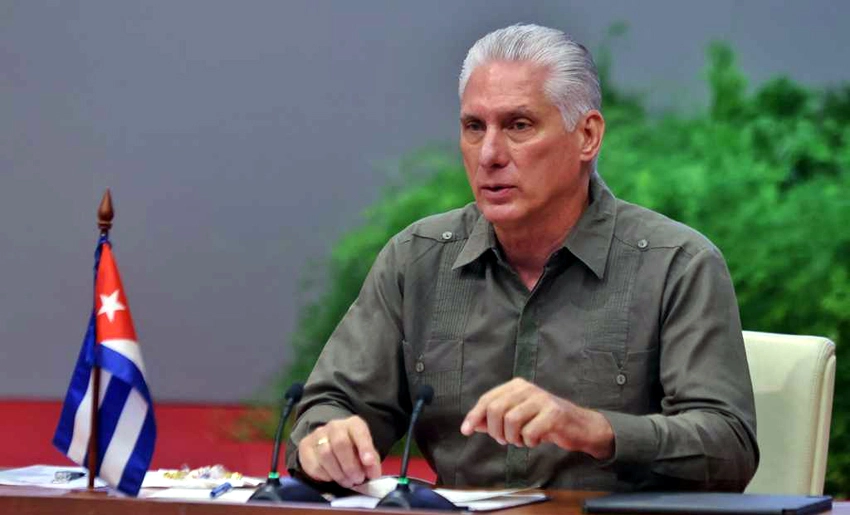
Cuban President Miguel Díaz-Canel denounced the intensification of the US blockade. As collective punishment against the Cuban people. Emphasized the continued importance of international solidarity in confronting it.
In an interview with Brazilian journalist Breno Altman, broadcast on a special edition of the program 20 Minutos de Opera Mundi. The president described US policy as “a criminal, truly genocidal policy.” Whose consequences impact both the national economy and the daily lives of families.
He noted that the current situation is the result of a process that has accumulated over more than 60 years. Aggravated since 2019, during Donald Trump’s first administration. Also when 240 additional measures were approved that prioritized, internationalized, and intensified the embargo.
He added that this is compounded by the executive order of January 29th, which imposes an energy blockade.
“No economy can survive without fuel,” Díaz-Canel stated. Explaining that the country needs approximately seven million tons of crude oil annually. It only produces between three and four million. Forcing it to rely on imports that are currently severely restricted.
The fuel shortage has reduced electricity generation and caused prolonged blackouts. Impacting the entire economy and affecting sectors such as transportation, water supply, waste collection. And the distribution of food and medicine, he explained.
In the social sphere, he indicated that more than 96,000 people are awaiting surgery. Including more than 11,000 children, due to resource limitations. While education has had to adapt to less in-person learning modalities. And the blackouts are forcing families to reorganize their routines.
Despite this situation, he highlighted the resilience of the Cuban people. Amidst these conditions, have maintained unity and hope. Without yielding or allowing themselves to be humiliated.
In his dialogue with the Brazilian journalist, the president also referred to international solidarity. Also both that received from governments and that coming from social movements and people. Considered it key to confronting the crisis.
He highlighted the support of countries like China and Russia. As well as Mexico and Colombia, which have sent food and supplies.
In particular, he mentioned the recent arrival of a Russian ship with 730,000 barrels of oil. Which he described as a highly symbolic gesture that allowed the island to access a third of the fuel it needs for a month.
He also highlighted initiatives such as the Our America convoy, organized by Progressive International. Moreover which delivered donations of photovoltaic modules, food, and medicine.
Regarding Brazil, he emphasized the historical ties between the two countries,. So he noted the support received from the people and government of the South American giant. He affirmed that President Luiz Inácio Lula da Silva has been one of the most active in denouncing the blockade.
Furthermore he warned that aid faces obstacles due to the extraterritorial nature of the US embargo. Which affects third countries, but reiterated the Brazilian government’s willingness to cooperate with the island.
With information from Prensa Latina

- Russia registers Cuban medicine for tumor treatment - 20 de October de 2026
- Visual Arts Exhibition Honors Fidel in Holguin - 20 de October de 2026
- Holguin Electric Utility Takes On Transformer Repairs - 20 de October de 2026