
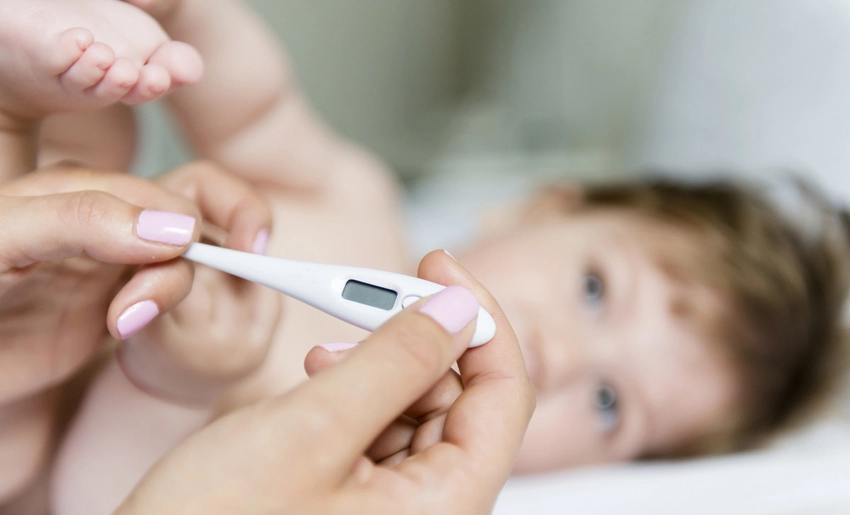
Families with young children should monitor for the onset of fever, a situation that requires careful assessment and medical follow-up. Particular attention should be paid if the fever occurs without other symptoms, especially in children under two years of age.
According to Dr. Alberto Rubén Piriz Assa, head of the Maternal and Child Health Program (PAMI) at the General Directorate of Health. “It is considered especially important to monitor cases where a fever is not accompanied by manifestations. Such as nasal congestion, ear pain, skin rashes, vomiting, or diarrhea.” He also drew attention to patients whose initial physical examination shows no abnormalities.
Piriz Assa notes that “this topic is currently a subject of significant discussion among various medical associations. It is well-established in the medical literature that the only factor that has reduced infant mortality. Specifically deaths resulting from fever without other symptoms. It is timely hospital admission and observation by healthcare professionals for at least 72 hours.”
He further emphasized the importance of timely clinical observation to detect potential serious bacterial infections early and to take action should the child’s condition change. The significance of this issue, he stressed, is threefold for infants under three months old and twofold for those under six months old.
Given the risk of serious infections, the intensive care specialist explained that close monitoring is required. A necessity that increases as the patient’s age decreases. In these age groups, serious infections can occur more frequently. Because the immune system is still developing and has not yet produced sufficient immunoglobulins (such as IgM and IgG) to defend against microorganisms. The doctor added that very young infants may not yet have received vaccines that help prevent potentially serious illnesses. For this reason, he noted, infants under one month old are especially vulnerable, though all infants require careful monitoring.
Piriz Assa emphasized that there is no single clinical parameter or laboratory result—either on its own or in combination with others. Also that can definitively determine which child will go on to develop a serious bacterial infection.
Consequently, he considers it essential for infants to remain under the observation of healthcare professionals for 72 hours. Furthermore, follow-up should not end upon discharge from the hospital. In particular, children under one year of age require subsequent check-ups. Both: families and healthcare staff must remain vigilant for the emergence of new symptoms or changes in the child’s condition. As there is a risk of infection even after hospital discharge.
The official in charge of PAMI (the Maternal and Child Health Program) explains that this issue is of vital importance. Given the mortality rate among children under one year of age in the province. Both for the sake of child health and the need to prevent complications.
Also the onset of fever in children, no matter how common it has become recently. Due to the high incidence of arboviral infections, respiratory illnesses, or other diseases—should never be overlooked. It is the body’s response to infectious agents or non-infectious causes, both of which require timely medical attention.

- Health authorities issue alert regarding the monitoring of fever in children under two years of age - 15 de October de 2026
- Lenin Hospital Announces Scientific Symposium in Honor of Its 61st Anniversary - 15 de October de 2026
- Residents Take Pediatric Rehabilitation Final Exam - 9 de October de 2026