
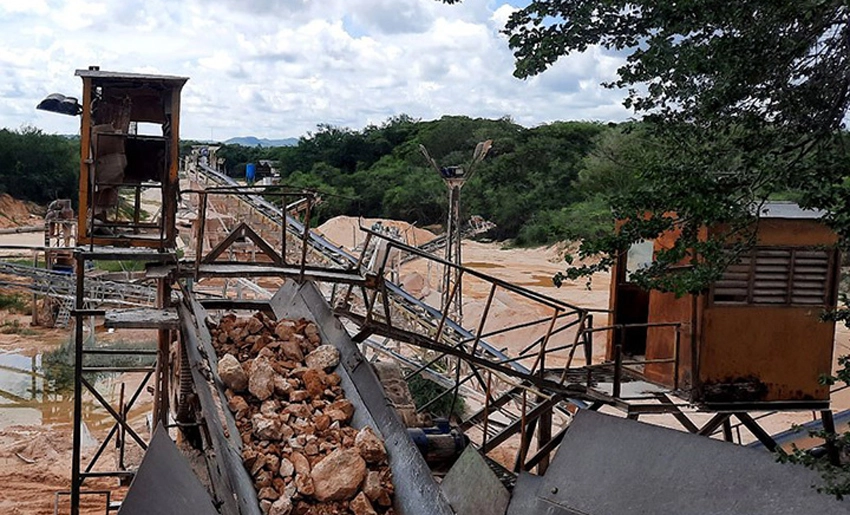
In an economic landscape marked by severe limitations, the Construction Materials Enterprise (Medano) in Holguin is rolling out a series of productive and managerial transformations to sustain its operations.
The entity, established over two decades ago and recognized four times as a “National Vanguard” (a top-tier designation for state enterprises in Cuba). It faces the challenge of maintaining production with scarce resources and restricted access to key inputs such as cement and fuel.
Yunior Leyva Pupo, General Director of Medano, explained that the entity had already been working. On strengthening the “socialist state enterprise” model since the 8th Congress of the Communist Party of Cuba (PCC). However, the onset of the COVID-19 pandemic, followed by the implementation of 43 specific measures aimed at strengthening state enterprises highlighted the need to go even further. “The 43 measures didn’t provide the ‘how-to,'” Leyva Pupo noted.
Now, those guidelines have taken on a new dimension through 176 economic and social transformations approved nationwide. A package designed to expand the autonomy of state enterprises and enable decentralized access to inputs, foreign currency, and fuel via market-based mechanisms.
To bring these changes to fruition, Medano convened its technical advisory council and outlined five core lines of action. The first focuses on resolving operational challenges through science, innovation, and technological management.
The enterprise has forged links with higher education institutions. Such as the University of Holguin, to develop projects aimed at import substitution and the utilization of local, endogenous resources.
Notable solutions already implemented include the use of locally sourced washed sand and the repurposing of waste generated during tile polishing to manufacture adhesive mortar. This line of work also encompasses professional development, with staff pursuing master’s and doctoral degrees to apply knowledge management to production-related challenges.
Moreover the second line of action involves establishing productive linkages with both state and non-state economic actors. Medano has expanded its reach beyond its immediate territory. Integrating with industries in regions such as Las Tunas and Camagüey by identifying opportunities to produce goods domestically that were previously imported. “This addresses another portion of what was once sourced from abroad. But could instead be produced within Cuba,” the executive explained.
This pursuit of local synergies is complemented by a third focus: the circular economy. Which has enabled the company to diversify its product portfolio. Medano now manufactures clay bricks, processes limestone sourced from municipalities like Mayari and Sagua de Tanamo, and produces a cement-free mortar (CeroCem). Additionally, the company creates cold-mix asphalt and furniture crafted from wood scraps that were previously discarded.
Efforts are also directed toward energy sovereignty through a gradual transition of the company’s energy mix. This involves installing photovoltaic technology and backup systems to reduce reliance on the National Electric System (SEN).
This energy capacity is distributed across the company’s headquarters and several of its basic business units (UEBs). Ensuring that operations can continue even during power outages. In the industrial sector—where high energy consumption and dust from aggregate crushers make photovoltaic systems impractical. Also the company is exploring other renewable sources, such as wind power. The goal is to reach approximately 40 kW of installed capacity by the end of the year. Which would allow the company to feed energy back into the SEN on weekends and strengthen the local power grid.
Social impact serves as the fourth line of work. Medano promotes a program for the advancement of women, which has led to improvements in electric mobility. Making it easier for them to commute to their workplaces. Furthermore, it promotes food sovereignty through the cultivation of vegetables at several of its business units (UEBs). As well as through rabbit, sheep, and poultry farming in various municipalities. “Our ultimate goal is to be able to provide for our daily midday meal,” stated Leyva Pupo. Adding that these efforts also help support vulnerable individuals.
Despite these advances, the executive identified three persistent barriers to the implementation of these changes. The first concerns the management of foreign currency accounts, a step that has already been achieved. The second relates to pricing; although prices are now aligned with market benchmarks, they still present challenges. The third, and perhaps most complex, is access to the foreign exchange market.
“Currently, the transformation regarding the foreign exchange market still faces certain barriers, which we have identified,” declared Leyva Pupo. The company requires foreign currency to import fuel, cement, and spare parts. Essential inputs for sustaining production in a context where the global energy crisis and United States sanctions against Cuba exacerbate the scarcity.
The case of this company from Holguin offers a lesson that extends beyond its own walls. It is part of the resilience built through the daily efforts of teams like the one at Medano. A group that, even under the most adverse conditions, demonstrates that intelligence applied to production and a commitment to social well-being can forge a path forward where others see only obstacles.

- Medano Implements Productive Transformations in Holguin - 29 de October de 2026
- Vertice Company Eliminates Ozone-Depleting Substances - 24 de August de 2026
- Holguin Honors Fidel Castro in Biran on the Centenary of His Birth - 14 de August de 2026