
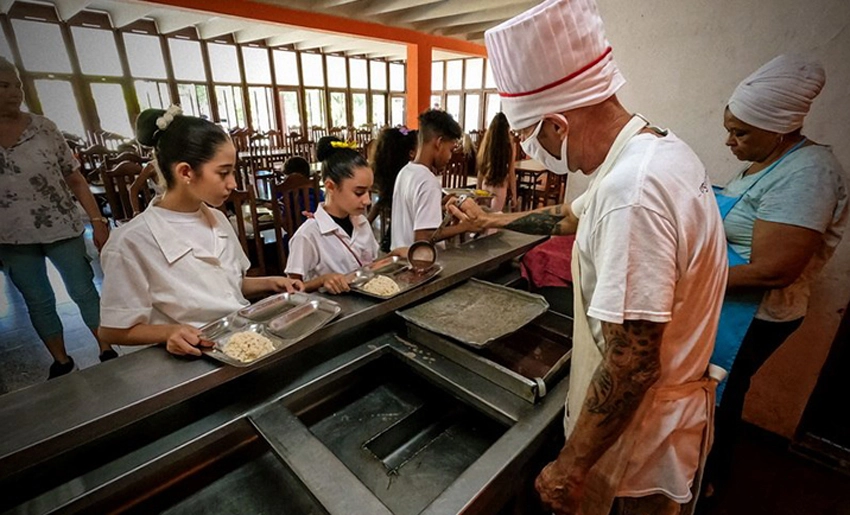
The Raúl Gómez García Elementary Art School in Holguin is strengthening the support provided to its boarding students. By improving the educational process, accommodation, and food services. With the goal of ensuring they can remain in the program despite the country’s complex economic situation.
Hirio Vera Martínez, the institution’s director, told the CNA that with an enrollment of approximately 300 children and young people. Also who receive artistic training in fields such as singing, music, dance, and balle. A key priority is improving the study and living conditions for those in the boarding program.
To ensure the continuity of the academic year, efforts are underway. Within the limits of available resources to repair the facilities. This includes sealing and polishing the wooden floors in the studios used for dance practice, he noted.
Moreover to foster a comfortable environment, the school maintains rigorous cleaning and sanitation across all areas. Especially in the dormitories, the infirmary, the kitchen, and the dining hall. While also working to ensure a stable supply of water and food.
Despite various limitations, the director noted, the school provides dining services that meet the students’ nutritional needs, as well as lunches for staff. To achieve this, the school utilizes its own agricultural produce and works to procure necessary supplies, though high costs remain a significant challenge.
Given transportation difficulties and the financial burden on families, the school—through partnerships with various organizations. It facilitates the transport of students to their homes in other municipalities across the northeastern region during school breaks, he explained.
Vera Martínez highlighted that the institution has a full complement of teaching staff for both general and artistic education. Additionally, there is support staff dedicated to ensuring the smooth execution of educational and extracurricular activities. As well as the scholarship program all committed to the well-being of the students.
Furthermore, she noted that the institution was one of the few of its kind to keep students in residence throughout the entire previous academic year, despite various challenges. This was made possible by creating conditions that allowed students to remain on-site and by maintaining regular contact with their families. Which ensured that the quality of instruction remained unaffected.
Among the primary difficulties, she mentioned a shortage of specialized equipment for the dance program—particularly dance shoes. Also as well as a limited supply of musical instruments and maintenance resources over the last few years, all of which impact student progress and performance.
With the goal of enhancing technical training through the lens of cultural decolonization. The institution employs methods such as integrating different disciplines into complementary activities and classes. This approach fosters practical learning and encourages students to take an active, leading role in their own education.
With information from CNA

- Lula Gains Ground While Bolsonaro Stagnates, According to Poll Ahead of Runoff - 23 de October de 2026
- Art School in Holguin Strengthens Support for Boarding Students - 23 de October de 2026
- Mendive, the Teacher of José Martí - 23 de October de 2026