
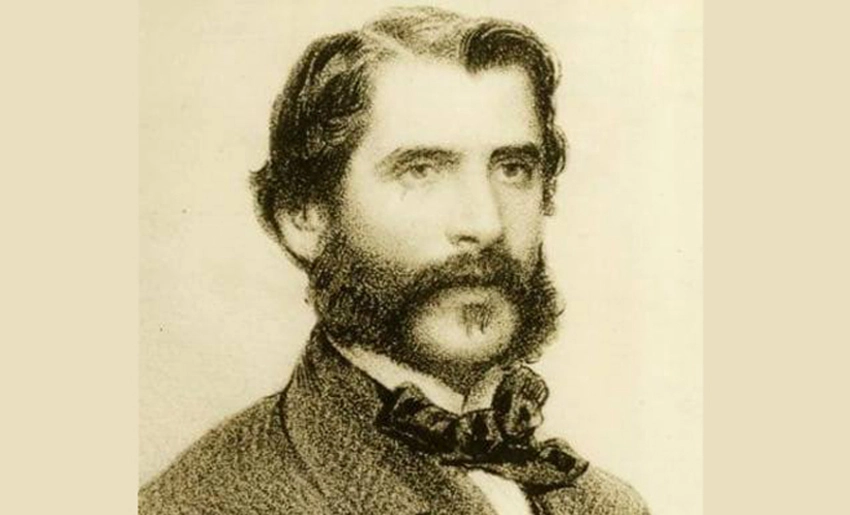
Cuba has had the honor of being home to a vast array of patriots. Among whom stands out a man of wisdom and a sensitive soul: Rafael María de Mendive y Daumy. A noble son of this land, a poet, writer, and fervent fighter for justice. He was born in Havana on October 24th, 1821, 205 years ago.
His prolific life was graced by many virtues, but he gained his greatest renown and glory as a prominent educator. Becoming the mentor to the man who would go on to be Cuba’s National Hero: José Martí, the Apostle of our nation’s independence.
On the anniversary of his birth, we remember this Cuban, deeply committed to the cause of emancipation. He earned the title “teacher of teachers,” having served as the primary mentor to a young José Martí. Like a father, he helped shape Martí’s core values. While also fostering in him and in his soul-friend, Fermín Valdés Domínguez, a love for freedom and a profound concern for the humble and for justice.
As a child, Mendive lost both his parents and came under the care of his older brother. Also who ensured he received an excellent education and a solid grounding in the humanities. In 1834, he entered the San Carlos Seminary, where he pursued studies in Law, Philosophy, and Latin. At just 17 years of age, he entered the Royal and Pontifical University of Havana, graduating with a degree in Law in 1844.
He spent eight years traveling abroad. A formative period for his cultural development. During which he connected with prominent figures in the political and literary spheres. Such as Father Félix Varela, an eminent educator, as well as José Antonio Saco and Domingo del Monte. Both of whom were in exile due to their anti-colonial ideals and convictions.
Mendive returned to Cuba in 1852. By 1856, having reached intellectual maturity, he joined the Economic Society of Friends of the Country. He began publishing his work in various outlets, including *Havana Magazine*, *Album of the Good and the Beautiful*, and *Havana Diary*.
This was a period of great literary creativity, particularly in his lyrical poetry. As his love for verse was among his deepest passions. His earliest known poems date back to 1847. His literary career gained further momentum when his verses were included in the anthology “Spanish and American Poets of the 19th Century”, among other prestigious publications.
Mendive also left a profound mark on Cuban history through his work as a teacher. By 1864, he had become the director of the Municipal Higher School for Boys. It was there that he met José Martí, who would go on to hold the educator in high regard. So much so that Mendive even concerned himself with the young man’s material well-being and the continuation of his education. Fully aware of the limited financial means of Martí’s parents.
For the “Apostle” of Cuban independence, Mendive served as a true role model. Martí was deeply moved by the passion with which Mendive spoke of the homeland, liberty, personal dignity, and justice. Consequently, Mendive’s home—more than just a school—became a space for growth in every aspect of life. A significant milestone in his career was the founding of the San Pablo school. Which he established in his own home at 88 Prado Street. The house became a hub for literary and patriotic gatherings. A space where his students absorbed the knowledge and values imparted by this eminent educator.
Following the events that took place on January 22nd, 1869, at the Teatro Villanueva. Which occurred after a performance of the play *Egg-stealing dog*—Mendive was arrested. He spent five months imprisoned at the Prince’s Castle. Specifically because his home had served as a center for patriotic meetings.
As a result, the school was shut down, and this staunchly patriotic teacher was exiled to Spain for four years. From there, he moved to New York, where he resided until his return to his homeland in 1878. The year the first Cuban war for independence concluded without achieving its objectives.
Nothing, however, could halt his intellectual pursuits. He directed several publications and contributed to various media outlets. He co-authored *Cuatro laúdes* alongside Ramón Zambrana, José Gonzalo Roldán, and Felipe López de Briñas. Furthermore, in collaboration with José de Jesús García, he published the anthology *Poetic America* and wrote the prologue for the second edition of Fornaris’s Poesy.
His deep commitment to education led him to direct the San Luis Gonzaga school in Cardenas. It was there that he fell ill in 1886; he was subsequently taken to Havana. Where he passed away on November 24th of that same year. Yet, his ideas endured, serving as a guiding light for the struggles of his former students and followers.
The most devoted of his students, José Martí, would say of him in an 1891 letter to Enrique Trujillo: “And how could you expect me to express, in just a few lines, all the good and novel things I might say about that man, so in love of beauty, seeking it in literature just as he did in the affairs of life. Who never wrote about anything other than the truths of his own heart or the sorrows of his homeland?”
Martí viewed him as a man in love with beauty—a beauty he sought not only in writing. But in every aspect of life, as a means to alleviate the world’s hardships. In a posthumous tribute published in the New York-based *The Future*, Martí recalled him—often at night—composing verses or speaking of those who had perished on the scaffold.
Whenever one studies or delves into the extensive body of work left by Martí. A treasure Cuba cherishes as an invaluable legacy. One is simultaneously honoring the life and work of the “teacher of teachers,” Rafael María de Mendive—a title aptly bestowed upon him.
On the 205th anniversary of his birth, the nation takes pride in its legion of educators. Teachers and professors who, inspired by visionaries like Mendive, have not only taught in the classroom. But have also equipped men and women with the knowledge and expertise to drive the nation’s scientific and technical advancement.
Each year, Cuba pays homage to this patriot-educator by presenting the “Rafael María de Mendive” distinction to teachers who have demonstrated meritorious service. Dedicating 20 years or more, with genuine love, to the holistic development of new generations.
With information from Aída Quintero Dip/CNA

- Mendive, the Teacher of José Martí - 23 de October de 2026
- UHo Participates in the 16th RED-DEES Meeting in Uruguay - 23 de October de 2026
- Jorge Gómez: 47 Years Behind the Wheel at Radio Angulo - 22 de October de 2026