
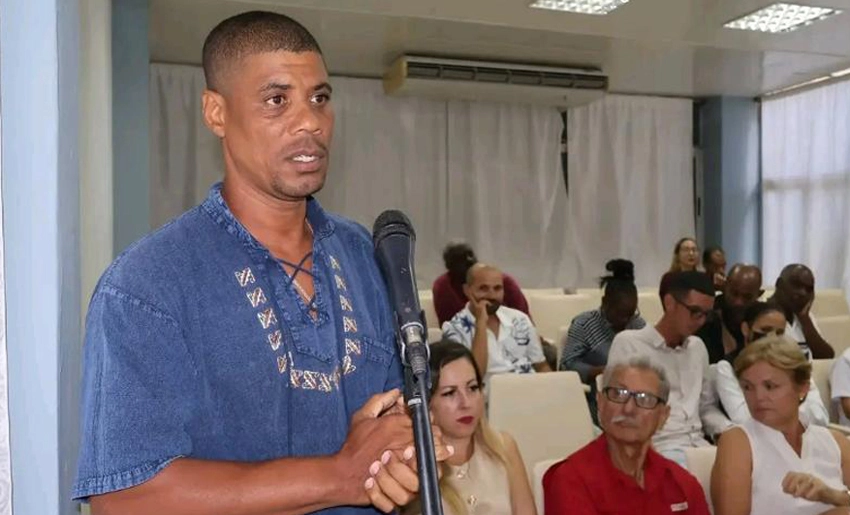
With the active participation of national authorities, administrators, legislators, and representatives from student and political organizations. A forum for dialogue and collective development took place this Thursday at the University of Holguin (UHo). The discussion centered on the Draft Education Law, a regulatory framework designed to transform the academic landscape and institutional coordination.
The academic and social gathering brought together key figures from the education and government sectors. Including Reynaldo Velázquez Zaldívar, Deputy Minister of Higher Education (MES), and Margarita Mc Pherson Sayú, a methodologist from the Ministry of Education.
They were joined by members of the National Assembly, administrators from various educational levels, and representatives from institutions. Such as the University of the Arts, the National Institute of Sports, Physical Education and Recreation (INDER), the Communist Party of Cuba’s school system, the Ministry of Culture, and the Ministry of the Revolutionary Armed Forces (MINFAR).
Also in attendance were leaders of local youth and political organizations, including the University Student Federation (FEU) at UHo, the Young Communist League (UJC) at UHo. The Federation of Secondary Education Students (FEEM), and the Communist Party of Cuba (PCC).
During the working sessions at the Holguin-based university, Mc Pherson explained that the proposed legislation is organized into 10 titles and 243 articles. Designed to streamline existing regulations and precisely adapt them to the demands of the current context.
Among the draft law’s most significant new features is the official certification of general education institutions. A process that will fall under the supervision of the National Accreditation Board (JAN) to validate and raise quality standards across the sector. The analyses shared by the speakers and participants highlighted that this modernization will introduce high-impact structural changes. Such as the consolidation of a more integrated educational system, the formal recognition of learning acquired through various pathways. Also the implementation of supplementary financing schemes, and greater protection of rights within institutions.
The proposed legislation emphasizes an inclusive model, supported by concrete assistance and verifiable quality standards. The rigorous exchange of views that took place at the university fostered an enriching debate. Which will directly contribute to refining the terms, categories, and concepts within the future legislation. In this way, the academic community and local social stakeholders affirm their active role in an open, participatory legislative process aimed at strengthening the future of education.
By: Daimy Peña Guillén

- UHo Debate About New Features of the Draft Education Law - 16 de October de 2026
- When the Countryside Stops Providing Food - 16 de October de 2026
- Evaluated in Holguin for Boosting Foreign Investment - 15 de October de 2026