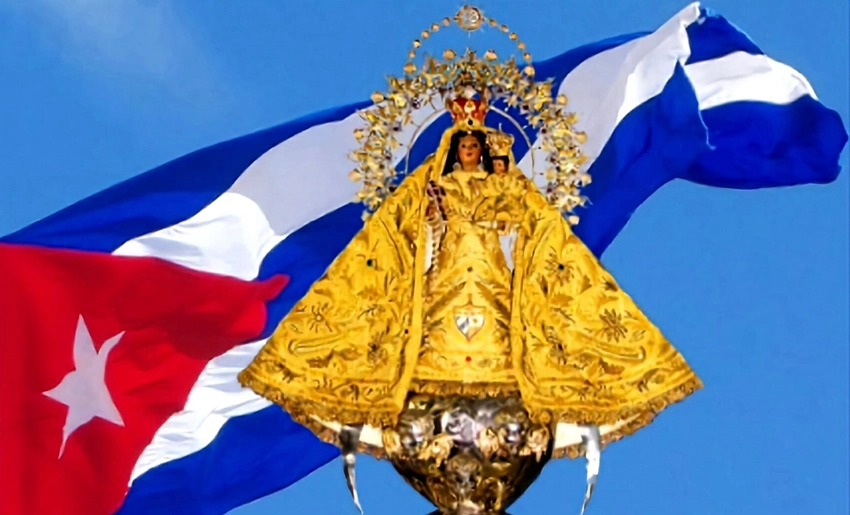
The salt air clings to our lips, and the north wind beats mercilessly across the waters of Nipe Bay. Anyone standing today on the shores of this Holguin coastline, gazing out at the vast expanse of water, can hardly remain detached from the power of the myth. It was here, on these same calm or raging waves, that more than four centuries ago, three simple men stumbled upon the miracle that would define the soul of an entire nation. For the rest of the world, Our Lady of Charity of Copper is the Patron Saint of Cuba. For the Church, a symbol of faith venerated in her sanctuary in El Cobre, Santiago de Cuba.
But for us, the people of Holguin, the story has a different flavor, more intimate, almost everyday. Charity wasn’t born in a temple, nor did it arrive in the luggage of a Spanish conquistador. It emerged from our waters, breathed our air for the first time, and took its first steps in this bountiful land.
Imagine the scene at the beginning of the 17th century, around 1612 or 1613. The scorching sun beat down on three salt gatherers rowing a small boat across the bay. The brothers Juan and Rodrigo de Hoyos, indigenous people of pure blood, and young Juan Moreno, a ten-year-old enslaved Black boy. Popular history forever christened them “the three Juans,” a humble trinity that unknowingly embodied the racial mixing that was just beginning to take shape on the island.
Searching for salt to preserve the meat of their cattle ranch in Barajagua, they spotted a white shape floating in the water in the distance. As they approached, surprise replaced weariness: on a carved board rested a small image of the Virgin Mary holding the Child Jesus in her left arm and a golden cross in her right hand. Clear letters on the wood defied the current: “I am the Virgin of Charity.” The cloth she was wearing was unusually dry.
Years later, in his old age, Juan Moreno himself would recount this moment in detail under ecclesiastical oath before the Archives of the Indies. That written testimony would fix for eternity the certainty of what the people of Holguin have always known: the spiritual heart of Cuba began to beat in Nipe.
To walk through the Mayari area today is to retrace the steps of that first journey. After retrieving the image from the water, the salt miners took it to Cayo La Virgen and, later, to Barajagua. Also where the locals improvised a humble altar for it in a thatched hut. Barajagua thus became the first home, the first makeshift temple where Creoles, Indigenous people, and Africans knelt together for the first time.
Both sites, now protected as National Monuments, are essential stops for those traveling the “Path of the Virgin.” Although the image’s final destination was the mining town of El Cobre, the umbilical cord was never severed. When the faithful embark on the pilgrimage to the National Shrine, for the people of Holguin, the journey doesn’t begin in Santiago. It begins at the exact spot where the wooden plank touched the shore of the bay.
If anything fills us with visceral pride, it is the essentially Cuban character of this devotion. The Virgin was not imposed by the metropolis; she sprang from the daily life of rural work. That is why, when Cubans took to the fields of the Cuban wilderness to fight for independence in the 19th century, the Virgin went with them.
She became the “Mambisa Virgin.” The liberators wore her image pinned to their chests like a protective shield. The General Antonio Maceo zealously kept a scapular bearing her likeness. It was no coincidence that, at the end of the wars of independence in 1916, Pope Benedict XV himself declared her Patron Saint of the Republic of Cuba. Responding to a moving letter signed by veterans of the Mambi Wars.
To this patriotic force is added the vibrant tapestry of Afro-Cuban syncretism. In the homes of Holguin and throughout Cuba, the yellow tablecloth, sunflowers, and candles not only honor Mary. But also greet Ochún, the orisha of fresh waters, beauty, and sensuality in the Yoruba tradition. In this perfect duality resides the essence of who we are.
In Holguin, faith is not a thing of the past, nor does it dwell solely in history books. It’s felt in the morning broadcast of the local radio station when it announces a novena. In the home altars where a worn religious image is always present. Also in the conversations of the grandparents who insist that the waters of Nipe still hold a special blessing.
Standing before Nipe Bay, feeling the sea breeze on your face, is to understand that Holguin’s identity is not explained solely through its parks or its hills. It is explained in that distant afternoon of 1612. When three simple sailors lifted a small wooden plank from the water. And, without knowing it, rescued the symbol that would keep together an entire nation.
By: Daimy Peña Guillén

- Warning Issued Regarding Possible Presence of Giant African Snail in Holguin - 24 de October de 2026
- Lula Gains Ground While Bolsonaro Stagnates, According to Poll Ahead of Runoff - 23 de October de 2026
- Art School in Holguin Strengthens Support for Boarding Students - 23 de October de 2026