
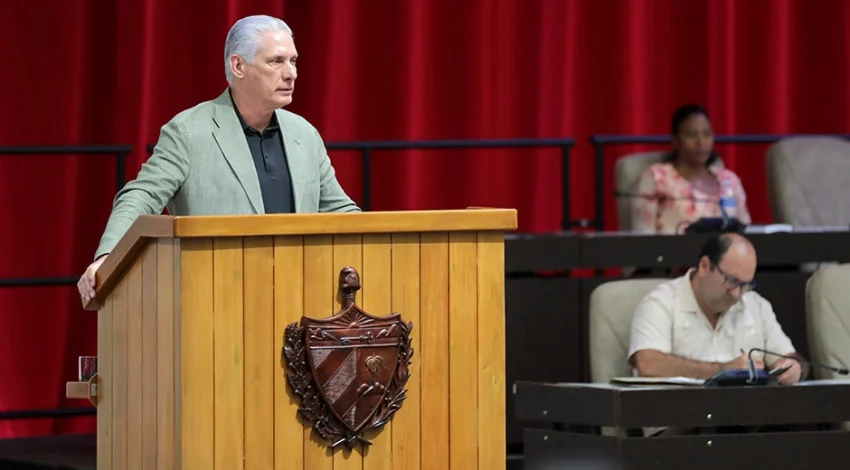
The measures announced to confront the complex economic scenario caused by the intensification of the United States blockade include the reduction of ministries and budgeted agencies in Cuba.
The National Assembly of People’s Power (Parliament) unanimously approved. In an extraordinary session of its tenth legislature, a broad program of economic reforms.
Moreover the group of 176 proposals, which introduce unprecedented changes to the socialist model of the Caribbean nation. It was presented to the plenary by Prime Minister Manuel Marrero.
The meeting included the participation, via videoconference, of Army General Raúl Castro Ruz, leader of the Revolution. And the presence of the First Secretary of the Central Committee of the Communist Party and President of the Republic, Miguel Díaz-Canel Bermúdez.
One of the central measures of the package, approved by a show of hands by more than 400 deputies. It is the aforementioned restructuring of the Central State Administration. Which includes a significant reduction in the number of ministries and budgeted agencies.
Marrero noted that a legislative proposal is circulating that contemplates the reorganization of state and government structures. To adapt them to the new economic conditions and make public administration more efficient.
This process, he said, would impact provincial and municipal administrations. Where adjustments to structures and staffing levels are planned. Also based on greater organizational efficiency and the rational use of public resources.
Furthermore the new measures come amid a severe economic crisis. Following the intensification of the criminal US blockade. Which for nearly seven decades has been the main obstacle to Cuba’s economic and social development.
The genocidal and arbitrary US embargo is causing billions of dollars in damage to the Cuban economy. With an incalculable human impact of lost lives, widespread shortages, and widespread health problems.
Released by Parliament in early June, the draft law on the Organization of the Central State Administration establishes the 20 ministries that will govern the country.
The proposal reduces the number of agencies to 21—20 ministries and the Central Bank of Cuba—from the current 27.
Among the changes to the ministerial structure is the proposed Ministry of Environment, Habitat, and Housing. Which would consolidate responsibilities currently dispersed among several entities.
Agriculture and the Food Industry are integrated into the Ministry of Agri-Food, and a new Ministry of Economy, Finance, and Planning is established. Higher Education is merged with Science and Technology. And the Ministries of Environment, Habitat and Housing. Industries and Construction; Sports and Recreation; and Information and Social Communication are also created.
With information from Prensa Latina

- Putin states that BRICS has generated over 40 percent of global GDP - 12 de September de 2026
- Between the wind of the tenths and bottled art - 12 de September de 2026
- ETECSA Holguin Hosts Science and Technology Forum - 12 de September de 2026