
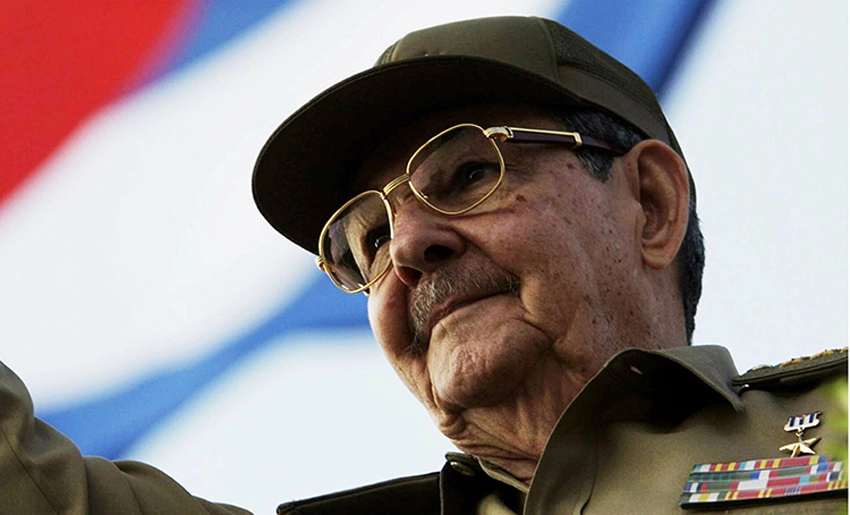
There are men whose names encapsulate the entire history of a nation, men whose path is defined by the boots of sovereignty. From all over Cuba, the murmur of the streets can be heard, not of astonishment, but of revolutionary indignation. The United States government, trapped in its rhetoric of siege and its eagerness to subdue the indomitable spirit of the Revolution, has dusted off an obsolete script. A spurious legal accusation against the leader of the Cuban Revolution, Army General Raúl Castro Ruz.
The news—the umpteenth infamy concocted in the courtrooms of South Florida. Reached the island not as a surprise, but as confirmation of imperial impotence.
From Washington, using a federal court in Miami as its instrument of execution. An accusation has been launched that evokes collective memory of the events of February 1996. When two aircraft belonging to the anti-Cuban organization “Brothers to the Rescue”. Flagrantly, repeatedly, and provocatively violated the sovereign airspace of the Republic of Cuba.
Those who today attempt to issue extraterritorial rulings from the comfort of the White House forget, or deliberately omit. The years of diplomatic warnings issued by Havana. They omit that any sovereign state has the inalienable right to defend its borders against air piracy financed by the Miami mafia.
The Cuban people, forged in resistance, identify this judicial maneuver not as an act of justice, but as a blatant political aggression. It occurs within a context of intensified economic strangulation. Also where the blockade and financial sanctions attempt to force a collapse of the country’s basic services. Unable to achieve social collapse through material deprivation, they resort to a moral assault against the symbols of the nation.
Washington’s most recent legal attack is not an isolated incident. Rather an attempt to prosecute the very history of the Revolution. The charges brought by the U.S. Department of Justice against Army General Raúl Castro Ruz and five Cuban military pilots focus directly on the events of February 24th, 1996.
The U.S. legal machine formally accuses the Leader of the Revolution of “conspiracy to murder U.S. citizens, first-degree murder, and destruction of aircraft.”
From an imperial perspective, he is identified as the highest authority. In his capacity as Minister of the Armed Forces (MINFAR), authorized the use of lethal force.
Cuba, invoking international law, has always maintained that the aircraft were operating provocatively. And that the downing occurred in Cuban territorial waters after multiple diplomatic warnings ignored by Washington. By reviving this case three decades later, the White House is not seeking justice. So rather a political lynching of a man whose biography is intertwined with that of the Republic itself.
For the Cuban people, Raúl Castro Ruz’s trajectory is the antithesis of the infamy being cooked up in the Florida courts. Born in Birán, his political baptism of fire came early. At 22, he was already taking up arms alongside his brother Fidel in the 1953 attack on the Moncada Barracks.
After being imprisoned on the Isle of Pines and subsequently exiled to Mexico. Where he recruited a young Argentine doctor named Ernesto “Che” Guevara. Raúl was one of the survivors of the perilous Granma yacht landing in 1956.
His military leadership was consolidated in the Sierra Maestra mountains. Promoted to Commander, he founded and led the Second Eastern Front “Frank País.” A liberated territory where he demonstrated not only his skills as a guerrilla strategist but also as a state organizer. Creating schools, hospitals, and civilian supply networks in the midst of war.
From January 1959, he assumed leadership of the Ministry of the Revolutionary Armed Forces (MINFAR). A position he held for almost half a century. Under his direct command, the Revolutionary Armed Forces (FAR) transformed from a guerrilla army into a modern and disciplined military force. Capable of safeguarding national sovereignty against constant CIA aggression and carrying out crucial internationalist missions on the Cold War map. Such as in the jungles of Angola and the plains of Ethiopia. During the harsh years of the Special Period in the 1990s. Raúl promoted business development within the armed forces. Guaranteeing the country’s economic survival without compromising its defensive capabilities.
When illness forced Fidel Castro to step down from the front lines in 2006. Raúl assumed the presidency of the Council of State and the Council of Ministers with a style marked by pragmatism, discipline, and institutionalism.
He was the architect of the “Updating” of the Cuban socioeconomic model. Expanding self-employment, eliminating bureaucratic immigration obstacles, and [other related issues].
While Washington tests new lists of sanctions and scripts for criminal prosecution against Latin American leftist leaders. In Cuba the figure of Raúl Castro Ruz remains intact, steadfast, a beacon of unyielding dignity.
The empire accuses from hatred and the frustration of not having been able to conquer the island. Cuba responds with the morale of a people who learned long ago that justice is not legislated in Washington. That the sovereignty of free peoples does not kneel before any foreign grand jury.
By: Daimy Peña Guillén

- Cuba Presents Coffee and Honey Investment Opportunities at FAO - 13 de October de 2026
- Attacks on vessels raise tension in Hormuz - 13 de October de 2026
- Ibero-American Festival Returns to Holguin - 13 de October de 2026