
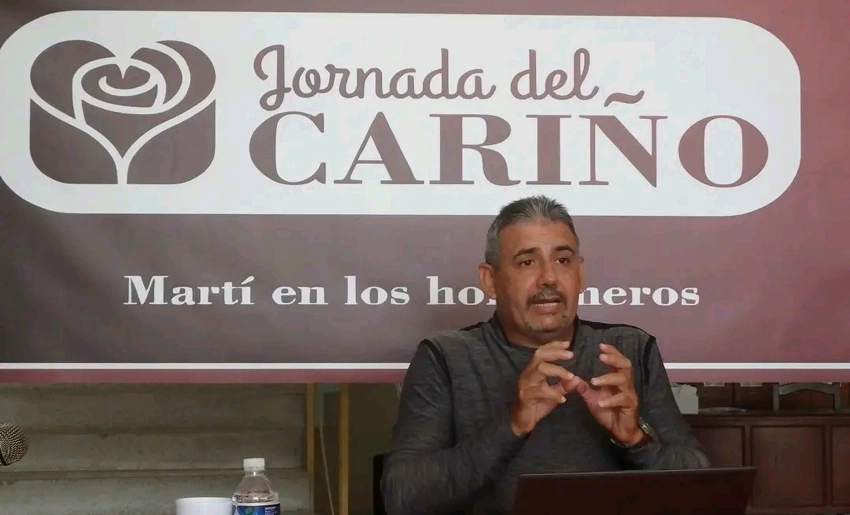
Neither Reformist nor Annexationist: “José Martí was a lucid and radical anti-imperialist.” Under this premise, Dr. Alexander Abreu Pupo captivated the audience at the Álex Urquiola Library in Holguin during a keynote address. That returned the Apostle to his most uncomfortable place for the enemy: the trench of ideas.
History is not written with concessions. Abreu Pupo began his presentation by evoking Máximo Gómez’s grief at the Teacher’s death at Dos Ríos. The Generalissimo was not only mourning a friend. He was bidding farewell to “the soul of the uprising.” But this moral authority did not arise from nothing.
The speaker traced the origin of that resolve back to 1869. At just 16 years old, Martí faced shackles and imprisonment. For calling someone an “apostate” for betraying his ideals. Far from breaking him, this experience provided him with the necessary lessons for a life he himself predicted would be short. One that had to be lived to the fullest for the sake of Cuba’s freedom.
Moreover the political landscape of the late 19th century was an ideological minefield. While the “Liberal Autonomist Party” peddled the idea of ”independence through evolution.” A patient wait for Spanish decline—Martí understood that sovereignty is not inherited, it is won.
The core of the academic debate focused on dismantling the political illusions that sought to hinder the liberation struggle. Emphasizing that Martí gave no quarter to reformism or to so-called “comfortable freedom.” Consequently, the Apostle focused his efforts on neutralizing the discourse of the Liberal Autonomist Party. Which advocated for passive evolution in the face of Spanish decline. Under the conviction that national sovereignty could not be the result of a biological waiting period, but rather of a revolutionary conquest.
Also this strategy of resistance materialized in the founding of a strong and resilient political party. Specifically designed to safeguard national dignity against those. Fearing the loss of their personal fortunes, preferred the shadow of annexation to the sacrifice of absolute independence.
Martí’s lucidity was, in essence, his ability to foresee the future.
Abreu Pupo cited the 1889 letter in which the Apostle denounced the United States’ desire to treat our nations as “natural dependencies.”
This warning has lost none of its force. According to the academic, what Martí announced 130 years ago is the root of the current blockade. And the strategies of cultural recolonization.
He also denounced the “comfortable” versions of Martí that abound in the digital ecosystem today. Attempting to portray him as a docile intellectual.
At the close of the fourth edition of the “Martí in Holguin” Day of Affection. So the message was clear: we cannot do without Martí.
The conference was a call for consistency. As we approach the centenary of Fidel Castro in 2026. Also the figure of the Apostle is reaffirmed not as a marble bust. As the indispensable guide for understanding that independence is a daily exercise in dignity.
By: Daimy Peña Guillén

- Cuba Now Has Marine Maps Suitable for Various Applications - 2 de October de 2026
- Experts say the future of tourism rests on sustainability and authenticity - 2 de October de 2026
- Transformations in Cuba: Necessary in Times of Urgency - 2 de October de 2026