
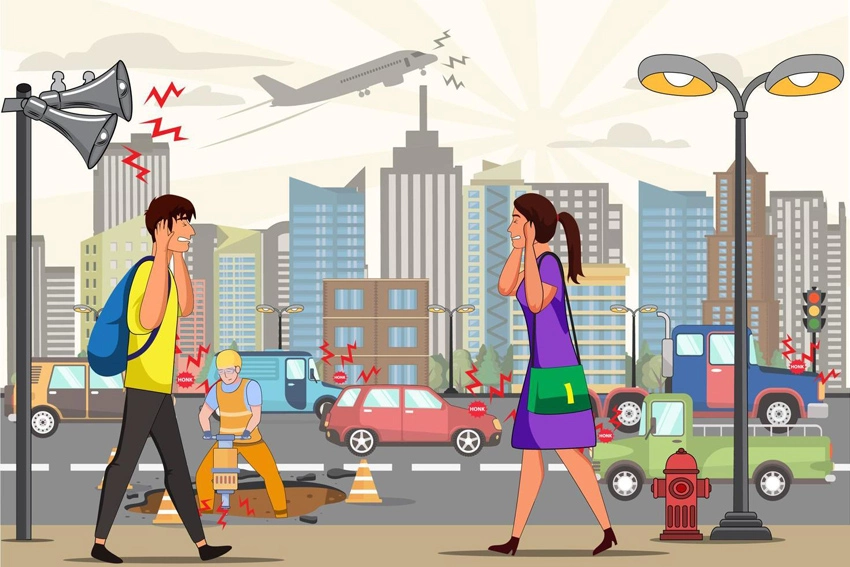
Every last Wednesday of April, the world stops—or should stop—the noise to reflect on it. This year, the date falls on the 29th, and this commemoration is not an environmentalist whim: it stems from the need to combat noise pollution. That invisible intruder that the World Health Organization (WHO) already considers a silent epidemic. Because noise doesn’t just annoy: it kills slowly, in the form of hypertension, insomnia, anxiety, and hearing loss.
Across the globe, exposure to noise is the norm. Cities like Delhi, Mexico City, and Madrid suffer from chronic levels above 65 decibels during the day. When the recommended level is no more than 55. But the problem isn’t just external: modern life has turned us into willing noise generators. With headphones at full volume, vacuum cleaners, blenders, televisions left on even when no one is watching, video calls in shared spaces, and unnecessary alarms. Never before has humankind been so exposed to an aggressive and continuous soundscape.
In Cuba, noise has a name and a face in everyday life. Added to the common problems is a very particular phenomenon: mopeds and motorcycles fitted with powerful sound systems that circulate at all hours blasting reggaeton or salsa at deafening levels. It’s simply a widespread practice that turns every street into an imposed soundscape.
These vehicles, often modified with speakers that double the engine’s volume, have become a symbol of Cuban noise pollution. Added to this are the aging vehicle fleet, buses where the driver forces his music on the passengers, neighbors who keep the party going until the early hours, and a certain ingrained idea that loud music is synonymous with joy or social presence. The consequence is a quality of life that suffers, yet many dare not complain.
In light of this, the contrast between the measures taken globally and those in Cuba is illustrative, but so too are the steps taken within the archipelago. Internationally cities like Paris, Barcelona, and New York have installed acoustic radars that automatically fine vehicles and motorcycles exceeding permitted decibel levels. The European Union requires strategic noise maps and five-year action plans. There are quiet zones protected by strict ordinances. The world is moving, albeit at varying speeds, toward more acoustically humane cities.
In Cuba, the legal framework exists and is not insignificant. Environmental and social coexistence legislation establishes tolerance hours (generally until 10:00 p.m. for residential music, with maximum levels of 55 to 65 decibels depending on the area). The National Revolutionary Police has the authority to act on complaints and can confiscate sound equipment when limits are exceeded. There are local efforts underway. Some community councils have managed to raise awareness among residents through community dialogue. And in certain municipalities, targeted operations have been carried out that have served to deter repeat offenders.
However, it is fair to acknowledge that enforcement faces challenges. Such as a lack of resources and the limited availability of patrols at night. Among other factors that often allow noise to persist without intervention. Therefore, there is still a long way to go. In this regard, it would be beneficial for Cuba to strengthen its educational campaigns in schools and through community media. Teaching that respecting others’ rest is also an act of civic responsibility.
Some international experiences could be studied with interest and adapted to the Cuban context. Always keeping in mind that the solution is not repression, but collective awareness.
The challenge is significant, but the will to improve coexistence is present in many communities. Among many officials who listen to their neighbors’ complaints every day.
Also this day confronts us with an uncomfortable question: are we willing to turn down the volume? It’s not about absolute silence, but about reclaiming the right not to hear what we don’t want to hear.
Because in constant noise, in the end, we don’t hear anything important: not a bird’s song, not a hushed conversation, not even our own body’s signals asking for rest. Silence is not emptiness; it’s the space where we can still think.

- Social Media: A Mirror of Our Humanity - 30 de June de 2026
- The Legacy of Vilma Espín, 19 Years Since Her Passing - 20 de June de 2026
- Aging with Dignity: A Call to Awareness Regarding Elder Abuse - 15 de June de 2026