
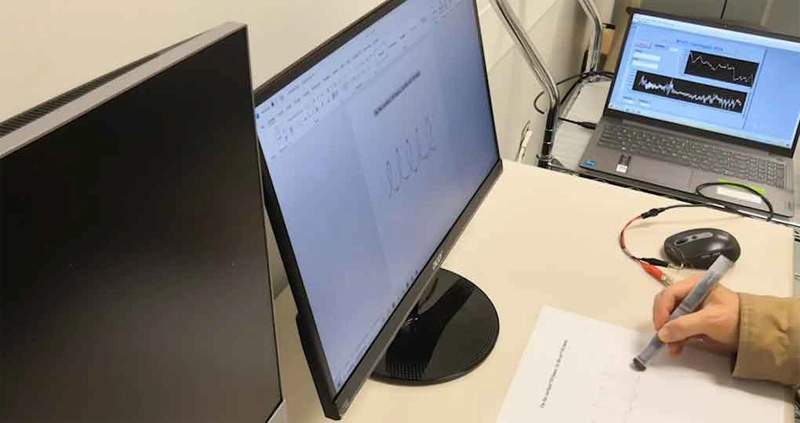
A team of researchers from the University of California, Los Angeles (UCLA), in the United States, is currently developing a pen with high potential to improve the diagnosis of Parkinson’s disease (PD).
It consists of a soft magnetoelastic tip and ferrofluidic ink, capable of sensitively and quantitatively converting writing movements, both on the surface and in the air, into high-fidelity analyzable signals for diagnosis.
According to the results of the research, published in the journal Nature Chemical Engineering, to validate the pen’s clinical potential, a pilot study was conducted in humans, involving both Parkinson’s patients and healthy participants.
The diagnostic element accurately recorded handwriting signals, and a one-dimensional analysis assisted by convolutional neural networks successfully distinguished PD patients with an average accuracy of 96.22 percent.
According to the researchers, this represents a low-cost, widely disseminable and reliable technology with the potential to improve diagnosis of this neurodegenerative disease in large populations and resource-limited areas.
The main symptoms of PD are motor, particularly stiffness, tremor, decreased movement or total inability to move, among others.
With information from Prensa Latina
Translated by Aliani Rojas Fernandez

- Putin states that BRICS has generated over 40 percent of global GDP - 12 de September de 2026
- Between the wind of the tenths and bottled art - 12 de September de 2026
- ETECSA Holguin Hosts Science and Technology Forum - 12 de September de 2026