
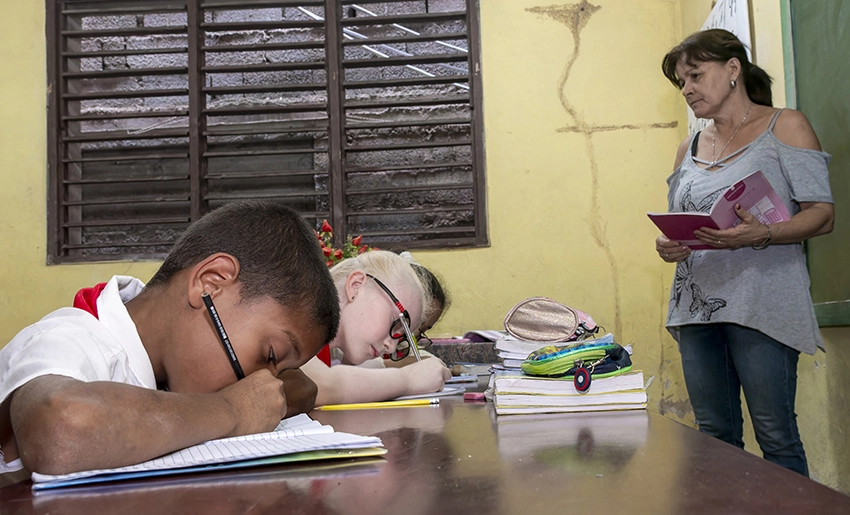
Yudelkis Rivera Oliveros, provincial head of Special Education in Holguin, revealed to Granma Newspaper the impact that the United States’ economic, commercial, and financial blockade has on this educational sector.
Across the 26 special education facilities in the province, there is a total enrollment of 3,381 students. This includes 280 students who receive instruction at home, taught by 76 teachers. After presenting these figures, she immediately began to explain a reality that is, without a doubt, heartbreaking.
“Currently, at the EIDE [sports-focused special education center], we have a girl with an amputated leg. Despite this physical-motor impairment, she plays table tennis and badminton and is a talented athlete. Because she has to move around a great deal and exert significant physical effort, her crutch frequently breaks. Ideally, she should use a prosthetic, but the imported adhesive required to manufacture one is unavailable.
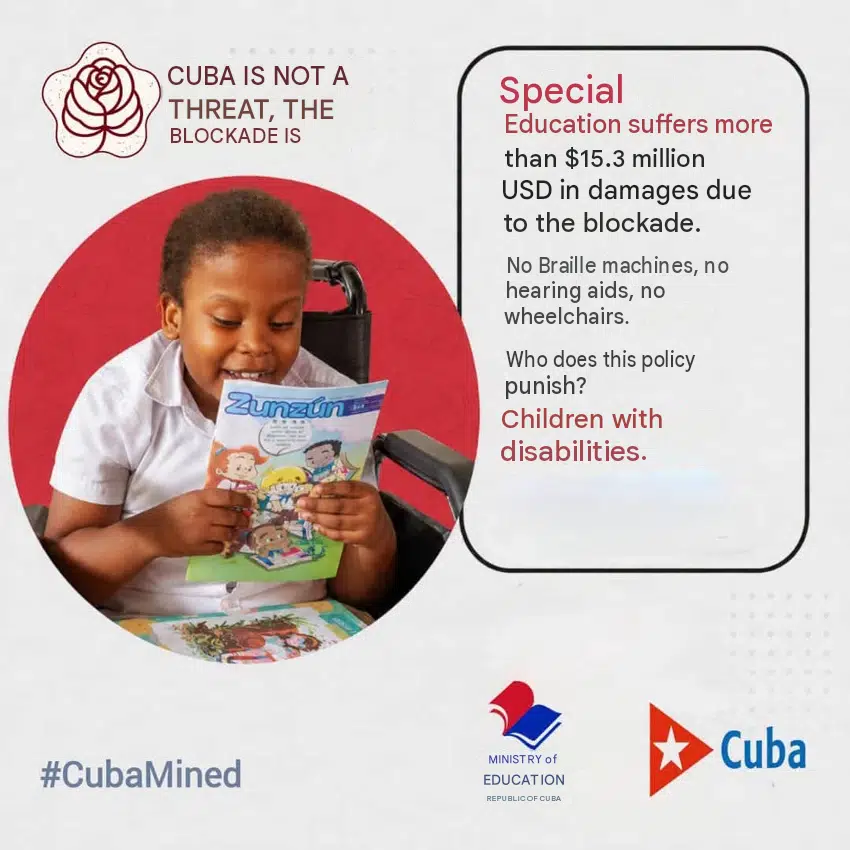
“We also have two blind students for whom we have been unable to purchase Braille machines from the United States. They have had to learn to write using a stylus and slate, which makes the learning process more difficult.
Also the JAWS system, a program that allows blind students to ‘read’ text from a computer by having it read aloud. It is impossible to acquire due to prohibitions imposed by the U.S. side. Because of these same criminal restrictions, both blind students and those with low vision face difficulties in using tactile learning materials, as there is no Braille paper available.”
The forcefulness of her arguments is striking—she is not merely citing statistics. She is speaking about the future of children. Children for whom this social initiative has worked tirelessly. Striving to ensure they can integrate into society and enjoy independence and opportunity. This is why Yudelkis is so well-versed in every detail. Just as she is crystal clear about who bears the blame for what is missing or fails to arrive.
“Five children have albinism and lack the glasses they need. Currently, in Cuba, there are no lenses with the correct prescription to help mitigate light refraction. The blockade prevents national entities from purchasing them.
“For our 14 deaf or hard-of-hearing students, we need an auditory stimulation room equipped with custom-fitted hearing aids. An audiometer, and other sound-related components. These, too, are denied to us, a denial that also affects two children currently waiting for cochlear implants.”
Her role allows her to gauge the critical need for early, individualized care. Intervention at the precise moment it can best address a disability. Without it, the consequences can persist for a lifetime. A harsh reality that cannot simply be ignored.
“When a child with a physical disability grows up without a proper crutch or wheelchair. Or when a blind or deaf child is denied the necessary aids, solely due to imperial malice. So their ability to live independently is severely restricted.”
Yet, sitting idly by is not in the Cuban DNA, especially when the well-being of children is at stake. One must constantly do everything possible, with whatever resources are available. One must take action and that is precisely what Rivera Oliveros asserts.
“We do not remain passive; we continue to seek solutions. We make adaptations to crutches and wheelchairs.” If someone is unable to attend the educational center, the teacher goes to their home to continue the lessons. I can assure you that nothing will stand as a barrier against the staff of the Special Education system. We will defend the joy and the rights of the Cuban children and adolescents for whom we are responsible.”
With information from Granma

- Blockade against Cuba affects special education students in Holguin - 26 de October de 2026
- National Baseball Series: The East Heats Up, While Pinar del Rio Pulls Ahead - 26 de October de 2026
- Cuba Expects Another Victory Against the Blockade at the UN - 26 de October de 2026