
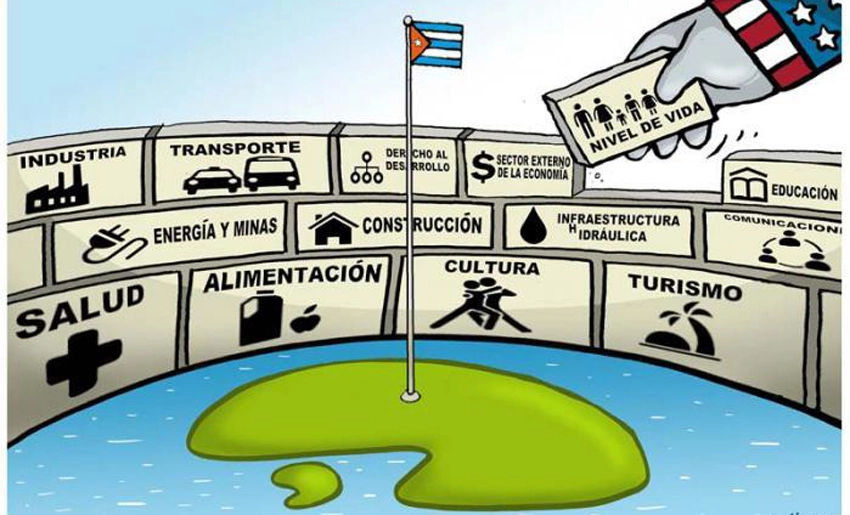
Today, Cuba faces the consequences of a worsening energy crisis and other issues stemming from Washington’s new imperialist escalation. This time, it is not merely a matter of the conventional blockade based on the Torricelli or Helms-Burton Acts. Which remain in effect and continue to cause harm but rather a technical and legal redesign. Aimed at suffocating the country through methods that are more sophisticated, harder to challenge, and more painful for the Cuban people.
A legal framework designed for suffocation
On June 30th, 2025, the Trump administration reissued National Security Presidential Memorandum 5 (NSPM-5). The document articulating its entire policy toward Cuba, though this was not a new measure, as it had already been in place since 2017.
However, this version expanded definitions and set objectives upon which the White House built two measures that altered the nature of the blockade imposed on Cuba.
The first measure, issued following the seizure of Nicolás Maduro, froze all shipments of oil and oil derivatives to Cuba from Venezuela. This was Executive Order 14380, signed on January 29th, 2026. Which declared a national emergency and authorized the imposition of tariffs on countries supplying oil and oil derivatives to the Caribbean nation.
Moreover this order not only prevents fuel from entering via third countries but also targets tankers bound for Cuban ports. Unquestionably an energy blockade in its rawest form.
The second measure was Executive Order 14404, issued on May 1st, 2026. Invoking that declared “national emergency,” it authorized sanctions against entities from third countries operating in key sectors of the Cuban economy. Such as energy, defense, mining, finance, and security or providing “support” to the Cuban government.
Also this framework includes secondary sanctions against foreign financial institutions. In other words, a European, Latin American, or Asian bank can be “punished” for doing business with the Caribbean nation. Even if it has no offices in the United States.
Extraterritoriality lies at the heart of this design; meanwhile, the Treasury Department’s Office of Foreign Assets Control (OFAC) maintains licensing as the only “legitimate” way to engage with Havana. Leaving all other forms of interaction under threat.
Under the umbrella of Executive Order 14404, lists of Cuban individuals and legal entities are maintained. Serving as a lure to sanction any foreign entity linked to them.
This extraterritorial pressure had a direct impact on maritime transport. In June, European shipping lines Hapag-Lloyd and CMA CGM suspended bookings to Cuba.
As a result, more than 7,000 containers bound for Cuba remain stalled in other Caribbean ports. Although the French company CMA CGM announced it would resume transporting food, medicines, and medical supplies, goods equally essential to addressing Cuba’s energy crisis. Such as photovoltaic systems were left behind.
The pattern is consistent: actions that do not challenge the blockade are permitted, while those that could alleviate it are blocked. U.S. interests are prioritized over measures that could benefit the Cuban people or even actors from third countries. In some cases—particularly regarding energy—the effect is twofold: the Petroleum Research Center (Ceinpet) appears on OFAC lists because it seeks to reduce reliance on imported inputs by utilizing domestic oil.
Thus, the aim is to prevent Cuba from finding sovereign solutions to its energy deficit. While simultaneously opening a specific channel for the Cuban private sector to receive fuel isotanks from the United States.
Washington’s underhanded tactics became evident on September 30th, when new regulations took effect that tightened the blockade and restricted the scope of action for various players. Including the Cuban private sector, which had previously benefited from “special treatment” (i.e., fewer restrictions) during the Joe Biden administration.
Among the most damaging measures are:
-The elimination of authorization for group “people-to-people” educational travel and for professional meetings or conferences in Cuba. Educational trips must now be sponsored by an organization subject to U.S. jurisdiction, and all travelers must be accompanied by a representative of the sponsoring organization.
-The elimination of “U-turn” banking transactions, which had allowed banks under U.S. jurisdiction to process operations that only indirectly involved Cuba.
-Direct and indirect financial transactions with entities on the Cuba Restricted List (CRL)—issued by the State Department and including GAESA. As well as numerous entities linked to the armed forces and other Cuban institutions—were prohibited.
-U.S. banks were prohibited from maintaining accounts for private Cuban entrepreneurs, and existing accounts were frozen.
From a decidedly imperialist perspective, the “legitimate” avenues for doing business with Cuba remain the licenses issued by U.S. authorities.
The impact on daily life
The aforementioned policies take a daily toll on Cuban families—especially those with sick members at home who face countless obstacles in transporting them.
They also affect the thousands of Cubans who must overcome immense difficulties every morning to get to work or school. Particularly those working amidst the stress caused by unstable electricity supplies in hospitals.
Energy restrictions and resource shortages caused by the blockade have severely impacted the operational capacity of the Cuban healthcare system.
One of the most telling figures is that the surgical waiting list reached 100,000 patients. Of these, 12,000 are children, over 16,000 require radiotherapy, and 2,888 depend on hemodialysis. Services that require a constant supply of electricity.
There is no state of conventional war between the United States and Cuba. However, the energy blockade and measures that drastically intensify the embargo constitute a serious violation of international law and human rights. And even qualify as a violation of international humanitarian law.
Furthermore the international community has not remained silent as Cuba denounces the energy blockade as “collective punishment” before the United Nations.
On July 7th, 2026, the General Assembly voted with 136 in favor, 9 against, and 30 abstentions—to hold an additional debate on the blockade.
This October, as it does every year, the Caribbean nation will submit its report. “Necessity of ending the United States blockade against Cuba,” to a vote in the General Assembly.
The document reflects the international community’s recognition of the humanitarian consequences of this policy and its overwhelming condemnation of a blockade that has currently reached unprecedented levels.
While Washington intensifies its economic war, the world votes against it. So this contradiction is, perhaps, the most telling image of what is at stake.
There is also a detail that reveals the true nature of this monstrosity. Demonstrated by the memorandum—NSPM-5—that outlines the Trump Administration’s actions against Cuba.
That document explicitly orders the Secretary of State and the U.S. Representative to the United Nations to oppose any international effort to lift the blockade until a “transitional government” exists in Cuba. In accordance with the criteria of the Helms-Burton and Torricelli Acts.
In other words, Washington not only rejects the international community’s overwhelming condemnation but actively opposes it diplomatically. Making any policy change contingent upon regime change in Havana that suits its own interests. An act of interference disguised by the euphemism of “transition.”
With information from CNA

- The Renewed Face of the Blockade’s Cruelty - 14 de October de 2026
- Holguin Promotes Tobacco Campaign with a Sustainable Focus - 14 de October de 2026
- Cuba Presents Coffee and Honey Investment Opportunities at FAO - 13 de October de 2026