
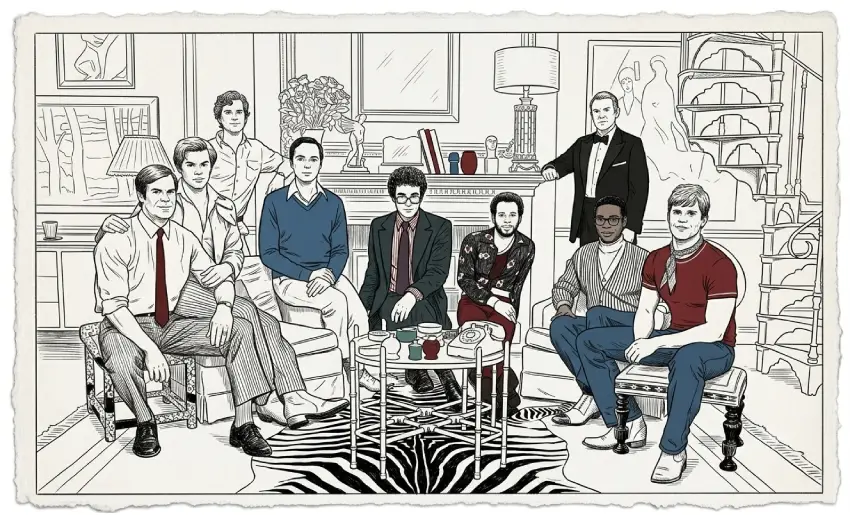
There’s a recurring image in this film: a car speeding through the streets of New York, the red lights failing to stop it. That car belongs to Michael, the host of the party. It’s also each of the guys in the band who gather that night in 1968 in his Upper East Side apartment to celebrate Harold’s birthday.
The film, directed by Joe Mantello and released on Netflix on September 30th, 2020. It is an adaptation of Mart Crowley’s novel of the same name. Which was previously adapted for the screen by William Friedkin in 1970.
Moreover the story unfolds at what appears to be a birthday party. With eight guests and a ninth who arrives unexpectedly. Alan, Michael’s former college roommate, shows up that night with a secret he never fully reveals, but which is, presumably, always just that.
His presence unleashes a torrent of cruelties and confessions. The guests, accustomed to shielding themselves behind the armor of humor, are unable to contain.
Juan Manuel Freire wrote in The newspaper that the film is, above all, a showcase of acting talent. And he’s right. Jim Parsons is magnificent as Michael: the alcoholic host who administers the poison. The rest of the cast also finds the perfect tone, balancing irony and sarcasm.
Much to our dismay, what one can’t shake from the end is that line Harold spits at Michael when the night has reached its breaking point: “Show me a happy gay man and I’ll show you a dead one.” However you translate it, it still carries the same weight. A fatal verse, without a doubt, the epitome of an era in which joy was not an option. And the terrible thing is that half a century later, that line still echoes in many places. As if nothing had changed, because it’s not so different.
The film summarizes a pattern that repeats itself across all walks of life. The urgency to resolve today what was postponed yesterday. Traumatic loves, made all the more painful by unprocessed guilt, the repression of feelings. Also the emotional need that never finds an outlet, the self-hatred disguised as hatred of others. Michael says it almost at the end, his voice breaking: “If only we could stop hating ourselves so much,” and no, it’s not a question. It’s a statement.
Also the film falls short at times, yes. It’s a filmed play, and at times it fails to conceal the loose ends. But what matters is the portrait of men who, fifty-old years ago, dared to say aloud what many wanted to dictate, then and now, but didn’t know how.
Trailer for the film: The Boys in the Band.
A work by: Liam Bornot, a journalism student

- Ediciones La Luz Presents New Releases at the Havana International Book Fair - 8 de August de 2026
- Holguin Youth Awarded “Fidel Centennial Youth” - 8 de August de 2026
- Cuba at the Central American Games: Medals Born of Perseverance - 7 de August de 2026