
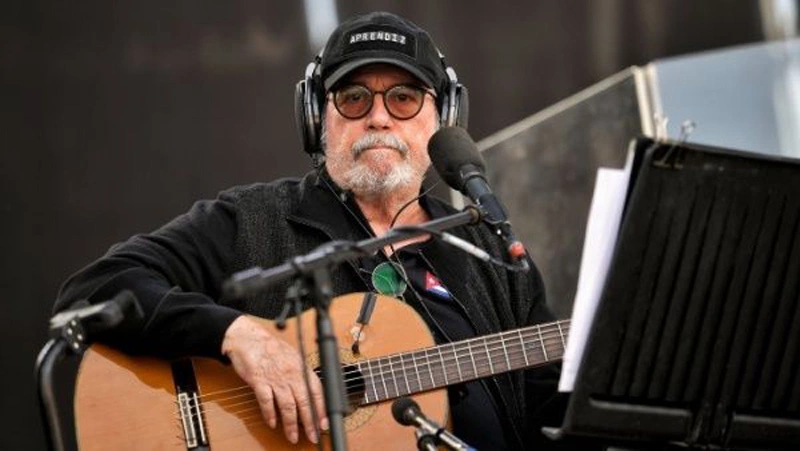
Considered, along with Joan Manuel Serrat, one of the best singer-songwriters in Latin America. Silvio Rodríguez is known both inside and outside of Cuba for writing songs that are poetry. Although I don’t really see the difference between good lyrics full of musical lyricism.
Many of his songs have become classics of Latin American music. Such as “I wish,” “Girón Beach,” “Unicorn,” “I dream about snakes,” “Let’s walk,” and “The mace.” Among his other well-known songs are political anthems like “Rifle against rifle” and “Song of the Chosen One,” and poetic melodies like “Where are they going?” and “Endless night and sea.” He has released more than 20 albums.
Rodríguez, both musically and politically, is a symbol of the Latin American left. His lyrics are notably introspective, while his songs combine romanticism, eroticism, existentialism, revolutionary politics, and idealism. As a humanist, his songs often reflect a secular worldview, where humanity should make the most of this world.
Rodríguez made his musical debut before a general audience on June 13th, 1967. On the television program Música y Estrellas (Music and Stars), invited to perform by musical director Mario Romeu. On that occasion, Rodríguez performed “Es sed” (It’s Thirst), “Sueño del colgado y la tierra” (Dream of the Hanged Man and the Earth), and “Quédate” (Stay). The latter of which later appeared on his album Expedición (Expedition), released in 2002.
Rodríguez states that he has always felt panic in front of the lights and cameras. However, despite his reputation as a nervous television presenter, his program was well-received by the Cuban public.
It wasn’t until 1967, with his first television appearance, that he began to gain widespread recognition and influence among Cuban revolutionary youth. With revolutionary yet fiercely independent lyrics (and a very informal dress code). Rodríguez quickly attracted the animosity of some members of the newly formed Ministry of Culture. Which was dedicated to eradicating the influence of the United States on Cuban culture.
In this context, the cultural institution Casa de las Américas and its then-director, Haydée Santamaría, played a crucial role. Haydée Santamaría was a respected revolutionary who participated in the 1953 attack on the Moncada Barracks and was the sister of Abel Santamaría. She became a protective, maternal figure for the young composers and many of her colleagues at the time. Casa de las Américas became a home not only for the new Cuban troubadours but also for many other left-leaning Latin Americans.
It was at this institution that Rodríguez met Pablo Milanés and Noel Nicola. Along with Rodríguez, would become the most famous singers and composers of the Nueva Trova movement.
In 1969, for nearly five months, he worked as part of the crew of the fishing vessel Playa Girón. During this fruitful period, he composed 62 songs, including the famous “Ojalá” and “Playa Girón.” The lyrics and music of these songs were compiled into a book titled Canciones del Mar (Songs of the Sea). In 1976, he decided to join the Cuban troops in Angola, playing music for the soldiers.
After more than 40 years of artistic work, Rodríguez has written a vast number of songs and poems (estimated to be between 500 and over a thousand). Many of which have never been set to music and probably never will be.
While his musical knowledge has continually grown (among his teachers is the renowned Cuban composer Leo Brouwer). He is more praised for the poetry of his songs than for the music that accompanies them. His lyrics are a staple of leftist culture throughout the Spanish-speaking world. And he was banned from the media during several dictatorial regimes that ruled Latin America in the late 1970s and early 1980s.
His debut album was Días y flores (Days and Flowers), released in 1975. Al final de este viaje (At the End of This Journey) and Cuando digo futuro (When I Say Future) feature songs he composed before Days and Flowers. He achieved international popularity in the early 1980s with Rabo de nube (Tail of a Cloud) and, in particular, Unicornio (Unicorn).
In the first part of his career, his work displayed a good deal of revolutionary optimism. Mujeres (Women), released in 1979, is, in contrast, a romantic and highly intimate album.
Midway through his career, Silvio Rodríguez experimented with sounds and rhythms that moved away from his trademark acoustic guitar. Accompanied by the group Afrocuba, for example, on Causas y azares (Causes and Chance).
In his later years, Silvio Rodríguez completely purified his sound through a return to the acoustic guitar. A great care and sophistication in his vocals, and exclusive control of the production process.
In 2007, he received an honorary doctorate from the National University of San Marcos in Peru. In 2022, he received the Coral of Honor from the Havana International Festival of New Latin American Cinema for his contributions to Cuban film soundtracks.
In June 2023, he was awarded an honorary doctorate in Social Sciences and Humanities by the University of Havana.
Rodríguez has been a great influence on many popular artists. He continues to search for lost unicorns to transform them into the beautiful songs that have also made us better Cubans.

- Journalism: The Great Novel of Daily Writing - 9 de September de 2026
- When Headphone Technology Can Affect Our Health - 9 de September de 2026
- Gambling Addiction: Not Betting Money - 1 de September de 2026