
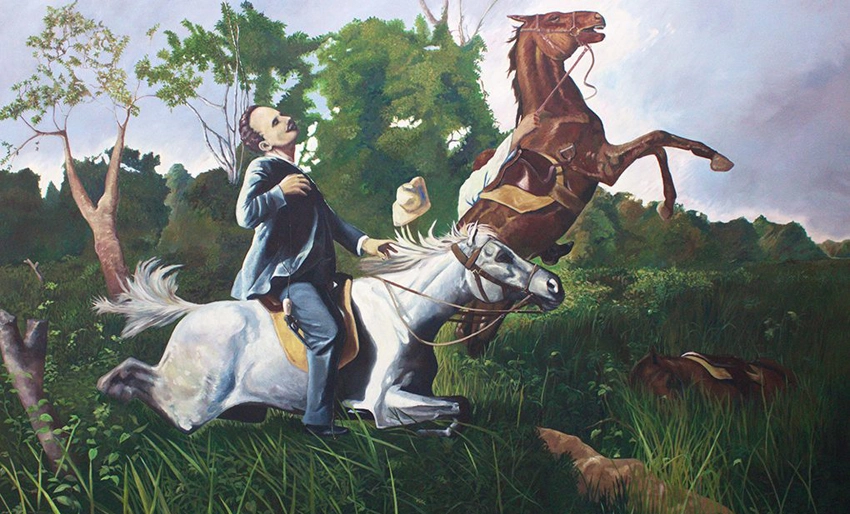
131 years after that May 19th, 1895, when José Martí fell at Dos Ríos. There are still those who believe his figure belongs to the bronze of statues or to occasional speeches. But in Cuba, speaking of Martí is something else entirely. It’s not about invoking him from a pulpit or repeating his phrases.
Rather, it’s about realizing that many of the things he wrote more than a century ago remain the best explanation for what is happening on the island today. Also the most practical tool for facing life amidst difficulties.
This is the case, for example, with the idea that “Homeland is humanity.” A phrase that reflects what Cuba truly does in the world. While the economic blockade imposed by the United States. A siege that has lasted for more than six decades and which the United Nations has condemned year after year in overwhelming votes. It attempts to suffocate the island, thousands of Cuban doctors and teachers have been deployed to dozens of impoverished countries in Africa, Latin America, and the Caribbean.
Moreover they vaccinate, teach reading, and save lives. They ask for nothing in return. This custom of extending a helping hand to the most needy neighbor is nothing other than Martí’s ideals at work, without an instruction manual. Because Martí never envisioned a selfish homeland, closed within its borders. Rather one that felt itself to be part of suffering humanity.
Another of these ideas that continues to resonate in every corner of Cuba is that of “to be cultured is to be free.” On the island, this phrase has been taken so seriously that education has ceased to be a privilege and has become a state policy. The numbers are there, verifiable in UNESCO reports.
But what is interesting is not the statistics, but what is happening in the neighborhoods. In any town in the Sierra Maestra mountains or in a neighborhood in Holguin province. A child learns the verses of “The White Rose” before their multiplication tables. This oral tradition, this way of instilling values from childhood, is a pure legacy of the Apostle.
And when a teacher reads “Simple Verses” to their students or a mother teaches her child with a borrowed book. They are demonstrating that the maxim that knowledge is the only path to freedom remains as alive as ever.
Martí’s anti-imperialism is also relevant, but not as an empty rhetoric. When he wrote about the “powerful neighbor” who despises our people and looks at us with covetousness. He was describing the same mechanism of domination that today manifests itself in the blockade. In the spurious lists of state sponsors of terrorism. In the financial sanctions that complicate even the purchase of medicine.
This is not theory: it is the daily life of Cubans, marked by shortages of fuel, supplies, and food. In response, the Apostle bequeathed a tool that is not violence, but moral resistance and creativity. That is why, when a farmer repairs a tractor with invented parts. Or a neighbor organizes a garden in an abandoned space, or an engineer programs software to replace a blocked application. They are embodying the National Hero in his most practical form.
131 years after his passing into immortality, José Martí is not a painting hanging on a wall. He is a way of thinking that appears when least expected. His relevance is not decreed; it is lived. And as long as there is a Cuban who defends their dignity with creativity. Also who teaches another to read, who invents a solution to a need. Or who helps a foreigner without asking for anything in return. The man who fell at Dos Ríos will live on. Not as a ghost of the past, but as a certainty of the present.

- New Holguin schoolchildren join the OPJM (+ Photos) - 8 de October de 2026
- Innovating in Cuba: the talent that produces, saves, and solves - 7 de October de 2026
- Cuban Deputy Prime Minister Assesses Water Availability in Holguin - 2 de October de 2026