
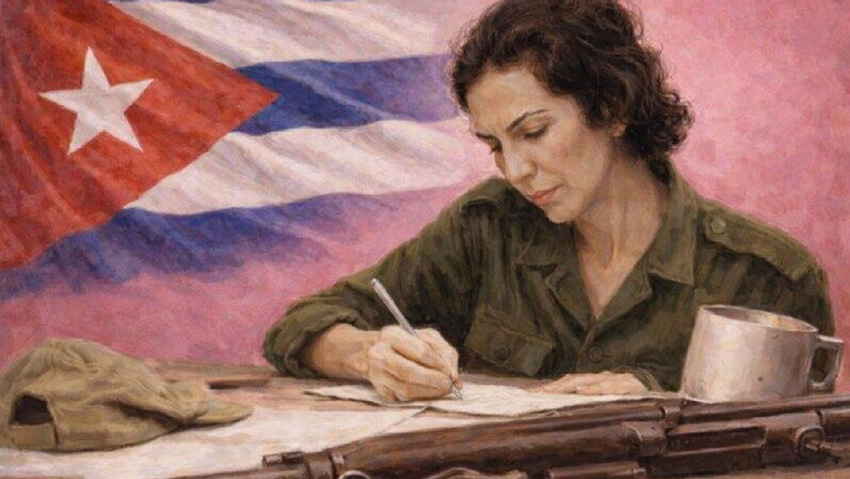
All Cuban girls remember the stories of Celia Sánchez Manduley hiding secret messages in the butterfly flower. It’s not an old wives’ tale or a bedtime story: it was a real war strategy. And that image—of a woman handing over a bouquet that concealed instructions for the rebels in the Sierra Maestra mountains—has been etched into the island’s memory. As a symbol of intelligence and tenderness.
But that flower is just the gateway to a life that, as we commemorate another anniversary of her birth this May 9th. It remains one of the cornerstones of the Cuban Revolution.
Celia was born in Media Luna in 1920 into a rural middle-class family. Her father was a doctor, and she grew up witnessing firsthand the suffering of the peasants and the injustice of a country divided in two. When Fulgencio Batista staged his coup in 1952. Celia was already a woman and refused to look the other way. She didn’t speak from a platform or write grand manifestos: she acted. She stored rifles on her farm, raised funds, and wove a network of contacts. That stretched from the fishermen of Manzanillo to the leaders of the exile community in Mexico.
Moreover she organized the logistics for the Granma landing. Celia organized a human network. As far as was possible, logical, and prudent, to help the heroes who arrived on December 2nd, 1956.
From then on, Celia became the first woman in the Rebel Army. Not as a nurse or a cook: as a combatant. In the Sierra Maestra, she carried a rifle, but also a notebook. She wrote down every name, every date, every loss.
Furthermore she carried the archives of the Revolution in a backpack she never let go of. She was also the one who welcomed frightened recruits, the one who mended torn uniforms. The one who wrote letters to the mothers of the fallen. It was a fact: she was the bridge between the guerrillas and the people. So with the certainty that this struggle had both memory and organization.
After the triumph of 1959, Celia preferred to work behind the scenes. As secretary to the Council of Ministers, as a member of parliament, but above all as the voice that reminded Fidel Castro that the Revolution could not forget the most humble.
It was she who rescued the scattered documents of the war and founded the Historical Archive. It was she who demonstrated that one could be fierce in battle and tender in everyday life.
That is her true significance for Cuba. Celia Sánchez is not a portrait, nor the name of an institution. For this country, she is proof that the homeland does not have to choose between strength and gentleness.

- Social Media: A Mirror of Our Humanity - 30 de June de 2026
- The Legacy of Vilma Espín, 19 Years Since Her Passing - 20 de June de 2026
- Aging with Dignity: A Call to Awareness Regarding Elder Abuse - 15 de June de 2026