
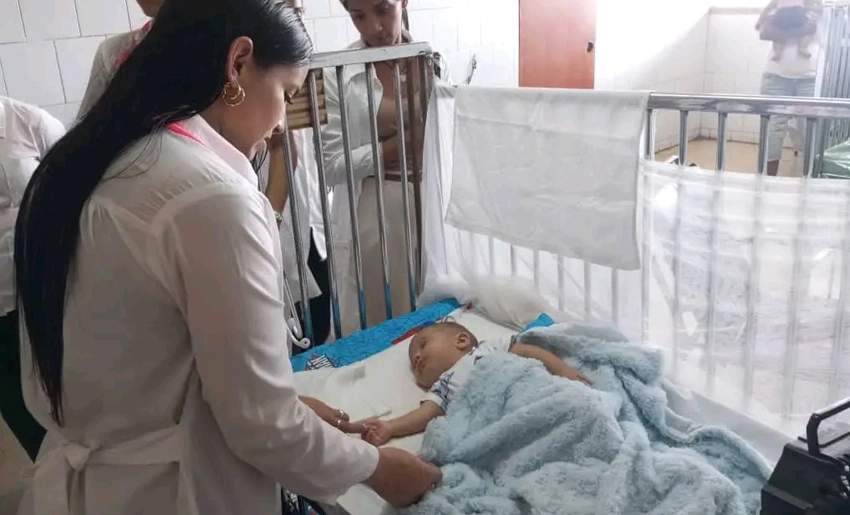
There are things that transcend blockades and blackouts. One of them is a mother’s heartbeat when her child wakes up with a fever a hundred kilometers from the hospital. Or the surgeon’s steady hand operating on a newborn in a dimly lit operating room.
In Holguin, the Octavio de la Concepción y de la Pedraja Provincial Pediatric Hospital feels more like a large house than a fortress. Because here, amidst Cuba’s complex energy and economic reality, childhood remains sacred. And what is sacred is cared for differently.
The first miracle is almost logistical: ensuring that a mother from the most remote municipality doesn’t have to sleep in a bus terminal with her sick child. For this reason, the Provincial Health Directorate decided that the doctors, not the children, should travel to the hospital. Today, 14 specialties—including Endocrinology, Rheumatology, and Dermatology—travel to the polyclinics. And for more specialized cases, like Pediatric Cardiology, there are clinics in every municipality. So, the cardiologist isn’t a stranger, but rather that doctor in a white coat who comes every two weeks.
Also the other major area is surgery. Scheduled operations have had to wait, that’s true. But no one waits when life moves faster than time. Newborns with birth defects and children with cancer take priority. There, no waiting list matters.
And speaking of cancer: the Regional Center for Pediatric Oncology treats children from Holguin, Las Tunas, and Granma. The economic blockade has hindered the acquisition of certain medications. Especially those from the United States, but the doctors have learned to be resourceful. They can’t always provide the first-line treatment. So they always find a way to ensure that no child goes without their care. The result is as moving as it is real: more than 90% of these children survive.
In the end, what sustains all of this isn’t a display case full of imported supplies. It’s the decision of a medical team that, faced with scarcity, doesn’t respond with indifference, but with unwavering ethics. Every IV drip is one more tiny heartbeat. Every successful surgery, an applause that no one hears but that all of us on the outside should be echoing.
By: Daimy Peña Guillén

- Campaign Launched to Mark Half-Century of the Engineering Construction Company in Holguin - 14 de October de 2026
- Healthy Habits Recommended to Prevent Thrombosis - 14 de October de 2026
- Holguin Marks 66th Anniversary of the Nationalization of Cuban Banking - 14 de October de 2026