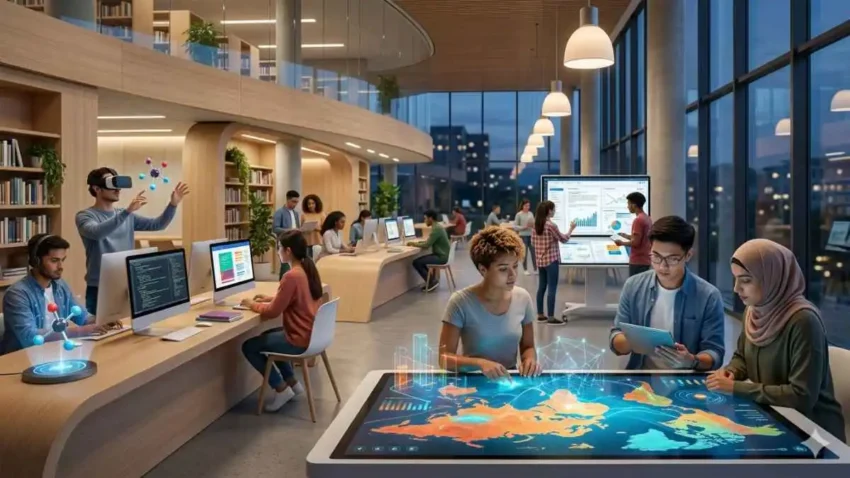
Every March 23rd, the world commemorates World Learning Day. A date that invites us to reflect on a process as old as humanity itself, yet more relevant than ever. Established to remind us that learning doesn’t end with a university degree or with youth. This celebration seeks to position the ability to acquire knowledge as a right and an essential tool throughout life. In a global context marked by the rapid pace of technological change and uncertainty. So turning our attention to how and why we learn becomes an exercise in profound collective responsibility.
The modern world demands that we be lifelong learners. According to international organizations such as UNESCO. Learning is not just about accumulating data, but about developing the ability to adapt, to unlearn in order to relearn, and to apply knowledge to solve real-world problems. We live in a society where information abounds, but well-processed knowledge is scarce. Therefore, fostering critical thinking and intellectual curiosity is more necessary than ever.
Moreover the global state of learning is cause for concern. Five years before the deadline set by the 2030 Agenda, the world’s education landscape is far from meeting its goals. UNESCO data reveals that 250 million children and young people are out of school, and 763 million adults are illiterate. In Sub-Saharan Africa, only 29 percent of young people complete upper secondary education, compared to 62 percent globally. Furthermore, an estimated 69 million teachers are needed to achieve the educational targets by 2030.
The GEM 2026 Report from this organization is unequivocal: none of the targets of Sustainable Development Goal 4 are on track to be met. The number of children out of school has stagnated for a decade. Learning levels have declined in numerous countries, and inequalities based on social origin, territory, and gender remain profound. The pandemic exacerbated structural problems, and the digital divide continues to widen these disparities.
In Cuba, promoting learning has historically been a fundamental pillar. From the early years of the Revolution, the country built a solid educational system based on the premise of education as a right for all. Over the years, Cuba has distinguished itself with a positive track record in training highly qualified professionals and in literacy campaigns that transcend borders. The Cuban nation has promoted learning not only in classrooms but also through community programs, arts education, and sports. Understanding that the integral development of the individual is the foundation of social progress.
However, as is the case everywhere in the world, the current landscape presents limitations that cannot be ignored. Economic difficulties, a scarcity of technological resources. And the impact of the embargo affect educational infrastructure and limit access to up-to-date sources of knowledge.
The digital divide becomes a real obstacle as the world moves toward virtual platforms and interactive learning environments that are often difficult for the Cuban population to access. These limitations, far from being a secret, are part of the challenges the country must face to ensure that learning remains the tool for personal growth that has been so widely promoted.
Learning has never been an easy path, and in times of crisis, even less so. But precisely in those moments, learning becomes an act of resilience. It doesn’t matter if it takes place in a well-equipped university classroom. A modest library, or through a phone screen with a limited connection. The essential thing is to never lose our curiosity to understand the world and the humility to recognize that there is always something new to discover.
Today, more than ever, we must motivate ourselves to keep learning. To learn to listen to other voices, to question the status quo with reasoned arguments, to collaborate with those around us, because together we build a more solid foundation of knowledge. Every book read, every skill acquired, every mistake that teaches us a lesson, is a step toward a fuller life and a more just society. That is the true power of learning: its capacity to make us better, even in the midst of adversity.

- Social Media: A Mirror of Our Humanity - 30 de June de 2026
- The Legacy of Vilma Espín, 19 Years Since Her Passing - 20 de June de 2026
- Aging with Dignity: A Call to Awareness Regarding Elder Abuse - 15 de June de 2026