
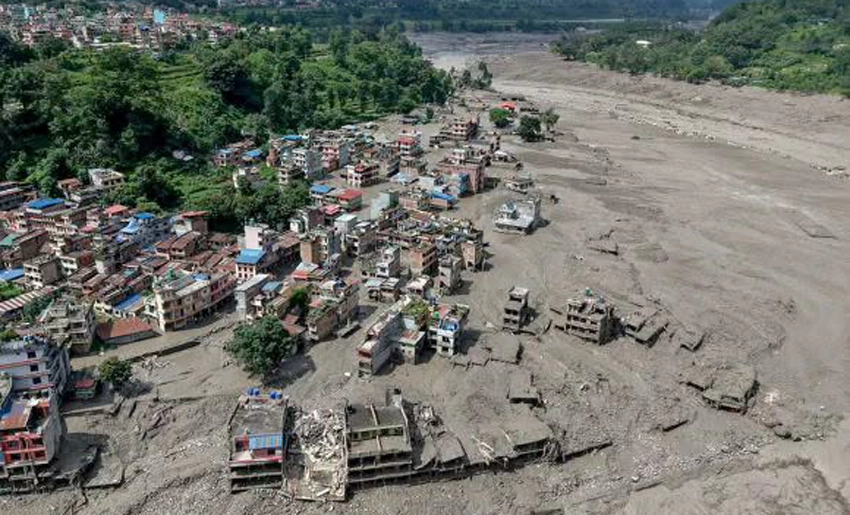
An unexpected wave of floods devastated everything in its path on the border between Nepal and Tibet after a glacier collapsed. Rescue teams searched for hundreds of missing people on Thursday.
As a result, a mountainous region of Asia, famous for its beauty and grandeur, is now covered in mud and debris. More than 350 people have died, according to police, and more than 1,300 are missing. Including dozens of foreigners and pilgrims. Hundreds more have been displaced throughout the Himalayan region.
The disaster has left at least 826 people missing in Nepal. Authorities in Tibet, an autonomous region of China, reported at least three deaths and 558 missing persons.
Climate experts from the International Centre for Integrated Mountain Development. Based in Kathmandu, said a glacial avalanche likely caused Wednesday’s flash flood.
UN Secretary-General António Guterres expressed his solidarity with the victims and their families. The tragedy strikes a region that has repeatedly suffered the effects of deadly natural disasters.
In April 2015, a magnitude 7.8 earthquake killed more than 8,800 people in Nepal and devastated numerous mountain communities. In October 2025, torrential rains again triggered floods and landslides in the east and center of the country, affecting more than 30,000 people.
These new floods come as the UN warns of the rapidly increasing risks associated with extreme weather events. The United Nations Office for Disaster Risk Reduction (UNDRR) estimates that the world could experience 560 medium- to large-scale disasters per year between now and 2030.
With information from Cubadebate and the United Nations

- Living Memory Against Terrorism - 12 de October de 2026
- Boca de Sama: Where Terrorism Shattered the Calm - 12 de October de 2026
- Virtual Health Innovation Event Held in Holguin - 12 de October de 2026