

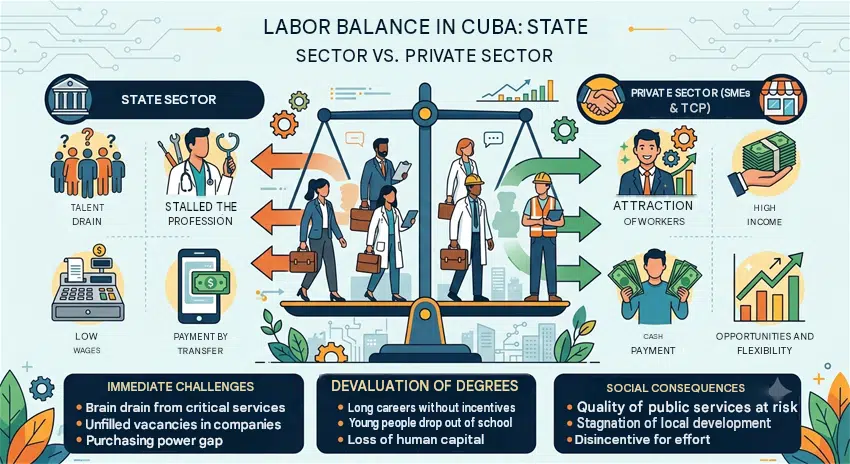
There are university degrees that now rest at the bottom of a drawer, covered in a silent but eloquent dust. They belong to engineers, professors, doctors, and specialists who one day decided that vocation alone is not enough to put food on the family table. Today, the labor landscape in Cuba faces a painful paradox. While the state sector sees its vacant positions multiply, the private sector—led by micro, small, and medium-sized enterprises (MSMEs) and self-employed workers. It attracts a skilled workforce that is legitimately seeking economic relief.
The main cause is no secret: the abysmal wage gap. In the current dynamic, what takes a professional a whole month. To obtain working for the state can often be achieved in just a week in the private sector.
Between Digital Payroll and Daily Cash
Also this monetary disparity is compounded by another significant obstacle: the means of payment. While the government pays most salaries via bank transfers. The private sector typically operates in cash. In the current context, having one’s salary tied up on a card has become a daily headache. The endless lines at ATMs—often out of stock or out of service due to technical and power failures—turn cash withdrawals into an ordeal. To make matters worse, much of the informal economy and private services require paper money or apply surcharges to electronic payments. Effectively devaluing the public sector worker’s income before they can even use it.
The dilemma of new generations: why study for five years?
Moreover this economic distortion is deeply affecting the psychology and life plans of future generations. For teenagers and young adults currently in secondary school. The incentive to undergo four or five years of rigorous university education is rapidly fading. Seeing established professionals left their fields to pursue unskilled but profitable jobs in the private sector. The logical response for many is to take a shortcut. The idea of “studying to become someone” is losing ground to the pragmatism of entering the private job market as soon as possible. Even if it means sacrificing intellectual development, a degree, or one’s vocation.
The implicit message young people receive is discouraging: academic effort no longer guarantees prosperity or personal stability.
The cost of dismantling the social pyramid
The real problem transcends simply changing jobs or individual aspirations. The massive migration of talent to jobs that don’t require technical training is gradually emptying the base of the country’s development.
Furthermore this is not just a loss of human resources. It is the breakdown of the link between scientific training, intellectual effort, and social well-being. In the short term, the result is evident in the decline in the quality of public services. In the long term, the consequences are even more serious:
-Loss of generational succession: Strategic institutions and entities are left without the critical mass of young professionals. Also who were supposed to ensure technical and scientific continuity.
-Brain drain and stagnation: Those who do not practice their specialties miss out on the training and constant updating that their fields demand.
-Devaluation of knowledge: A society that does not reward knowledge risks mortgaging its own future development.
Are the measures sufficient?
The recent salary adjustments represent an attempt to stem the bleeding. But in an inflationary scenario with serious liquidity constraints. These measures are still perceived as far from competing with the payment capacity and flexibility of the private sector.
Moreover this is not about demonizing private management—which plays an indispensable role in driving economic growth. But about recognizing the urgent need to restore the true value, effectiveness, and dignity of public sector salaries. Balancing the scales, dignifying public sector professional work. Ensuring that university classrooms once again become a desirable project for the future is not just an economic dilemma. It is a social imperative upon which the country’s destiny depends.
By: Alvaro Raúl Suárez Leyva

- Energy Mix Transition Continues in Holguin Schools - 10 de September de 2026
- Cuba Implements New Regulations to Boost Agriculture - 10 de September de 2026
- Holguin’s Medano Company Drives Innovation in Construction Materials Management - 10 de September de 2026