
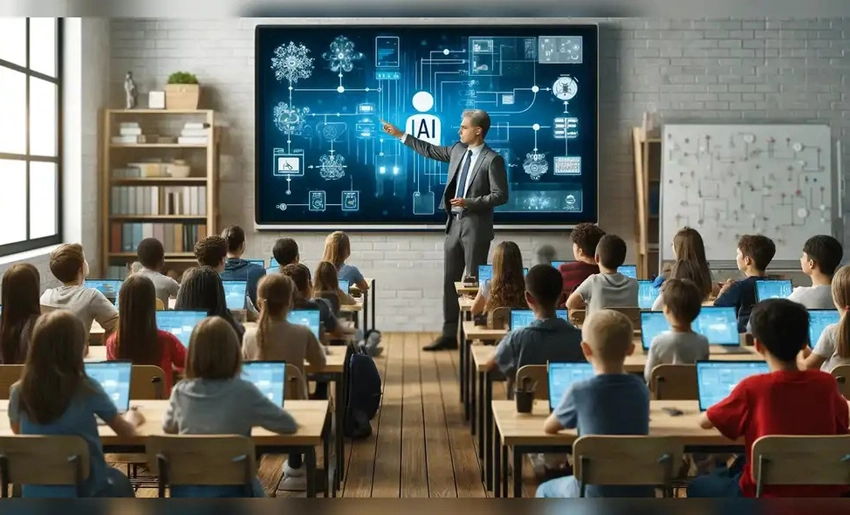
Artificial intelligence (AI) has become a tool present in everyday life. It’s in mobile phones, search engines, translation apps, and, increasingly, in classrooms.
Its incorporation into the educational field has opened a debate that goes beyond technological innovation. Is it helping students learn better or is it fostering a new form of dependency?
Artificial intelligence in education consists of the use of systems capable of analyzing information. Recognizing patterns, and generating responses to support teaching and learning processes. This ranges from platforms that personalize content according to each student’s pace to virtual assistants that answer questions in seconds.
AI offers tools that seemed unthinkable just a few years ago. It summarizes texts, explains complex concepts, corrects exercises, and boosts creativity by generating ideas.
Like everything, it has its benefits: it facilitates access to information, promotes more personalized learning, and saves time on repetitive tasks. For many students, it represents significant support when researching. Understanding difficult topics, or practicing languages. Likewise, teachers can use it to develop teaching materials, design activities. Or analyze their students’ academic progress more efficiently.
However, technology also presents significant challenges. The main risk arises when artificial intelligence ceases to be a tool. And becomes a substitute for critical thinking.
Copying answers without understanding them, completely delegating the completion of assignments. Or blindly trusting the information generated by these systems limits the development of fundamental skills. Such as analysis, argumentation, and creativity. Furthermore, AI is not infallible: it can offer outdated, incomplete, or incorrect information if the user does not verify the sources.
Therefore, the real challenge is not prohibiting its use, but learning to use it better. Formulating good questions, comparing information with reliable sources. Using it as support, not as a replacement for learning, are essential practices for harnessing its potential.
AI has arrived to transform education, but knowledge still depends on people. Any platform can replace curiosity, reasoning, or the ability to question what is learned.
By: Indira Vania López Samé

- Living Memory Against Terrorism - 12 de October de 2026
- Boca de Sama: Where Terrorism Shattered the Calm - 12 de October de 2026
- Virtual Health Innovation Event Held in Holguin - 12 de October de 2026