
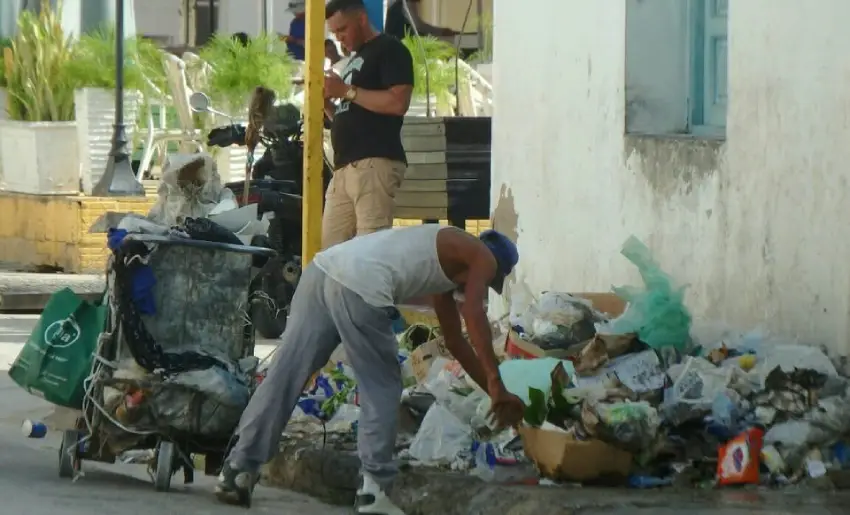
For some time now, Holguin has no longer been recognized as one of Cuba’s cleanest cities.
Today, the urban landscape consists of street corners transformed into makeshift dumps. Streets where garbage obstructs traffic, and a haze that blankets the entire city.
Moreover the accumulation of solid waste is the result of a chain of inefficiencies. Where collection by the municipal services is clearly insufficient. And control over the major generators of waste—micro, small, and medium-sized enterprises (MSMEs), self-employed workers, and state-run centers—is practically nonexistent.
Every day that passes, the mounds grow, overflow, and invade sidewalks. Turning the surroundings into a permanent source of pollution.
But the problem goes beyond aesthetics. The garbage has direct consequences for public health. Rodents, insects, and disease vectors proliferate, finding their ideal habitat in these landfills.
Faced with a lack of systematic solutions, some resort to burning trash. And then the air fills with smoke, invisible toxins, and that persistent odor that seeps into homes, clothes, and lungs. Far from solving the problem, this transforms it into an even more dangerous one.
Above all this, they hover: the aurochs. Increasingly visible, increasingly numerous. They trace circles in the sky of a city that seems resigned to their presence. If you don’t believe me, look up at the sky any day and tell me if it isn’t the most obvious symptom of a deteriorating environment.
If those responsible for solving the problem don’t do it, we must, because it is our city. We must not become accustomed to this. Sometimes we boast of being the most beautiful city in Cuba, but today, sadly, the present reeks of neglect.
By: Miguel David Bruzón Hernández

- Cuba Now Has Marine Maps Suitable for Various Applications - 2 de October de 2026
- Experts say the future of tourism rests on sustainability and authenticity - 2 de October de 2026
- Transformations in Cuba: Necessary in Times of Urgency - 2 de October de 2026