
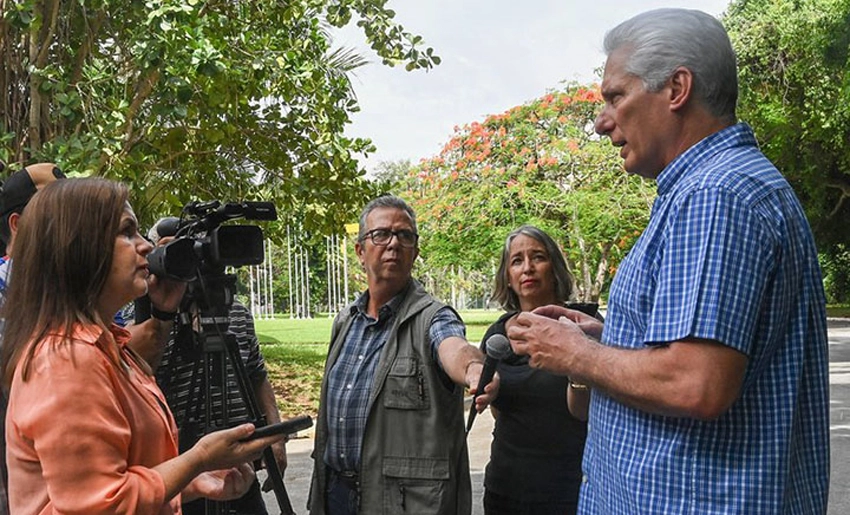
Miguel Díaz-Canel, First Secretary of the Central Committee of the Communist Party of Cuba and President of the Republic. He addressed the country’s main priorities for overcoming the current complex situation. Marked by the hostility of the United States government.
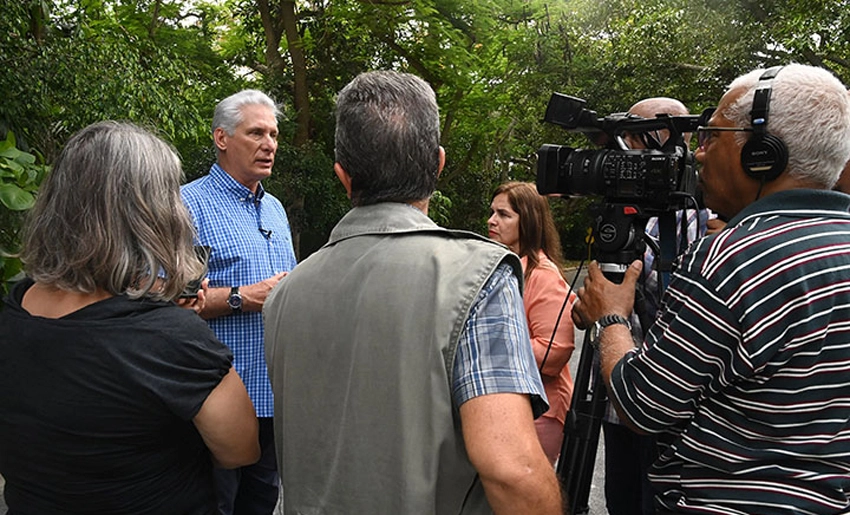
“In complex times, one cannot do without the passion for development.” This is a Fidel Castro-era concept that embodies the will not to be defeated. It was shared by the First Secretary of the Central Committee of the Communist Party of Cuba, Miguel Díaz-Canel Bermúdez. With the press team of the Presidency of the Republic.
Taking as a starting point a question alluding to the difficult times the country is experiencing. What could be done from the Island to move forward. Even grow, the dignitary shared reflections on several measures designed to overcome the current situation.
Also the first, he said, “is preparation for defense. And you all know the intensity with which each element of the territorial defense system is being prepared. How are the weekly Defense days being utilized, and all the work being done to refine the plans—adapting them to the lessons learned. While also seeking ways to optimize population protection and public participation in a People’s War strategy.”
The other major priority, the president stated, “is the Economic and Social Program for 2026.” Díaz-Canel recalled that it was submitted for public debate at the end of last year. That this collective reflection “generated many proposals. Especially regarding elements of transformation in the economic and social model.”
“This public debate broadened, strengthened, and reinforced the projections contained in the initial document.” And respecting the opinion of our people, in recent months we have worked intensively with experts, consulting criteria, including international criteria, using Artificial Intelligence platforms,” comparing, he said. The Island’s experience with “the particularities of countries like China and Vietnam. Which are also in the process of socialist construction and which, at a certain point, not as prolonged as ours, experienced blockades.”
Moreover the Head of State affirmed: “I believe there is a maturity in a significant portion of these ideas, these proposals”; and he detailed that they “are being given the final details for approval in the Political Bureau, in the National Assembly. Immediately begin a process of informing and explaining to the population, because the most important thing would be that these transformations that must be carried out are understood, shared, defended, and that we go out and implement them with complete efficiency.”
Work has been done, the president commented, on more than twenty issues “related to transformation.” The first of these, he specified, “has to do with the system of economic management.” There is a whole set of proposed measures or actions that will allow us to resolve old contradictions we have between the Plan, between central planning and incentives.” Díaz-Canel spoke about the importance of breaking down barriers to stimulate national production. Also both “to offer more goods and services to our population” and for exports that generate income.
“In other words, the perspective of everything we are proposing is that together we can productively boost the country, create wealth, and distribute that wealth with social justice.” The president warned that “if we don’t have wealth, it is very difficult to move forward.” Especially in social programs and in addressing “the inequalities that have been created. Addressing the vulnerabilities of individuals, families, and communities.”
Along the same lines, he stated that there is a set of measures designed to resolve “the contradiction between centralization and decentralization.” And he extended more than one question: “What should the country’s central planning focus on? What should it promote?” What strategic priorities must be addressed? While safeguarding these essential needs, he emphasized removing obstacles and granting powers “to other levels, so that they can carry out their own activities that also boost the endogenous potential of those areas.”
The Municipality and the State Enterprise: Key Pieces of the National Machine
Municipal autonomy and enterprise autonomy were other work priorities that the Cuban President reflected on. Regarding the powers that can be granted to municipalities, he referred to creating the conditions so that these entities have “every opportunity to decide which are their enterprises, which are their economic actors, and which are the matrices of interrelation.”
Díaz-Canel Bermúdez commented that there will also be a restructuring of the state apparatus, the government, the business sector. The Party, political organizations, and mass organizations throughout the country: “There is already a draft bill that has been made public on the National Assembly website. So that the population can offer their opinions before it goes to the National Assembly. Also there is a significant reduction, not only in the number of ministries.
This will lead, he argued, to “savings in the budget, which will then be available to support social programs or to support salary reform, which we must implement as soon as possible. Especially in the budgetary sector, because in the business sector there are no limits. That is, each company designs its own salary system and pays salaries based on the revenue it is able to generate.”
Also the dignitary emphasized: “I believe we will then achieve a State, a Government, and organizations that are less bureaucratic, more dynamic, and more adaptable to the demands of our times.”
Furthermore the First Secretary of the Central Committee of the Communist Party of Cuba also emphasized: “That everything we do contributes to addressing social inequalities and vulnerabilities.”
More powers for the proper use of land
The expansion of powers—the Head of State reflected—is largely aimed at stimulating and revitalizing agricultural and food production. He referred to “the powers that will be granted for land use; to give land to those who can truly produce it; to minimize idle land; to maximize productivity; to ensure producers have access to input markets, both in foreign currency and in national currency; and to give producers access to the foreign exchange market.” So that producers from any sector—state, cooperative, private, and foreign investment, which may also be involved in food production—can interact and form partnerships.”
The Head of State referred to the possibility, for both the State Socialist Enterprise and all sectors, “of opening real accounts in foreign currency at banks.” He also shared the idea that “all procedures for creating companies, all procedures for promoting agricultural production. It should be as streamlined as possible, with minimal delays, paperwork, and bureaucracy; and that a range of business models should be developed among different actors. Allowing us to achieve food sovereignty and self-sufficiency in food production in a short time.”
A More Dynamic Foreign Trade
The president commented on “a group of measures aimed at foreign trade, exports, value chains, and logistics,” all designed to make this area of the national structure increasingly “more dynamic.” In this regard, he mentioned that “it will not be mandatory for any economic actor to export and import through intermediaries”; and added: “Those who import inputs or raw materials for production and service processes in Cuba will benefit from import tariffs more than those who import finished products that can be manufactured domestically.”
In outlining the premises for this revitalization, the president emphasized “that deposits in real accounts will be respected. The possibility of allowing a group of entities engaged in foreign trade to hold accounts in other countries is also being evaluated.”
Regarding non-state management forms, Díaz-Canel stated that “prohibited activities will be limited,” with the aim of broadening the scope of each form “to allow for the development of the greatest number of activities, all within clear rules and legal frameworks.” He also said that “opportunities for shareholding participation will be expanded.”
Currently, the president affirmed, a process is underway to expedite the approval of MSMEs, both state-owned and non-state-owned, that had submitted their projects and objectives but had not yet been approved: “And all these powers will also be extended to the municipalities; therefore, the process will be simpler.”
The president emphasized the importance of “streamlining and incentivizing the special economic partnership relationships that we have already approved between state-owned and non-state entities. Which is something that has already been approved but has not yet been fully utilized.”
Cuba’s Energy Demand, Social Projections, and Other Goals
Another priority that has been addressed and promoted—as the president explained—is the use of renewable energy sources in all sectors. Focusing on how we are becoming “less and less dependent on electricity generation using fossil fuels—and especially imported fossil fuels—given the impact of this criminal energy blockade on our country, which has seen only one oil tanker enter Cuba in the last five months.”
On the topic of energy, he said, “we are committed to increasing electric mobility, both through the importation of electrical equipment. And through the assembly and manufacturing of different types of equipment in Cuba.”
Addressing another high-priority task for Cuba, Díaz-Canel stated: “We are going to gradually eliminate subsidies for products, in order to implement subsidies for individuals. With differentiated attention given to those who need it most.” He also spoke of “taking into account the social responsibility of all economic actors on our map of stakeholders,” at the municipal, provincial, and national levels.
The Head of State told reporters that “there are proposals regarding fiscal policy,” alluding to a different relationship between the budget and state-owned enterprises. So that the budget does not have to finance the inefficiency of those enterprises.
Later in his remarks, Díaz-Canel Bermúdez said: “There is also a vision regarding monetary policy, and especially regarding a resizing and a different operation with the participation of all actors in the foreign exchange market. And here I come to the need to strengthen our financial and banking system.”
On Tourism, Fuel, Trade, and Human Capital
Regarding tourism, severely impacted by the imperialist blockade, the president alluded to the importance of moving towards “new approaches. With new players” that will allow for the development of “all the infrastructure we have.”
“We cannot think, at this time, only about the large chains when many of them. Due to pressure from the United States government, have withdrawn from the country.” Along the same lines, the Head of State referred to how “we manage businesses in the real estate and tourism sectors. With new approaches and with other players who are not those who have traditionally been in these areas.”
Furthermore, “we are going to remove, as much as possible,” the president said, “the restrictions on vehicle imports. Always prioritizing, in terms of tariffs and prices, the import of electric vehicles, electric vehicles that are charged with solar energy.”
Regarding domestic trade, Díaz-Canel Bermúdez emphasized the importance of “leveraging our existing network of retail infrastructure and managing it more efficiently and quickly,” so that “domestic trade becomes an incentive for national production and fosters development.”
He noted that plans are underway to establish electronic invoicing nationwide and, to the extent possible, to further expand the use of digital platforms for domestic trade.
“There are also actions and measures focused on human capital, particularly on protecting the potential of our young, skilled workforce.” In this regard, the president spoke about “how we protect them through wages and incentives. So that these young people don’t have to pursue projects abroad. And have the conditions and opportunities to contribute to their country’s development here.”
Cuba Has Not Stopped
Toward the end of his remarks, the Head of State spoke about “having confidence,” because “the country is not stopped. The country is intelligently confronting this entire situation. We can’t say everything so clearly because the enemy is lurking in everything we do.”
The First Secretary of the Central Committee of the Communist Party emphasized. “I believe our response must be one of unity. These things will be openly discussed. Anyone who has a better idea or a better proposal should share it, and it will always be considered.”
Regarding the heroic resistance of the Cuban people, he stated: “They want to condemn us every day with some measure.” The dignitary denounced rhetoric that speaks of an increasingly aggressive escalation by the empire. He spoke of “psychological warfare to intimidate us, to make us afraid, to make us surrender.” But he also considered a crucial detail in these historic days: “They don’t realize that there is a people, for the most part. Willing not to surrender, not to be humiliated, and not to lose what can be improved.”
The Cuban President referred to a perfection that “we must achieve among ourselves. With our own effort and talent, not with external interference. That wants nothing to do with what the Revolution has dreamed of for the people of Cuba.”
With information from CNA

- Guardalavaca Beach, a Favorite Natural and Tourist Destination in Holguin - 28 de July de 2026
- Holguin Ensures Transportation for Kidney Patients in Eco-Friendly Vehicles - 28 de July de 2026
- Solid Waste Collection Boosted in Holguin - 28 de July de 2026