
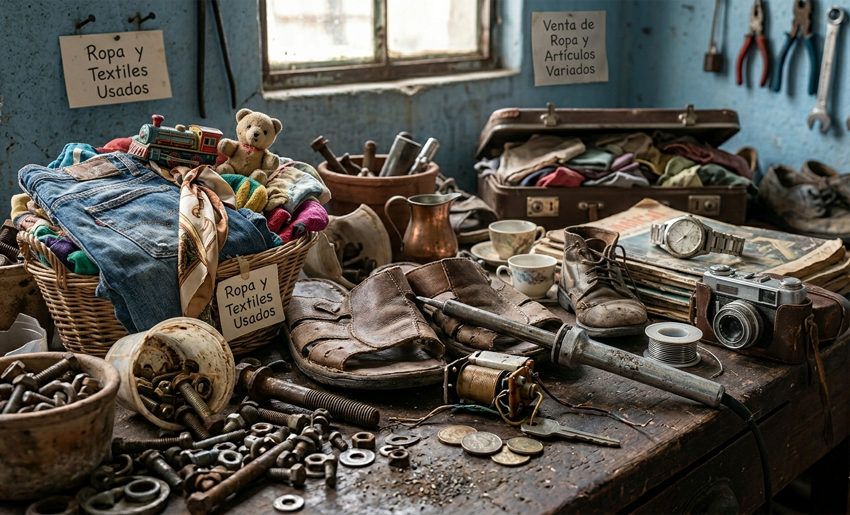
In almost every Holguin home, there’s a drawer, a box, or a corner in the yard dedicated to the seemingly useless. An old screw, a frayed wire, a piece of hose, or a broken switch that “can still handle one more cycle.” The culture of patching things up: Circular Economy or Secondhand Survival?
The phrase “don’t throw it away, it might be useful for something” has become a household mantra. What began as a desperate response to the scarcity of basic goods in Cuba has mutated. Over the years, into an intricate commercial structure: the informal market for secondhand, thirdhand, and even fourthhand items.
If we take a look at local dynamics, the traditional weekend garage sales and the unstoppable flow of buy-and-sell groups on WhatsApp and Facebook are no longer an anomaly. They are the true shopping center of everyday life. There, you can find everything from a pair of shoes that are half worn out to a patched-up voltage regulator.
We’ve gone from occasional need to the institutionalization of a formally informal market. This kind of “circular survival economy” demonstrates the incredible resilience and ingenuity of a society adept at extending the lifespan of things.
Cubans don’t throw things away; they transform, adapt, and inherit. However, this phenomenon hides a profound psychological dimension: the mental strain of living in a perpetual present of makeshift solutions. Where owning something new is a luxury for the few and the norm is living with what’s used, repaired, or discarded by someone else.
Extending the lifespan of an object is an ecological virtue and an act of ingenuity, but when it becomes the only available option, it ceases to be a green alternative and becomes a material limitation.
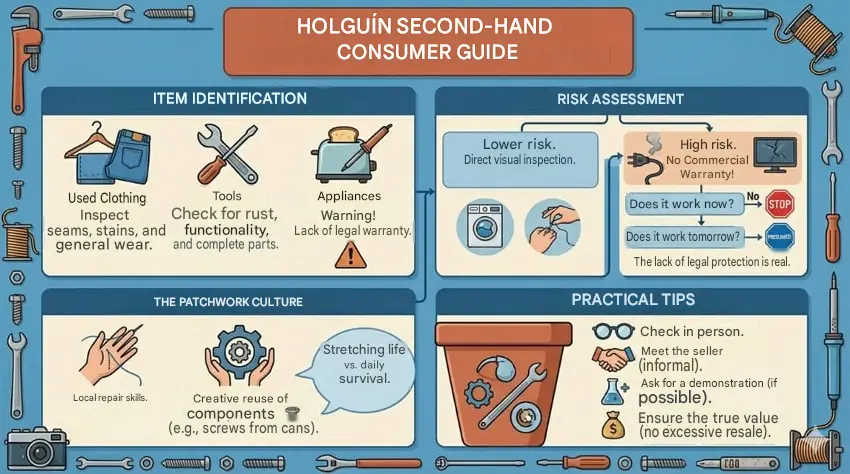
The greatest danger of this unregulated trade lies in the complete lack of legal protection for the consumer. When a citizen painstakingly scrapes together thousands of Cuban pesos to buy a used refrigerator, television, or phone on social media. So they are entering into a blind agreement, based solely on good faith.
If the appliance breaks down after three days, there’s no receipt to hold onto, no consumer protection law to protect them, and no official repair shop to take responsibility for a part that was already patched up. The buyer assumes all the risk, becoming vulnerable to scams or the total loss of their savings in an ecosystem where warranties are nonexistent.
Regulating this scenario is complex, as it operates within the informal sector and the daily grind. But ignoring its shortcomings is not the solution either. As long as state-run stores lack stable and affordable options in Cuban pesos (CUP), and new economic actors remain. Focused on importing high-end products inaccessible to the average wage. Resale platforms will continue to be both the lifeline—and the risk—for the average citizen.
The ingenuity of Holguin residents in making the impossible work deserves applause, but not romanticism. A society cannot advance by focusing solely on what others discard. Patching things up solves today’s problems, it’s true; but tomorrow needs to be built on solid, new foundations with guarantees.
By: Álvaro Raúl Suárez Leyva

- Cuba denounces the impact of the US blockade on its health sector before the BRICS - 23 de July de 2026
- Audiovisual Photography Course Concludes in Telecristal - 23 de July de 2026
- San Rafael Community Hosts Provincial Commemoration of July 26th in Holguin - 23 de July de 2026