
In the heart of Holguin, where the city seems to stand still in front of Las Flores Park, there is a house that never sleeps. It is the headquarters of Tele Cristal, the broadcasting station that for four decades has been the window. Through which the people of Holguin have seen themselves. Laughed with its characters, cried with its tragedies, and celebrated its victories. This April 16th, 2026, it celebrates 40 years with a name that is already an emotional part of the province’s heritage.
But the story began earlier, much earlier. To understand the significance of this anniversary. One must go back to December 5th, 1976, when the first television images filled the airwaves of Holguin.
It wasn’t yet called Tele Cristal. It was just an embryonic dream, taking shape in front of an old bus terminal. With modest equipment and a handful of men and women who believed in the magic of television. Then, ten years later, on April 16th, 1986, that dream received its definitive name: Tele Cristal. Like the mineral that refracts light into a thousand flashes. The television station set out to reflect every nuance of Holguin’s identity.
It was the 1980s, and television in Holguin had its own distinct character. Under the founding vision of Alfonso Bandera—director, actor, screenwriter, and professor at the Higher Institute of Art (ISA)—the television station began to forge its identity. Bandera, who went on to preside over the Artistic Council of Specialties. Understood that television could not be a mere news outlet, but rather a stage where popular culture could find its voice. Alongside him, a group of pioneers—among them announcer Dania González. Who still describes Tele Cristal as “an extension of my home”—began building what would continue to thrive decades later.
It was during this golden age that the programs that are now living history were born. “Video Lux,” under the direction of maestro Francisco Rosabal, revolutionized Cuban music videos and made Holguin a national benchmark.
“Rumores de la Campiña” brought the most genuine humor from our countryside to the city center.
“El Patio de Gabriela” and “Caricare en Clave de 2” transcended provincial borders and found their way into homes throughout the archipelago. And every afternoon, “Holguin de 5 a 6″—or simply “the 5 to 6 show.” As viewers affectionately called it—accompanied the commute home after the workday.
But it wasn’t all magic in front of the cameras. Behind the glass of the Master control room, a woman was breaking barriers. Luisa María Naranjo became the only woman in the country to operate the national broadcast signal from that booth. For more than 40 years—and with the 2021 Small Screen Award to her name—Luisa María has been the technical heart of Tele Cristal. Demonstrating that television can also be made with a woman’s hands and a titan’s heart. Alongside her, names like Jorge Muñoz Leyva and César Hidalgo Torres—recently declared Artists of Merit by the ICRT—have crafted the soundtrack and the perfect words that have accompanied generations of Holguin residents.
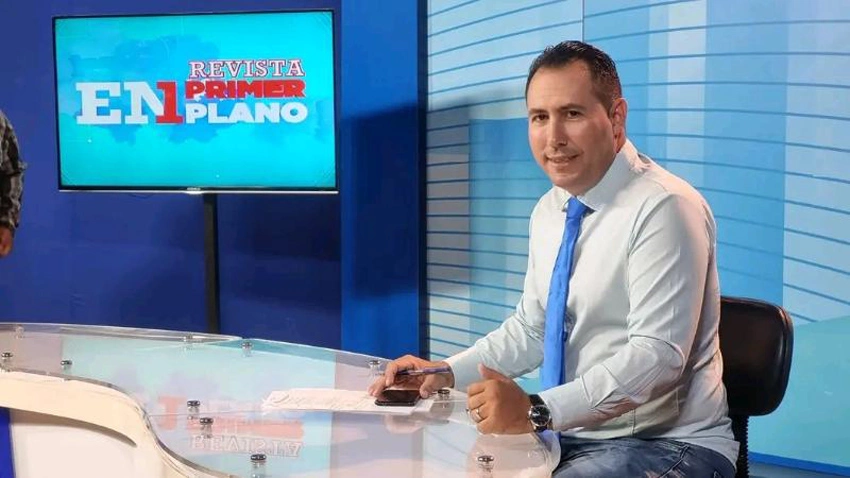
Time passed, and television changed. The 1990s arrived, the Special Period, and adversity became a daily reality. Tele Cristal, like all of Cuba, learned to do more with less. Creativity became commonplace. Holguin’s filmmakers proved that limited resources couldn’t overcome limited talent. It was in this crucible that programs like En Primer Plano (2002) emerged. Revitalizing television journalism in the province. And the programming schedule continued to expand. Always bearing the hallmark of that name that promised refractions of light.
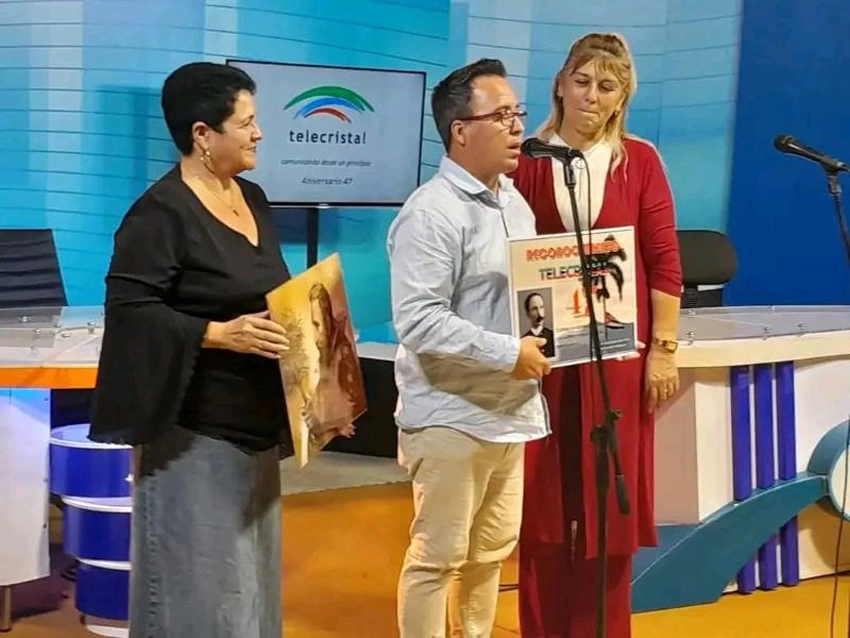
Now, no 40-year history is without generational shifts. The management of the television station has faced its challenges. Many directors have borne the responsibility of keeping television alive in Holguin—whose names deserve to be rescued from the historical record—and who kept the station afloat during complex times. However, it is in the present that Tele Cristal is undergoing one of its boldest transformations. For several years now, the station has been led by Diuvichén Vila Torres. A man who understands that the television of the future cannot ignore sustainability or technology.
Precisely under Vila Torres’s leadership, Tele Cristal has taken a qualitative leap that transcends the artistic realm. Amid Cuba’s complex energy situation. With blackouts and power generation deficits impacting every family—the television station became the first in the country to use renewable energy for its broadcasts.
The project, completed in 2026, installed a 10 kW solar panel module with 7 kW of storage. Implemented by the Pitec Local Development Project in just two days. Vila Torres’s words resonate with legitimate pride: “The process began with an ambitious plan that sought to make Telecristal independent of the national energy grid. We are no longer dependent on the national grid’s energy and are able to broadcast uninterrupted.”
So this achievement, which might seem like a simple technical note, holds profound symbolism. While the country faces challenges in its energy matrix. Telecristal stands as an example of technological sovereignty and foresight. It is not a privilege, its employees insist, but a demonstration that planning and collaboration. With Radiocuba, Etecsa, and local stakeholders—can yield concrete results.
But television is not just technology. Above all, it’s about connection. That’s why Tele Cristal has successfully migrated to the digital realm without losing its essence. Its website—www.telecristal.cu—and social media are now natural extensions of the small screen.
There, journalists like Marel González, Luis Enrique Díaz, Iván Romero, Yordanis Rodríguez Laurencio, María Karla Casaus, Roberto Carlos Rodríguez, Enrique Ajo, and many more. They embrace the challenge of “reaching audiences more closely through the digital platform, with enhanced visuals.” Because the audience is no longer the same as it was in 1986. And Tele Cristal, true to its name, reflects this new light.
Today, as we celebrate four decades since its official launch, the city of Holguin is preparing to celebrate its television station. Not with grand celebrations or million-dollar displays—because modesty is also a form of dignity—but with the sincere affection of those who have grown up seeing their neighbors on screen. Recognizing their streets in the news reports, and being moved by the stories that only Tele Cristal knows how to tell. Because that has perhaps been the television station’s greatest feat: erasing the boundary between television and life, between the control room and the living room of every home.
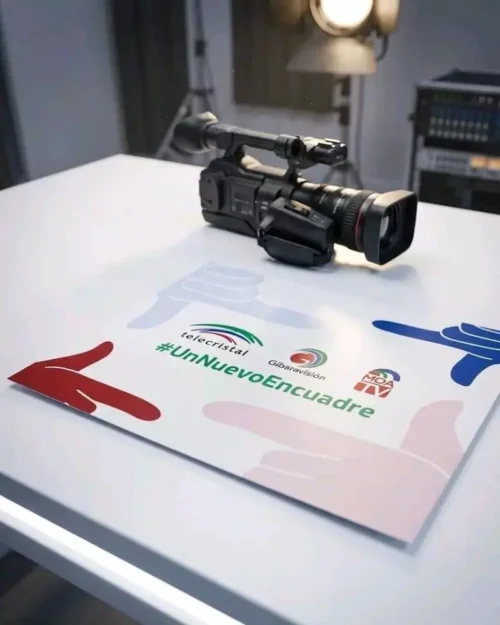
Many chapters remain to be written. The 40th anniversary is not a full stop, but a comma. Tele Cristal will continue communicating from the very beginning. As its slogan says—but that “beginning” is no longer just the origin. It is also the beginning of each day, the first light of morning that ignites with solar energy. And the certainty that, whatever happens, the people of Holguin will have a window open to their own identity. That, ultimately, is television worth watching. That is Tele Cristal.
By: Daimy Peña Guillén

- Progress on Electrical Infrastructure and Renewable Energy Integration in Holguin - 16 de October de 2026
- UHo Debate About New Features of the Draft Education Law - 16 de October de 2026
- When the Countryside Stops Providing Food - 16 de October de 2026