
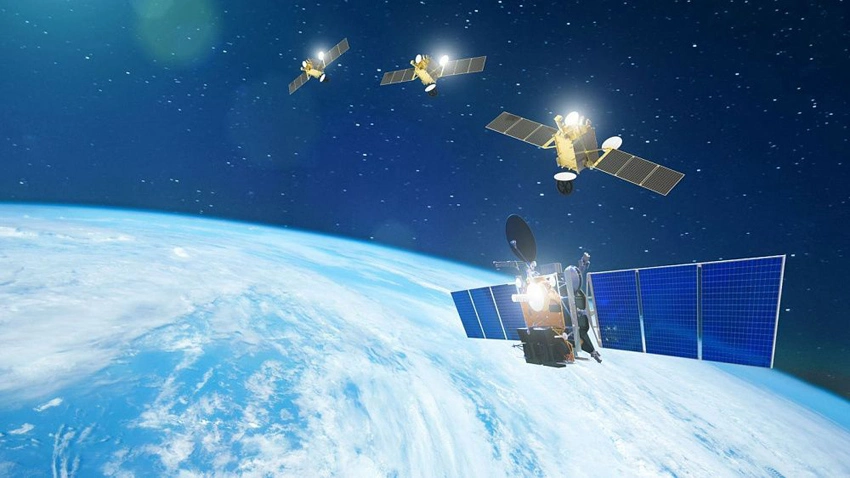
Professor Andrei Baranov of the Peoples’ Friendship University of Russia has developed algorithms that quickly determine a spacecraft’s maneuvering parameters. The multinational channel TVBrics reported Wednesday.
This advancement uses minimal data, requiring only one or two measurements from Earth. It is a particularly relevant development in the context of a growing number of satellites in orbit. Also where every second is crucial to avoiding collisions.
Moreover the innovation allows for near real-time tracking of active satellites. And prediction of the trajectories of so-called space debris, reducing the risk of collisions in orbit.
Currently, it is estimated that around 5,000 maneuverable satellites operate in near-Earth orbits. These constantly modify their trajectories to adjust their position, avoid debris, or perform new tasks.
However, traditional methods require multiple observations and more time. Increasing the risk of dangerous close approaches.
The new approach demonstrates that just one or two brief measurements are enough to calculate the orbit after a maneuver. According to the researcher, the system works similarly to star navigation. So using advanced mathematical models.
Also the algorithm employs a series of measurements lasting only a few seconds or minutes to completely reconstruct the maneuver: when and how the engine was activated. How the orbit changed, and where the object is headed.
Furthermore, the method allows for the estimation of unrecorded perturbations affecting passive objects. Such as rocket stages or large-surface-area fragments. Whose trajectories are difficult to predict with traditional models.
The results have already been tested with real data from geostationary satellites. Showing a margin of error of only fractions of a percent. The method is ready for practical application in space tracking centers.
With information from Prensa Latina

- Healthy Habits Recommended to Prevent Thrombosis - 14 de October de 2026
- Holguin Marks 66th Anniversary of the Nationalization of Cuban Banking - 14 de October de 2026
- Workforces in Holguin mark ANIR event with productive results - 14 de October de 2026