
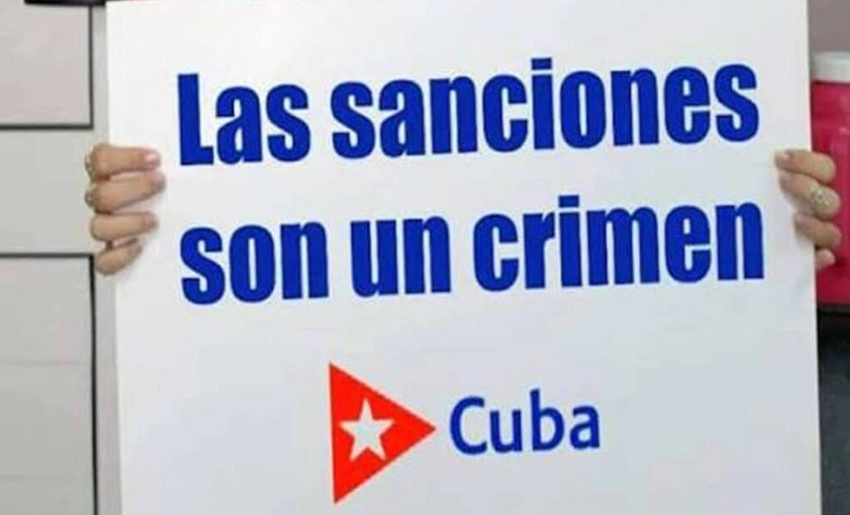
On Thursday, the United States government issued a new set of sanctions against entities and individuals. Adding to its long list of unilateral coercive measures against Cuba. As part of its “maximum pressure” policy toward the island nation.
A State Department fact sheet listed the eight entities targeted, including companies linked to the oil sector. Also as well as two individuals and five vessels involved in fuel transport.
Among the sanctioned Cuban state entities are CUBAELECTRÓNICA. Which handles the import and export of electronic and communications products, and TECNOSIME, a provider of technical and technological services.
The extraterritorial reach of these sanctions extended to two Chinese companies: China National Electronic Import and Export Company (CEIEC) and Beijing H&C Technologies Co., Ltd.
Moreover the announced measures are implemented under Executive Order 14404, signed by President Donald Trump on May 1st. This order authorizes the imposition of restrictions on individuals and organizations. That, in Washington’s view, pose a threat to U.S. national security.
Concurrently, the Department of the Treasury expanded the scope of secondary sanctions. Authorizing measures against foreign nationals who operate or have operated. Within the manufacturing, technology, electronics, or maritime sectors of the Cuban economy.
Secretary of State Marco Rubio justified this tightening of the blockade against Cuba. By claiming that the measures are not directed at the Cuban people, but rather at the country’s elites.
During his address on October 28th at the UN General Assembly, ahead of the vote on a Cuban resolution calling for the lifting of the blockade. Which received majority support from the international community. The Foreign Minister denounced the collective punishment represented by this unilateral siege.
The blockade on fuel is tantamount to a naval blockade. “It is an act of war, an act of collective punishment, and an act of genocide. All prohibited under international law,” Rodríguez emphasized.
Its severe consequences fall upon individuals, limiting their fundamental human rights, affecting third-party countries. Turning the essential needs of the population into instruments of political coercion, he added.
Its effects—he noted—are felt at the tables of Cuban families, at the bedside of the sick, during childbirth or in the operating room. In the food and classrooms of children, in the lack of electricity, potable water, and medicine. And in the prices of goods essential for life.
“Cuba is not a threat! The blockade is!” declared the head of the Cuban delegation at the annual review session held at the UN headquarters in New York.
In the first half of this year, only one ship carrying 100,000 tons of crude oil arrived in Cuba as humanitarian aid from Russia. Leaving a shortfall of 2,667,800 tons of fuel compared to what had been planned.
Furthermore, the national surgical waiting list has reached 100,000 patients, 12,000 of whom are children.
With information from Prensa Latina

- Hemodialysis Guaranteed for Mayari Patients Through Alternative Transport Arrangements - 6 de November de 2026
- State Department Announces New Unilateral Coercive Measures Against Cuba - 6 de November de 2026
- Lugdis Pineda Takes on New Challenge with Cuban National Baseball Team - 5 de November de 2026