
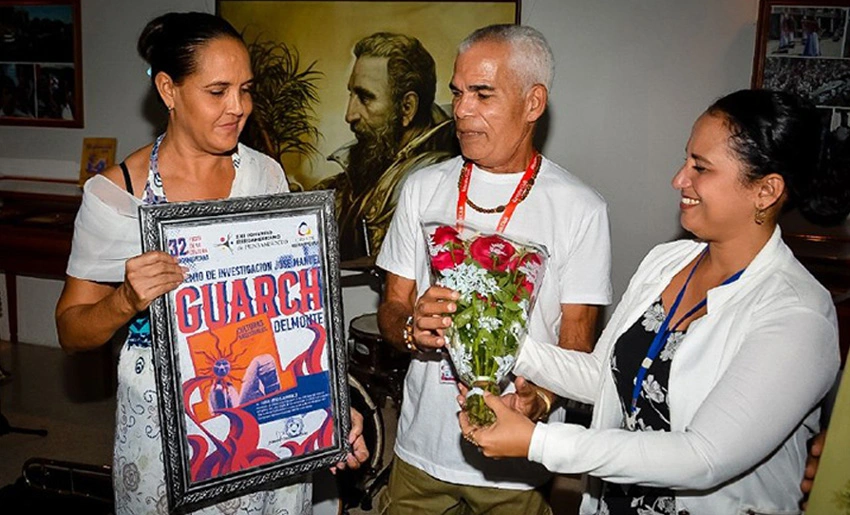
Historian Nuvia Artigas Almarales received the 2026 José Manuel Guarch Delmonte Award in this eastern city today. For her research on scientific racism within 19th-century Cuban anthropology.
The 32nd Ibero-American Culture Festival solidified this city in eastern Cuba as an epicenter for regional intellectual debate. By hosting the theoretical sessions of the Ibero-American Congress of Thought. This year’s edition focused on examining colonial legacies, identity-formation processes, and the contemporary challenges facing the Global South.
During a ceremony held in the “Revolution” hall of the La Periquera Provincial Museum. The event recognized outstanding research aimed at recovering historical memory. Promoting gender equity, and exploring the sociocultural roots of Latin America and the Caribbean.
The top honor, the 2026 José Manuel Guarch Delmonte Award, was presented to historian Nuvia Artigas Almarales for her rigorous study. *A Racism with a Scientific Veneer: Modernity in Institutionalized Cuban Anthropological Thought (Second Half of the 19th Century)*.
Also the research uncovers how certain academic currents of the era legitimized racial hierarchies under a false guise of scientific objectivity. A phenomenon with profound implications for the critical analysis of the Americas’ past.
Meanwhile, the “Ibero-America in Us” Award was granted to Cosme Casals Corella for his inquiry, “Caridad Rodríguez Cullel and Elena Guarch Rodríguez. “Two Women in the Annals of Cuban Archaeology.” This work highlights and validates the contributions of women to a discipline that has traditionally been sidelined in narratives dominated by a male-centric perspective.
The jury composed of Doctors of Science Ana Cristina Castro Fuentes, José Fernando Novoa Betancourt, and Leidiedis Góngora Cruz. Also granted honorable mentions to proposals with significant pedagogical and social impact. Notable among these were the work *Aboriginal Communities That Inhabited the Historical Region of Cárdenas*, by Ernesto Aramis Álvarez Blanco (from Matanzas). As well as a methodology developed by Jhoannis Jacinto Rodríguez Avalos. On the use of journalistic texts to foster critical thinking in the teaching of Contemporary World History at the pre-university level.
Beyond the presentation of awards, this Ibero-American gathering reaffirms its pluralistic commitment by connecting the academic work. Carried out within the archipelago to issues shared across the region. Such as decolonization, Indigenous memory, and social justice.
For Holguin the permanent host of this cultural event, the gathering serves as a driving force for scientific and artistic life. Showcasing on the international stage the results of research. Conducted within Cuban institutions that advocate for regional integration and the defense of regional identity.
By: Daimy Peña Guillén

- Historical Research Honored with the Guarch Delmonte Award - 27 de October de 2026
- Holguin’s Firefighters Approach Their 330th Anniversary - 27 de October de 2026
- United Nations: U.S. Blockade Against Cuba Under Review Again - 27 de October de 2026