
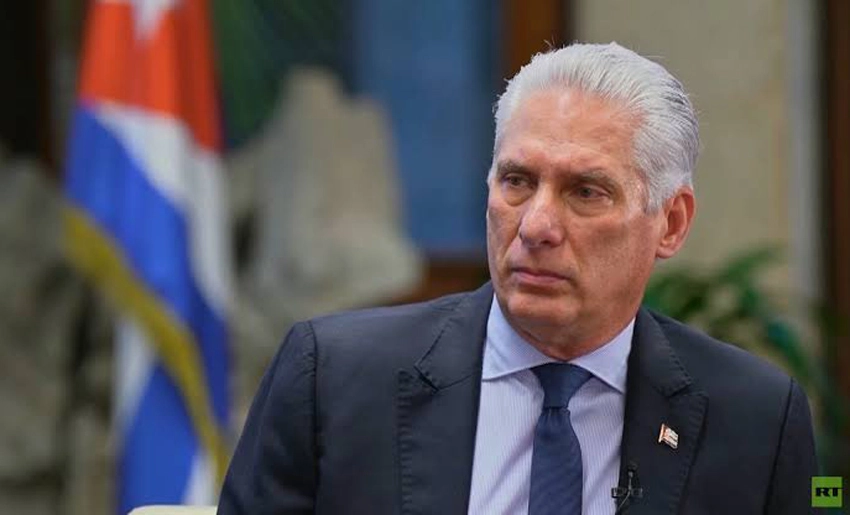
Cuban President Miguel Díaz-Canel gave an interview to RT, in which he discussed the changes that must occur in the island’s economy to prosper amidst the US embargo. Why dialogue is important, and how to counter the “deceptive” agenda of Western media.
Urgency of Transformations
“I would say that the transformations we want to undertake, that we want to implement, that we have announced, were essential transformations. They had to be done, they had to be done even if we weren’t living in this context. Because their purpose is to perfect the construction of socialism in our country,” the president explained.
According to him, some changes had been postponed because “they carry risks, they involve challenges.” And much work still needs to be done “to ensure they are better understood.” Furthermore, there are modifications that must be approved in “an extremely complex context. Where there is a hegemonic drive on the part of the United States government, which is trying to crush multilateralism. Which uses force as a means to resolve conflicts, and which is also leading the world toward a course of action that disrespects international law and the Charter of the United Nations.”
“Today, we are not only experiencing the traditional blockade that we have withstood for more than 66 years, but we are also experiencing its intensification. Which was the defining characteristic of the Trump Administration during its first term. Now we have the combined effects of both of these periods and, in addition to that, an energy blockade. It is a policy of maximum suffocation, of maximum pressure. Solely aimed at breaking the will of the State. They are applying collective punishment against the Cuban population.” It is an expression of genocide and crime.”
In this regard, Díaz-Canel expressed his conviction that “at some point, those who have orchestrated this policy against Cuba will have to answer internationally for the crime and genocide they have perpetrated.” “And we must act, we must act, we must act with a sense of urgency, with a sense of responsibility, and also with great composure,” he urged.
“Collective punishment”
The president emphasized the importance of a fair debate in the face of the challenges the country is experiencing.
“The thing is, we have to be realistic about the moment we are living in, with all the complexity I was explaining to you. It’s been six months since a fuel ship arrived; only one Russian ship has come.”
“Here [the Americans] have put so much pressure on foreign companies that a significant portion of them have withdrawn from the country. Today, our economic, productive, and service processes have deteriorated considerably as part of this collective punishment. So we face a great dilemma that we must be able to resolve,” he explained.
The head of state indicated that Cuba continues its socialist construction, “not only to resist, but to advance.” While subjected to the “longest-lasting blockade ever imposed by the world’s most powerful nation, now compounded by an energy blockade.”
What is the essence of the transformations?
The president also explained the nature of the planned modifications. “What is the essence of the transformations we are proposing? Well, that these transformations unleash the productive forces. And that by unleashing the productive forces we create wealth, and that we are able to distribute that wealth with social justice,” he emphasized.
“We believe that by the end of July we will be in a position to begin implementing 121 of those 170-plus transformations,” he promised. Adding that the first of these will be “aimed at vulnerable people, retirees, and those with lower incomes.”
“We are going to start working, we are going to correct what goes wrong. We are going to expand on what goes right, and we are going to assimilate any new proposals.”
The U.S. cannot limit Cuba’s capacity for action.
Oliver Zamora also recalled, during the conversation, that “the United States is doing everything possible to drive investors out of Cuba.” In this regard, he asked what chances of success the Cuban transformations would have in this context.
Díaz-Canel gave a resounding answer: the blockades cannot limit Havana’s capacity for action. Nor can its internal policies be subordinated to what Washington wants to impose as collective punishment. “It’s true that they are trying to discourage investment in Cuba, but investment markets and the interest in investing in Cuba aren’t just in the United States. They exist in other regions of the world,” the president emphasized.
“Unfortunately, we don’t talk about these things publicly because there is a truly aggressive persecution of anyone who has or wants to do business with Cuba. […] There are many people, many companies, many entities that are interested in working with Cuba and are willing not to submit to the dictates of a nation that believes itself to be the empire that can rule the world.”
“We have every right, regardless of this intensified blockade, to have the opportunity to buy fuel in the world, just like any other country in the world. We have the right to trade with other parts of the world. We have the right to invest,” he specified.
The leader reiterated that it is always necessary to pay attention to the conditions under which Cuba tries to continue its development. “The thing is, no one has ever had to build socialism. I insist, under the conditions that Cuba has faced. More than 60 years with the longest blockade in history. But it is a blockade, what kind of blockade? Economic, commercial, and financial. Who has imposed it? The most powerful nation in the world, which also controls world trade and global finance. Therefore, we are not talking about just any blockade. And, in addition to that, they have now intensified it,” the president stated.
“Neither a copy nor a mere imitation”
Díaz-Canel also commented on what Cuba is doing: whether it is forging its own path or copying models from other countries. “We have a regular annual exchange of experiences between our communist parties. With the Communist Party of China, with the Communist Party of Vietnam, analyzing how we are carrying out the processes of social construction,” he said.
But, at the same time, Havana is building its own model because its specific historical conditions “are different.” “China and Vietnam, when they began their reforms years ago, were not under blockade. At one point, they even received most-favored-nation status from the United States,” he stated. “Therefore, neither a copy nor a mere imitation. Heroic creation is what we must do,” he expressed.
Why is dialogue with the U.S. important?
The Cuban president explained why the island maintains a channel of dialogue with the United States and whether it is worthwhile to continue these contacts.
“We have to return to historical references.” The Revolution has always advocated finding solutions to bilateral differences between Cuba and the United States through dialogue. “I am convinced that we will always have ideological differences. But I am also convinced that it is possible to find areas and spaces where we can build cooperation that benefits both our peoples. And helps guarantee peace and stability for both nations and the Latin American region,” he stated.
In this regard, he specified that confrontation “is not what the people of both nations deserve.” “I believe we can establish a civilized relationship between neighbors. Regardless of our differences, but it must be on a basis of respect and equality. Where nothing is conditional, and where, of course, the issues of our political system, our self-determination, our independence, and our sovereignty are not up for debate,” he stated.
“Because we have always maintained—Fidel [Castro] taught us this, as did the Army General—that dialogue is the path to peace, and peace is the prerequisite for achieving stability. For moving forward, for a better world and that is why we defend dialogue.”
Díaz-Canel maintained that, nevertheless, “dialogue is very difficult under these circumstances. When there is a power that constantly assumes the role of aggressor” and “has historically failed to honor its commitments.”
According to him, the U.S. now employs “a high level of threatening rhetoric,” speaks of possible military aggression. And uses “very perverse practices to continue tightening this collective punishment and this siege” on Cuba.
Now, the president denounced, Washington has invented another pretext to convince the world that this aggression against the island is necessary. It accuses Havana of financing and creating “a platform for left-wing political terrorism.” “The world knows that we are a country of peace, that is why we defend peace, that is why we defend dialogue. So that is why even in such difficult circumstances, but from a position of principle, we seek to advance dialogue,” Díaz-Canel stated. Adding that the island does not want war because it would be “a bloodbath that would bring terrible consequences for both nations,” both Cuba and the United States.
“Supremacist” and “Deceitful” Media Narrative
Expanding on the topic of US aggression, the president denounced the “supremacist, capitalist, and imperialist” media narrative. With which Washington tries to conceal its culpability in the challenges facing the island.
“I always characterize the multidimensional aggression that the United States government is currently waging against Cuba as having an ideological component. A cultural component, and a media component,” the president stated.
“Ideologically, they are trying to impose a hegemonic way of thinking on us. Culturally, they are trying to erase our identity. […] And all of this is being supported by the media with a massive supremacist, capitalist, and imperialist political communication strategy. Which has a very high component of media manipulation. Very slanderous, very deceitful,” he added. In this regard, Díaz-Canel stated: “We’ve seen this not only in the case of Cuba, but throughout the world.” “They did it to manipulate the situation in Venezuela, they did it to justify the war against Iran,” he warned.
“I believe that as perverse as the prolonged blockade is, so too is the disrespectful and cynical way in which the United States government accompanies this prolongation. With a narrative that tries to conceal its culpability and focuses it on the concept of these failed states. How it tries to exaggerate all the problems Cuba is experiencing without acknowledging why it is the cause of those problems,” he criticized.
At the end of the interview, Oliver Zamora thanked the Cuban president for once again dedicating a few minutes to RT “in such difficult times.” “We always follow you, always, when we want clarity amidst so many lies being told in the world,” Díaz-Canel responded.
With information from RT en Español

- U.S. Dermatologists Develop an Oral Pill for Hair Loss in Men - 21 de October de 2026
- Cuban Foreign Minister Denounces U.S. Pressure Regarding Votes Against the Blockade - 21 de October de 2026
- Second Phase of the “Sowing Life” Project Launched in Holguin in Cooperation with Mexico - 21 de October de 2026