
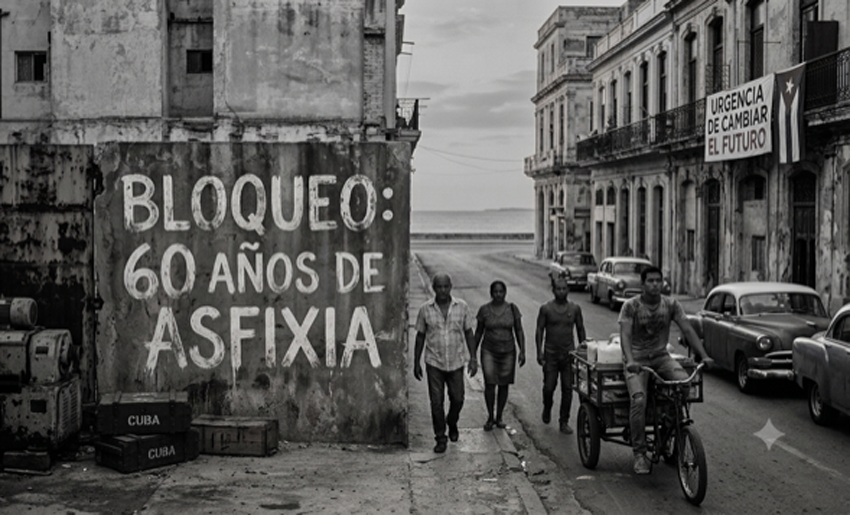
For some time now, uncertainty about Cuba’s future has become a constant concern among those of us who live on the island. This is not an isolated perception: the deterioration affecting multiple sectors creates a complex scenario. A kind of polycrisis that many interpret as a path toward collapse. Frequently attributed to the policies of the United States government. Faced with this situation, a familiar reaction immediately arises: how long will the blockade continue to be blamed?
The question is not new, but neither is the reality that underlies it. For more than six decades, Cuba has lived under external pressure. Marked by sanctions, surveillance, and an international narrative that attempts to standardize the world according to its own definition of human rights.
In this context, the effects of a sustained confrontation are also reflected on a symbolic level. In certain sectors, there is a sense of shame regarding national identity. With people who disown their own history and idealize foreign models. Even imagining a transformation of the country under schemes completely alien to its own trajectory.
However, any honest analysis demands recognizing that the history of Cuba and that of the United States have been inextricably intertwined. One cannot be understood without the other.
Now, looking outward cannot become an excuse to ignore what is happening within the country. Internal problems exist and require responsible attention. It is not enough to appeal to history; it is essential to critically examine it. Acknowledge mistakes, and avoid the inertia of justifying everything.
Now, a reflection by Eusebio Leal comes to mind: great figures cast great shadows. This idea invites us to question the tendency to idealize leaders without subjecting them to the scrutiny of their results.
This is a time that demands critical thinking, the capacity for questioning. A citizenry less complacent with those who live off the backs of the nation.
In parallel, new power dynamics are emerging within Cuban society. This phenomenon stems from a natural law of society and of the species: the connection between economic and political power. For a political culture like ours, formed on different principles. Also this is a particularly significant blow to those who built this national project.
The truth is that change seems inevitable. Nothing that remains static survives the passage of time. In this process, the people have not only the possibility. But also the right, to rectify, to redefine their course, and to seek their own answers. Even so, the conviction persists that Cuba is moving forward, albeit not without tensions.
Amid this scenario, an essential question arises: Is the Cuban government responding to the interests of its people?
Perhaps one of the most eloquent responses was offered by Eusebio Leal himself in an interview with Salim Lamrani twelve years ago:
“We would be the vilest, most cowardly, most mediocre people on earth to submit to a five-decade tyranny without rebelling. Our people rose up on numerous occasions for over a hundred years (…). Therefore, this people is capable of becoming enraged, of taking up arms, and of fighting for its own path. We are a people of passions.”
Perhaps the greatest contradiction is not choosing between the past and change. But finding a way for that change not to renounce dignity or collective memory.
Cuba is not starting from scratch, nor can it afford to simply copy foreign models without any mediation. Its path, inevitably, will have to be its own, built on critique, participation, and shared responsibility. Because if the history of this country has shown anything. It’s that its people don’t remain passive in the face of uncertainty: they confront it, discuss it, and, when the time comes, transform it.
By: Miguel David Bruzón Hernández

- When Screens Sell the Wrong Path - 18 de October de 2026
- Russia Delivers 750 Tons of Vegetable Oil to Cuba - 17 de October de 2026
- Neurotic Anonymous Shows That Cinema in Cuba Is Alive and Shining - 17 de October de 2026