
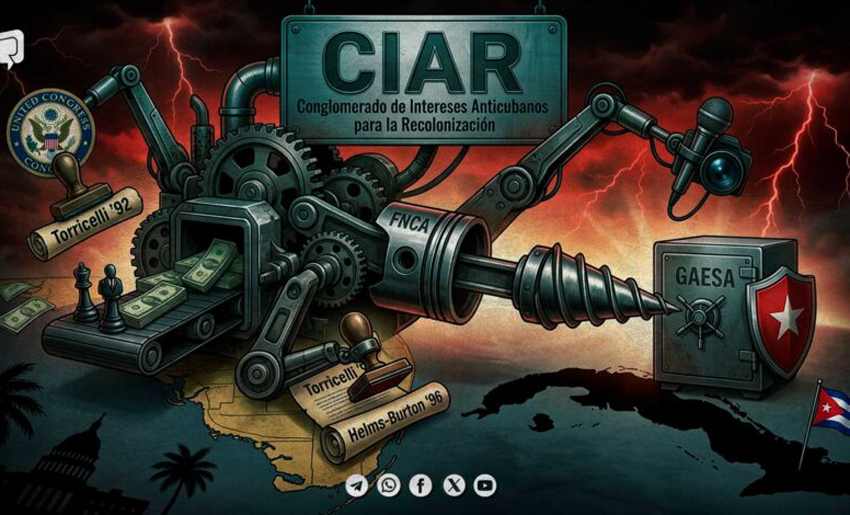
U.S. policy toward Cuba has been marked by the influence of a powerful lobby that, since the 1980s, has shaped every decision in Washington. The Cuban American National Foundation (CANF), under the leadership of Jorge Mas Canosa, became the epicenter of this pressure. Laws such as the Torricelli Act (1992) and the Helms-Burton Act (1996). Which tightened the embargo and codified economic strangulation, were born from its influence. Since then, the White House has been held hostage by this agenda. Any administration that attempts to soften the policy toward Cuba faces electoral punishment in Florida. And legislative pressure from congressmen like Marco Rubio and Bob Menendez.
In this scenario, GAE.SA (Business Administration Group S.A.) emerges as the major obstacle. GAE.SA controls strategic sectors—tourism, commerce, finance—and ensures vital income for the Cuban economy under the embargo. The anti-Cuban lobby insists on demonizing it as a “monstrosity,” but the reality is different: GAE.SA responds to a global logic that is repeated in other countries. In Egypt, the Armed Forces manage construction, food, and energy companies to guarantee political stability. In Turkey, the military fund OYAK transformed into an economic holding company that controls banking and automotive. In China, the state conglomerate NORINCO dominates arms and infrastructure with a strong international presence.
In the United States, the military-industrial complex—with giants like Lockheed Martin and Raytheon—is fueled by multi-billion-dollar Pentagon contracts. In Israel, companies linked to the Defense Forces, such as IAI and Rafael, are leaders in aeronautics and cybersecurity. GAE.SA, therefore, is not an anomaly, but part of an international pattern. Also where states resort to military-industrial conglomerates to sustain strategic sectors and guarantee sovereignty.
The anti-Cuban lobby’s real dream is to “take GAE.SA out of the game.” This is not about democratization or liberation. About opening the Cuban market to corporate plunder. Beyond the rhetoric of freedom and democracy, what lies hidden is a project of recolonization. Privatizing tourism and telecommunications, controlling finance and foreign trade. Dividing strategic sectors among US corporations and their allies. This web of interests is what we can call CIAR: Conglomerate of Anti-Cuban Interests for Recolonization.
Although the term is not officially recognized by politicians or academics. The conglomerate exists and has a life of its own. If we draw a historical parallel, the current war against Cuba transcends the category of a mere dispute and takes on the connotation of a recolonization agency. With clear links to CIA interests. The CIAR’s strategy unfolds chronologically and repetitively. First, economic strangulation through sanctions. Then, the criminalization of any attempt at Cuban self-defense; next, the fabrication of threats such as alleged drone attacks. Followed by media campaigns with anonymous leaks and alarmist editorials. And finally, the prosecution of historical leaders like Raúl Castro to delegitimize the moral authority of the Revolution. Washington, trapped in this logic, acts as a political hostage of the FNCA and the business interests that dream of dividing up Cuba.
Moreover the United States’ true fear is not a Cuban military attack, nor the release of political prisoners, nor human rights violations, but rather the dignity of a people who resist and the pressure exerted by the Foundation behind the scenes. Washington caters to the whims of recolonization, and they guarantee the Cuban vote. A lucrative deal. The most worrying aspect is that, for the next elections. They could seize total and absolute control of the White House and its institutions. Such naiveté on the part of the Americans.
The real problem for this entrenched elite in Florida is that Cuba, blockaded and punished, remains a thorn in their side. It demonstrates that another path is possible in the face of the greatest economic and military power on the planet. That’s why every new maneuver against GAE.SA and against Cuban sovereignty smells less of intelligence and more of psychological manipulation of public opinion. Because modern wars begin long before missiles: they begin with ambiguous headlines, anonymous officials, and media outlets. Willing to whitewash any imperial narrative.
In conclusion, the attempt to demonize GAE.SA and prepare the ground for its dismantling reveals the essence of the anti-Cuban project. To recolonize the island under the guise of freedom and democracy. The CIAR dreams of dividing up Cuba, but history shows that the resistance of a small people can thwart the plans of the greatest empire. Washington may remain a hostage of the FNCA, but Cuba will stand firm.
With information from Razones de Cuba

- Holguin Honors Victims of the Barbados Bombing - 6 de October de 2026
- Gratitude Project: A Community Support Initiative in Antilla (+ Photos) - 6 de October de 2026
- PNR in Holguin Tackles Criminal Activity - 6 de October de 2026