
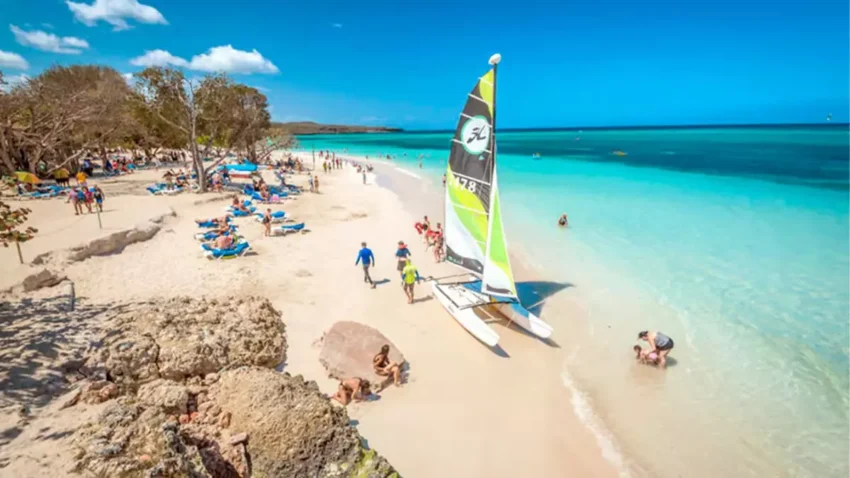
Tourism has historically been the beating heart of the Cuban economy. The “locomotive” meant to pull the rest of the sectors along. However, at the close of the first two months of 2016. Also the indicators showed not only a slowdown, but a contraction that demands a detailed analysis.
Today, Cuba is not only competing against the Caribbean’s paradisiacal destinations. Against its own structural limitations and a socioeconomic context that weighs heavily on the “smokeless industry.”
Recent statistics, provided by the National Office of Information and Statistics (ONEI), reveal this difficult moment. Through February 2026, the country received a total of 363,649 travelers. A figure representing only 73.1 percent of the number reached during the same period in 2025.
In net terms, this means that 134,080 fewer people entered the country compared to the previous year. If we focus on the segment of international visitors who generate foreign currency. The picture is even more complex: 262,496 visitors were registered. Equivalent to a decrease of 112,642 tourists compared to 2025.
What lies behind this decline? It cannot be ignored that tourism is a sensitive sector. Unstable electricity supply, rampant inflation, and logistical difficulties create a gap. So between the legendary hospitality of Cubans and the standards that travelers demand.
This energy crisis is even disrupting air travel. The reduction in flight frequencies from key source markets. It has directly impacted the flow of travelers to different destinations within the country.
Iberia, to cite the most recent example, announced the gradual suspension of its flights to the archipelago. With a complete cessation of operations scheduled for June. Although they plan to resume the route in November, this decision is contingent on the situation “improving.” A significant blow to connectivity with the European market.
But behind the ONEI figures and the airline announcements. There is an even more complex reality being experienced on the ground. This decline is not just a macroeconomic problem or a matter of state balance sheets. It is a crisis that deeply affects the individual economies of thousands of Cubans.
We are talking about entire families that depend on the flow of tourism. From hotel workers who see their jobs threatened. Also to owners of small businesses, hostels, and other ventures that today face empty hallways and tables without customers.
In this scenario, Holguin, the country’s third-largest tourist destination, presents itself as a paradoxical case study. On the one hand, the province continues to invest in infrastructure development. Projects on the Ramón de Antilla peninsula continue to add rooms to an already robust hotel infrastructure in areas like Guardalavaca and Playa Pesquero.
However, a sad reality for some time now is that investment in construction in the province. It seems to be progressing at a different pace than market development.
The gap between installed capacity and actual occupancy is widening. While the lack of integration with local producers limits the possibility of offering sustainable gastronomy without relying on imports.
Ensuring stability and efficient management—a complex task that doesn’t depend entirely on the country’s internal administration. It is vital for the sector’s survival and for Cuba and Holguin to once again become not just a sun and beach retreat. A multicultural destination where the industry’s well-being ultimately translates into well-being for its people.
By: Leannis Berbén Leyva

- Russia registers Cuban medicine for tumor treatment - 20 de October de 2026
- Visual Arts Exhibition Honors Fidel in Holguin - 20 de October de 2026
- Holguin Electric Utility Takes On Transformer Repairs - 20 de October de 2026