
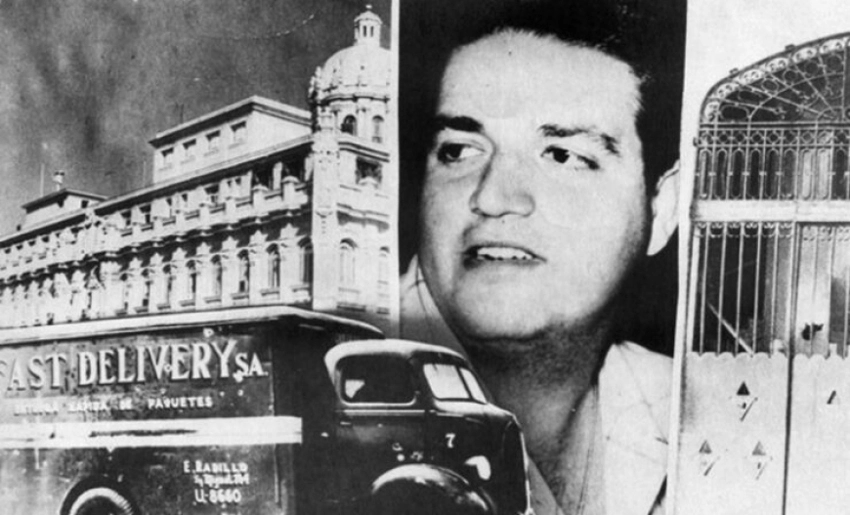
On March 13th, 1957, Havana echoed with the explosion of a heroic struggle. Amidst gunpowder and young blood, with the certainty that history is not written only in ink, but with the pulse of those willing to die for it. On that day, José Antonio Echeverría fell, and with his death, not just a generation died: a symbol was born.
At 24, an architecture student and president of the Federation of University Students (FEU). He embodied that youth that refuses to merely observe. In a Cuba living under Batista’s dictatorship, he understood that denunciation without action becomes complicit in silence. Therefore, together with his comrades in the Revolutionary Directorate. So he planned an operation as audacious as it was risky: to storm the Presidential Palace and bring the tyrant to justice.
That day, a group of armed young people stormed the Palace gates. The crossfire shook the pillars of power. José Antonio, meanwhile, was fulfilling another crucial mission: to seize Radio Reloj.
From the most listened-to radio station in the country. His voice was heard in every corner of the island: “People of Cuba! At this moment, the dictator Fulgencio Batista has just been revolutionaryly executed. In his own den, the Presidential Palace, the people of Cuba have gone to settle accounts with him. And it is we, the Revolutionary Directorate, who in the name of the Cuban Revolution have delivered the coup de grâce to this oppressive regime (…).”
That message, which lasted barely minutes, was the spark that ignited hope. But the dictatorship responded with its full repressive apparatus. As he left the radio station, on his way to the University of Havana. The car he was traveling in was intercepted by another vehicle on the side of the university grounds. A firefight ensued, and a burst of machine-gun fire ended his life.
That same afternoon, other young men also fell: José Machado, Juan Pedro Carbó Serviá, Fructuoso Rodríguez, Joe Westbrook. All students, all with their whole lives ahead of them, all convinced that freedom is won with courage.
For young Cubans, José Antonio is not a photograph in a textbook. He is a mirror in which to see themselves when discouragement weighs heavily or comfort tempts them to look the other way. In times when noise is sometimes mistaken for struggle. His example reminds us that true commitment hurts, but it also transforms. He lives on in every young person who studies to be useful, who raises their voice against injustice. In every university student who understands that knowledge without conscience is sterile.
For Cuba, this date is a reminder that the dignity of a people is measured by the capacity of its children to give everything for it. He, with his pure smile, continues to walk the halls of the University of Havana. Also he remains present on every corner of the city that saw him born and die.
José Antonio Echeverría didn’t die on March 13th. That day, he simply became eternal. And his example, like a flame that never goes out, continues to illuminate the path of those who believe that youth. When it is authentic, does not pass through life without leaving its mark.
- Holguin to Host Provincial “Pedagogy 2027” Event - 22 de October de 2026
- UHo Launches Doctoral School as Part of the International CRISS Project - 15 de October de 2026
- New Holguin schoolchildren join the OPJM (+ Photos) - 8 de October de 2026