
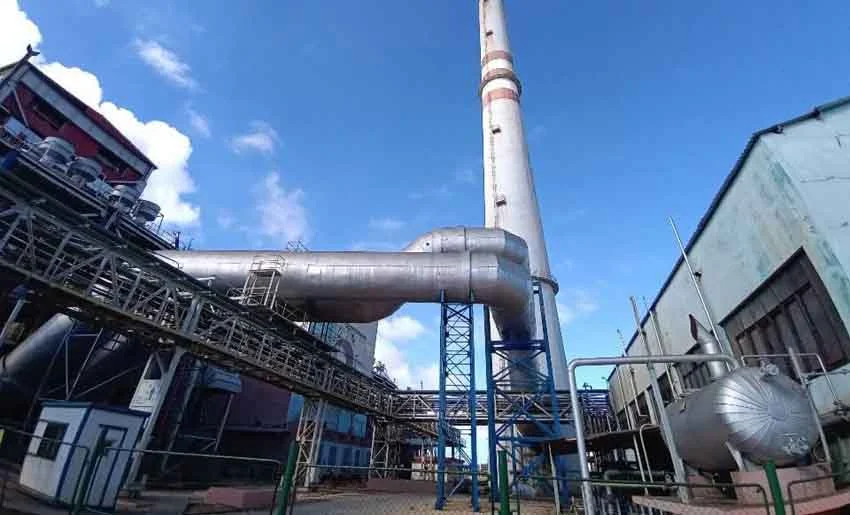
The Lidio Ramón Pérez thermal power plant, located in the town of Felton—within the Mayarí municipality of Holguín province. It maintains a quality management system certified under the Cuban standard NC-ISO 9001.
Among its primary corrective actions are those aimed at eliminating ozone-depleting substances. Explained engineer Tania Hernández Gálvez, a specialist with the entity’s Management Systems Group.
Hernández clarified that fossil-fuel power plants do not directly emit substances that destroy the ozone layer. Such as the chlorofluorocarbons (CFCs) regulated by the Montreal Protocol (1987), which entered into force in 1989 during their combustion process.
However, Hernández noted that these plants do emit precursor gases that affect air quality and contribute to the formation of ozone-depleting substances at ground level. Furthermore, their operation involves other practices that have an indirect impact.
Meanwhile, engineer Yaimara Vargas Piñero, a specialist in science, technology, and the environment, highlighted that, in order to comply with the provisions set forth in relevant resolutions. An inventory of all climate-control (HVAC) equipment was conducted. Working alongside refrigeration technicians, the team identified units that contained ozone-depleting substances.
Subsequently, a voluntary commitment was made to gradually phase out this equipment, with the goal of replacing it. A schedule was also established for transitioning to units that use eco-friendly refrigerant gases.
Vargas added that, during the rehabilitation of unit number one, burners that emit low levels of nitrogen oxide were installed. Adjustments and optimization procedures for the boiler are carried out during both startup and daily operations.
Plant maintenance protocols require the proper handling of equipment containing substances regulated under the Montreal Protocol. To this end, measures were taken to eliminate ozone-depleting substances, in compliance with Resolution 126 of 2012.
Adherence to these measures earned the organization both provincial and national awards. Granted by the Ministry of Science, Technology and Environment (CITMA) recognizing it as an entity free from ozone-depleting substances.
Each piece of equipment replaced, every adjustment made to the boiler, and every voluntary commitment represent concrete steps taken by an industry that embraces its responsibility toward the environment.

- Measures Strengthened at Felton Thermal Power Plant to Protect the Ozone Layer - 24 de November de 2026
- “QR Code “: An Open Door to Exchange - 16 de November de 2026
- Holguin Seeks Energy Alternatives in the Face of Climate Change - 13 de November de 2026