

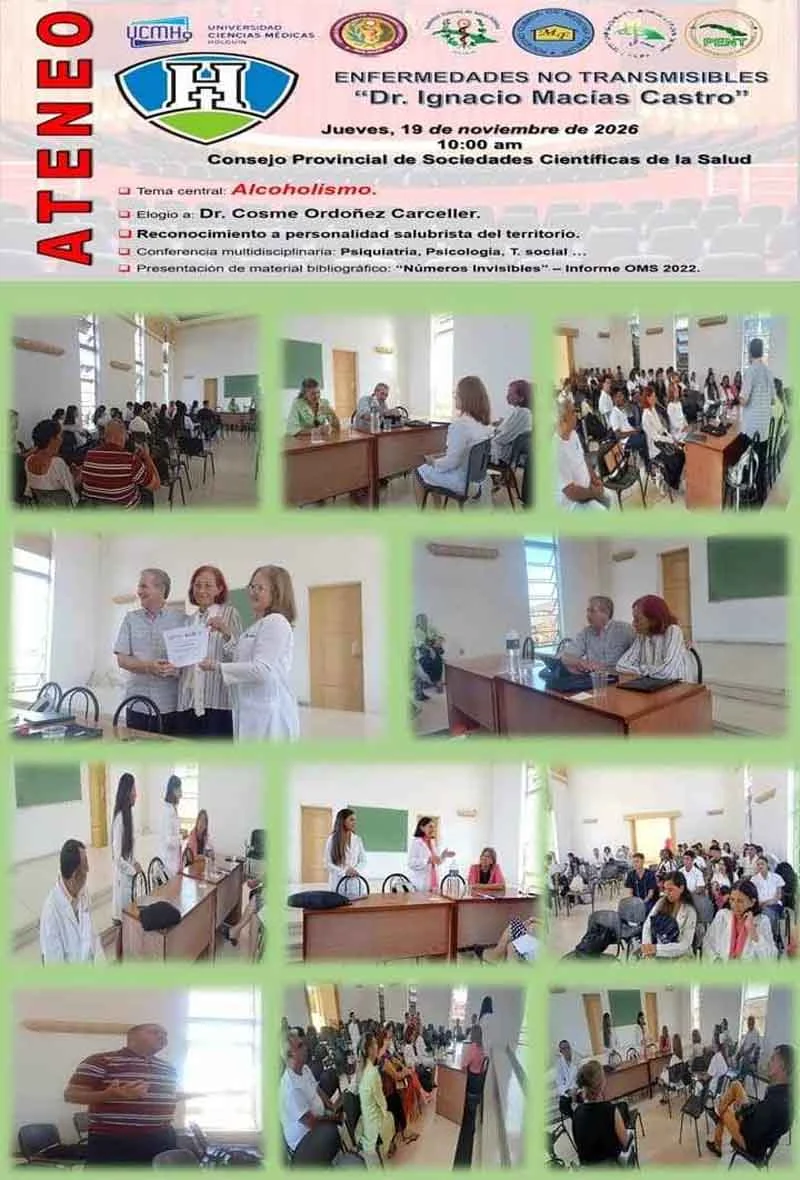
Key issues regarding the medical, familial, and social impact of alcoholism were examined at the “Ignacio Macías Castro” Athenaeum on Chronic Non-Communicable Diseases. The forum brought together health specialists and medical science students at its regular venue: the Provincial Council of Scientific Health Societies, located in the provincial capital.
Many people view having an extra drink at a party, or a regular glass of alcohol to “relieve stress” after work, as nothing more than a common social habit. Yet, behind this behavior—so normalized within Caribbean culture. It lies one of the most insidious gateways to a scourge that is increasingly taking hold in modern life.
Health specialists in Holguín addressed this very issue during the most recent session of the Provincial Athenaeum on Non-Communicable Diseases. This scientific forum analyzed the primary risk factors that threaten the population’s quality of life.
Why is alcoholism such a significant concern in today’s healthcare landscape? In Cuba, according to data from the First National Health Survey (2018–2020). Conducted by the National Institute of Hygiene, Epidemiology, and Microbiology under the Ministry of Public Health (MINSAP). More than 70 percent of the adult population consumes alcoholic beverages. It is estimated that between 7 and 10 percent are already experiencing direct problems related to alcoholism.
Perhaps most alarming to the medical community is the early age at which consumption begins. Nearly 68 percent of the Cubans surveyed reported that they started drinking between the ages of 10 and 19. In the province of Holguín, studies conducted within primary healthcare settings. Such as those in the Alcides Pino health area confirm that this harmful habit is a primary trigger for high blood pressure, heart disease, and liver damage. It disproportionately affects individuals in their prime working and reproductive years.
During an academic forum, where experts in prevention, treatment, and rehabilitation provided updates on the progression of this health issue. It was demonstrated that alcohol-related problems do not remain confined to the glass. Rather, they trigger a “domino effect” that undermines four fundamental pillars of life:
On a personal level: The body pays the price. Excessive consumption is linked to over 200 health issues. It damages the liver—potentially leading to cirrhosis—spikes blood pressure, impairs memory, disrupts the nervous system. And significantly increases the risk of developing various types of cancer.
Within the home: The family becomes the primary, silent victim. Alcohol fractures communication, destabilizes household finances, and, in the most severe cases, opens the door to domestic violence, leaving deep emotional scars on children.
In the workplace: It leads to absenteeism, reduced performance and concentration, and an increase in workplace accidents. An employee struggling with dependency loses functional capacity. Jeopardizing both their own job security and the stability of their team.
In the social sphere: It manifests in traffic accidents—a leading cause of death among young people. As well as community conflicts and a heavy financial burden on public health services.
The forum, coordinated and led by Dr. Juan Carlos Baster Moro, maintained its tradition of honoring prominent figures in Cuban medicine and recognizing local professionals who have made significant contributions to the provincial healthcare system.
On this occasion, tribute was paid to the distinguished Cuban public health expert, Dr. Cosme Ordóñez Carceller. Furthermore, the special guest for this edition was Dr. Gisela Gallego Boch, recognized for her extensive work in management, teaching, and research. A commitment that keeps her actively involved in the education of professionals in the medical sciences.
In her address to the audience, Dr. Gallego Boch shared experiences from her professional life that have made her a role model for current and future generations of physicians in Holguín.
The discussion prompted numerous contributions from the attendees, who all highlighted the negative impact that this addiction has on those close to the individual, as well as on families and communities. Particularly significant were the testimonies from guests who have successfully completed rehabilitation, serving as clear proof that recovery is possible.
Holguín possesses extensive experience in the comprehensive treatment of addictions, catering to both domestic and international patients. Every polyclinic in the province has mental health teams and mutual-aid groups dedicated to providing care and guidance to those struggling with an addiction.
Alcoholism is not merely a “vice” or a lack of willpower. It is a chronic, progressive disease—yet one that is both preventable and treatable. Recognizing in time when alcohol consumption shifts from being occasional to becoming a necessity is the first step toward embarking on a long, but entirely feasible, path to detoxification.

- Alcoholism: A Subject of Analysis in Holguín - 24 de November de 2026
- Holguín Hosts the Major Celebration for Cuban Nursing (+ Photos) - 18 de November de 2026
- Mirurgia: A Life Dedicated to Looking Beyond the Image - 14 de November de 2026