
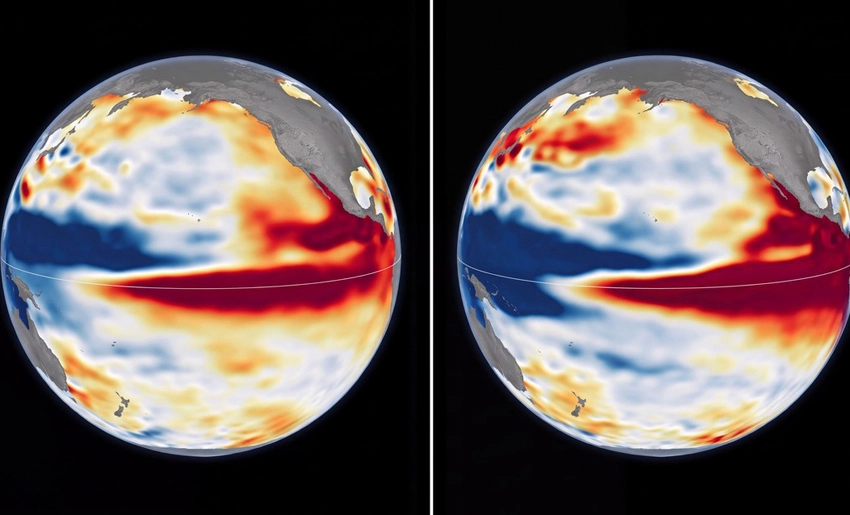
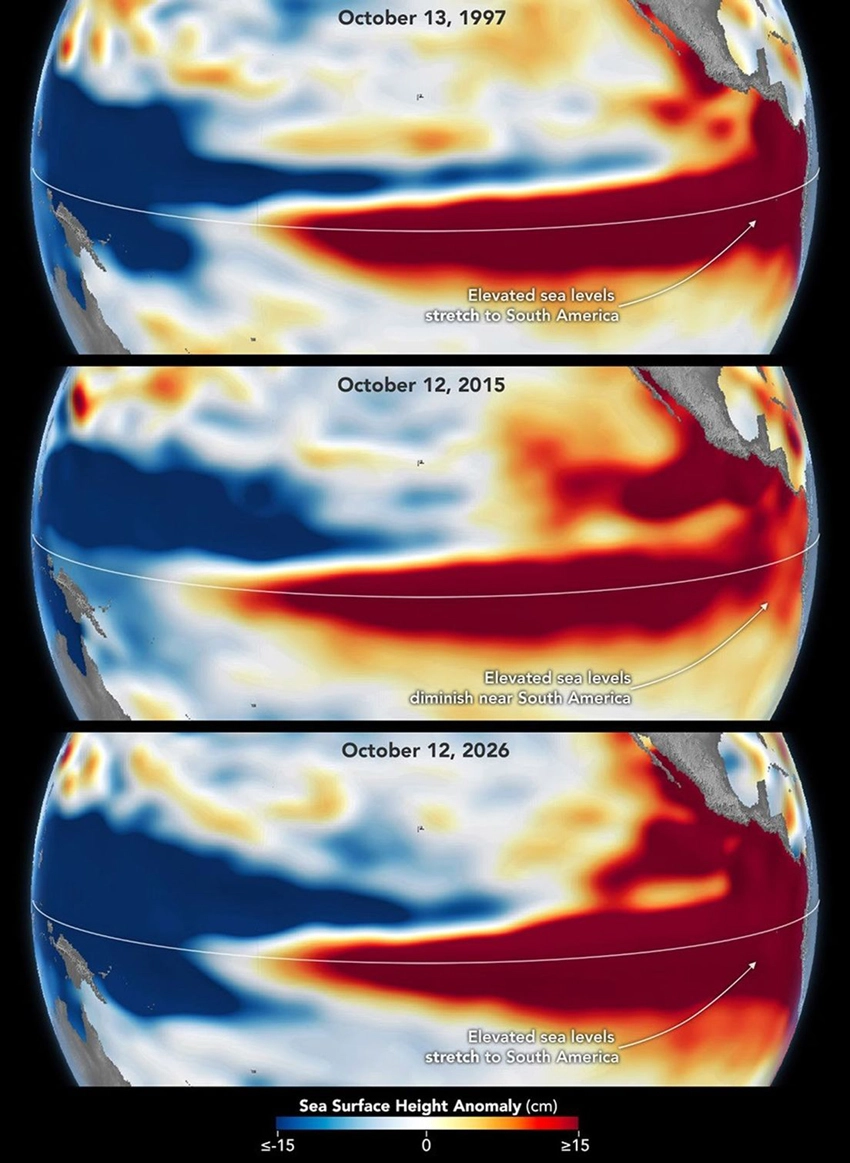
NASA released three images of The Boy phenomenon—captured in 1997, 2015, and 2026. To compare them and predict the impact of the current event.
The Boy occurs approximately every two to seven years. Causing water in certain areas of the equatorial Pacific to warm.
Also the U.S. space agency noted that the most intense recent The Boy events were recorded between 1997–1998 and 2015–2016. During those years, the phenomenon triggered fires in Indonesia and the Amazon. Droughts in Southern Africa, which led to poor harvests; and heavy rains and flooding in Southern California, USA.
“The current The Boy rivals these giants from the past,” the agency warned.
How should the images be interpreted?
Whenever an The Boy event begins in the ocean, trade winds typically keep warm water in the western Pacific. However, when these winds weaken, the warm water shifts eastward. Further diminishing air currents and potentially even reversing their direction. The waters continue to warm and accumulate in the central and eastern Pacific, intensifying the cycle.
Despite a similar formation process, each The Boy event is unique. It depends on where heat accumulates in the Pacific and how the atmosphere responds. These variations can be detected by altimetry satellites. Which are capable of measuring sea-surface height. Since water expands as it warms, causing sea levels to rise.
Abnormal levels in the eastern and central equatorial Pacific point to The Boy. Specifically, these sea-level anomalies are illustrated in the three images released by NASA. Red indicates areas where the sea level is higher, white represents normal levels, and blue shows where the sea level is lower.
Trends align
“What makes altimetry unique is that we have a 35-year record from nearly identical satellites that follow virtually the same ground track, with each mission overlapping the next. This allows us to look back and compare this The Boy event with what occurred in 1997. As it stands, this one appears to be even more intense,” noted Josh Willis, a NASA project scientist for sea-level-related missions.
Comparing this to the 1997–1998 event, the researcher pointed out that the consequences could be similar. Both show a comparable tilt in sea level, with warm waters extending all the way to South America. In the 1990s, these effects resulted in heavy rainfall across California and the entire southern United States. However, The Boy event of 2026 developed much more suddenly than the one in the 1990s.
Nevertheless, both events differ significantly from the 2015–2016 episode. Back then, the exceptionally warm waters along the equator did not extend toward South America to the same degree. The phenomenon struck Central America and the southeastern United States, and also led to major flooding in Mexico.
In any case, it is not yet known for certain how it will play out this year. “There is always a bit of uncertainty here,” noted Willis. Adding that it is merely the “best estimate at the moment” that experts can provide.
With information from RT in Spanish

- NASA compares The Boy events of 1997, 2015, and 2026, reaching an alarming conclusion - 3 de November de 2026
- Recovery of the School Network Continues in Holguin One Year After Hurricane Melissa - 3 de November de 2026
- Publication of Law 186 Establishes the Ministry of Environment, Habitat, and Water Resources - 3 de November de 2026