
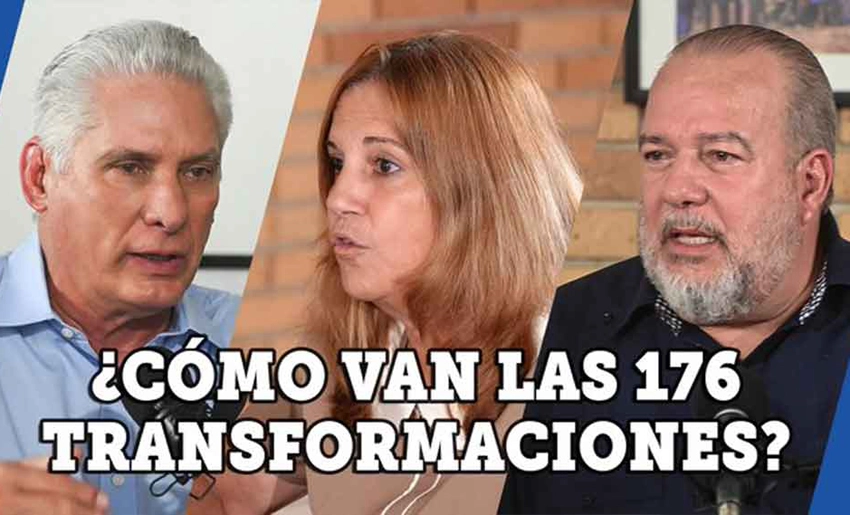
Cuban President Miguel Díaz-Canel stated that the economic transformations currently being implemented in the country are necessary. To creatively confront the main obstacle to the nation’s economic, social, and human development.
While hosting the podcast *Desde la Presidencia* (From the Presidency)—dedicated to analyzing the progress of 176 economic and social transformations. The leader emphasized that “we are in a moment of urgency, under conditions of war against Cuba.”
He described this scenario as a “fourth-generation war,” involving escalating coercive measures aimed at suffocating the economy.
The leader denounced the fact that the island is facing a multidimensional war. Encompassing the economic, ideological, cultural, and communication spheres.
Díaz-Canel highlighted the country’s steadfast and responsible efforts to advance these transformations. Also the fundamental goal of which is to unleash economic potential without losing sight of the social dimension.
“The challenge is immense, but we will not stop,” the leader asserted, stressing the commitment to remain consistent and coherent in pursuing these changes. He considered that “the endurance of the Revolution is the best proof that we are on the right track. Because we have been subjected to a ruthless attack, to ruthless aggression, and to genocidal and criminal practices by the United States administration.”
Moreover the Prime Minister of the Republic, Manuel Marrero, was also present at the discussion session. Díaz-Canel asked him: “How much progress has been made, and where do we stand now?”
He detailed that, over the last three months, the country has focused on designing the implementation process. With 160 concrete proposals and 197 legal regulations approved.
It has been arduous work—not without frustrations, given that the desired results are not yet visible—noted Marrero. Also who mentioned the challenge of striking a balance between the economic and the social spheres.
The Head of Government addressed both attacks from the enemy and doubts raised by friends. Specifically, many people concerned that these changes might represent “a shift toward capitalism.”
Marrero affirmed that this is “a totally sovereign decision” that is not a response to external pressures.
He further indicated that these measures break down limitations, obstacles, and unnecessary bureaucracy. Paving the way for progress—even if that progress is not yet perceived in terms of an improved quality of life for the population.
These transformations, Marrero said, should not be viewed merely in quantitative terms, but rather as qualitative changes. He reflected that people will notice the impact when there are fewer blackouts, fewer water shortages, a wider range of products available, and better prices.
He noted that the context is highly complex, yet “the conditions are in place” to see progress.
“We will not allow,” he declared, “these transformations to remain merely on paper.”

- Transformations in Cuba: Necessary in Times of Urgency - 2 de October de 2026
- Beach studies continue in Holguin - 2 de October de 2026
- Holguin Health Sector Strengthens Ties with Adolescents and Youth - 1 de October de 2026