
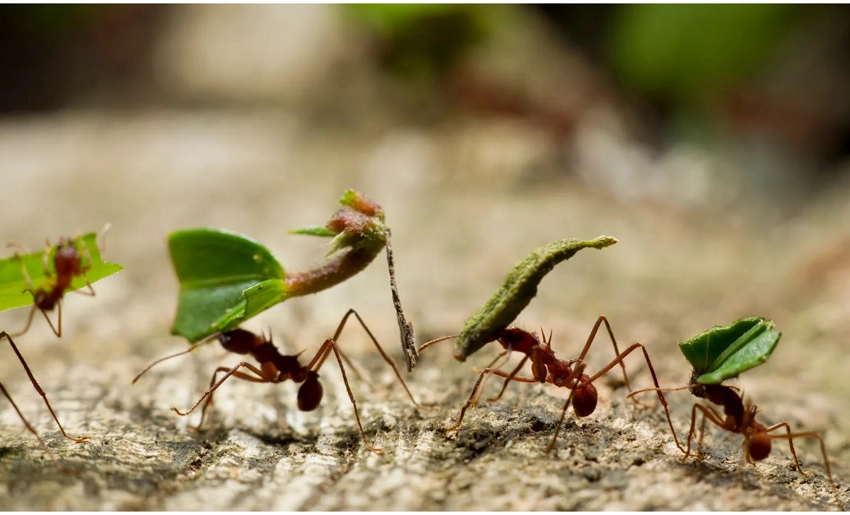
For some consultants and economists today, ants can serve as a significant example. Due to their industriousness and ability to stimulate means of production and initiatives.
Aside from a very complex animal world with secrets still unsuspected by humankind. There exist in its landscapes some undeniable heroines: ants.
Intelligence, perseverance, solidarity—these could well be three words that characterize these small insects that live on Earth and constitute true examples for humankind: ants.
Much has already been said about them, but their symbolic value for people remains fundamental. When comparing them to those who describe their heroes as strong, large, heavy, and ill-tempered.
Another world awaits within the earth, guided—or rather, guided—by the legs of these small creatures that have much to teach us and to show us how things, and life, should be.
We’re talking about ants (Formicidae), a very peculiar family of hymenopteran insects. Found everywhere, both surprising us with their unique characteristics and annoying us with their unwanted appearances.
But even their size and musculature don’t necessarily indicate their status as one of the most successful zoological groups on the planet.
Scientists believe there are at least 12,000 species, and according to these studies, the first ants appeared in the Late Cretaceous period, or about 120 million years ago.
Also these insects develop through complete metamorphosis, passing through egg, larva, pupa, and finally adult stages. The difference between one caste and another lies in their diet during the larval stage.
Therefore, the worker ant’s first days are dedicated to protecting the brood and the queen. And their defense must be strong against predators such as anteaters, birds, and other insects.
Some ant names are curious, such as the Argentine ant, the Fire ant, and the Tecurues Builder ant, with varying sizes and habits.
Ants cultivate fungi in special chambers, possess a stinger for defense. Although their best method of combat is biting and spraying formic acid. Above all, they are incredibly industrious and productive.
With a body divided into head, thorax, and gaster or narrow waist. These insects hold the record for being the best adapted, small, and intelligent, thanks to their excellent organization—a true testament to ingenuity.
With information from Prensa Latina

- Jorge Gómez: 47 Years Behind the Wheel at Radio Angulo - 22 de October de 2026
- Cuba Begins Its Journey Toward the U-18 Baseball World Cup in the Dominican Republic - 22 de October de 2026
- China Supports Cuba’s Sovereignty in Face of Arrest Warrant for Raúl Castro - 22 de October de 2026