
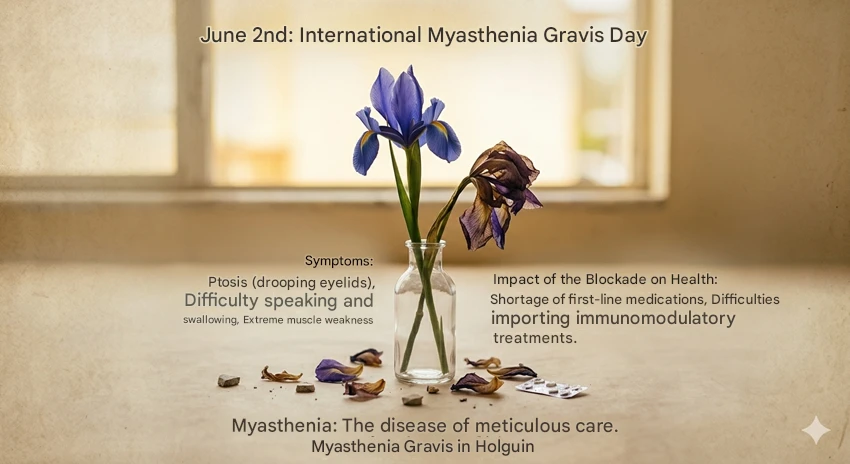
The clock strikes six in the evening in Holguin, and for most, it’s time to go home, to rest, or to plan dinner. For my mother, however, it’s the moment when the world begins to blur. Her eyelids, rebelling against her own will, begin to droop with the weight of a lead curtain. She tries to smile, but the gesture is cut short in a strange grimace. She tries to speak, and the words drag on, thick and slurred, as if language had turned to stone.
It’s not ordinary tiredness. It’s not the physical exhaustion of someone who has had a long day in the fields, the factory, or the office. It’s myasthenia gravis, a neuromuscular, autoimmune, and chronic disease. The global calendar invites us to confront every June 2nd, on its International Day.
In Cuba, reports of diagnosed patients are not few. Local statistics confirm that dozens of families live with this condition. However, socially, Myasthenia Gravis remains a ghost. A complete unknown that walks among us disguised as “laziness” or “apathy.”
Beyond “I’m exhausted”
Misunderstanding is perhaps the first painful symptom. The patient with Myasthenia Gravis wakes up strong. As the day progresses, the receptors that connect their nerves to their muscles give out.
“Sometimes people think you’re exaggerating,” my mother told me a few months ago. When holding a cup of coffee became an impossible challenge.
That’s why this isn’t just a medical condition; it’s a disease requiring meticulous care. The family becomes the lifeline. You have to learn to read the signs: the change in tone of voice that foreshadows a respiratory crisis, the difficulty swallowing that demands stopping eating immediately. At home, empathy replaces haste, because understanding that fluctuating muscle weakness isn’t a whim is the first step to saving a life.
When a crisis strikes, the inevitable destination is the hospital. There, Cuban healthcare workers—doctors, nurses, and neurologists whose compassion defies description—wage a fierce battle. Diagnosing and stabilizing a myasthenic patient requires surgical precision. As a contraindicated medication can be fatal.
However, the reality of hospital life is fraught with obstacles. Caring for these patients becomes a delicate and meticulous task due to the severe limitations imposed by the economic, financial, and commercial blockade of the United States of America. First-line medications, specific immunomodulatory treatments, and chemical reagents essential for clinical monitoring are often unavailable in the national pharmacy network. Also because their patents belong to American companies or because the country’s financial channels are blocked.
Seeing a family member in an intensive care unit waiting for a drug that the country must obtain through third-party markets. Paying exorbitant prices and circumventing prohibitions, is a painful lesson in geopolitics etched onto the skin of our loved ones.
The blockade here isn’t an abstract slogan. It’s the lack of a lightbulb that restores air to the lungs, strength to the eyes, and a voice to a desperate throat.
Despite the headwinds and material shortages, Myasthenia Gravis in Cuba is not experienced in absolute isolation. Faced with a scarcity of resources, the alternative has always been. And will always be an outpouring of human compassion. There is a universe of things we can do that don’t depend on imports, but rather on our capacity for empathy.
Helping a patient with Myasthenia begins by easing their daily burdens. We all can. If you know a neighbor, friend, or family member who suffers from the disease, help them. We can educate our neighbors, drivers, and coworkers so they understand that this extreme fatigue is real and deserves respect, not hasty judgments.
From our homes, patience is the best medicine: learning to listen to the silences. Adjusting the rhythm of the family routine, and building a safe environment where the sick person doesn’t feel like a burden, but rather the center of our love.
Hope resides in that network of wills woven among the doctors who don’t give up. The families who become experts at deciphering glances, and a society that, little by little, begins to open its eyes to the invisible.
This June 2nd, the call is to multiply that knowledge that saves. For my part, as I finish writing these lines, I return to caring for my mother. I adjust her pillows, smile at her, and although I know that her muscles today don’t allow her to return the gesture. I know that she responds with the undiminished light in her eyes.
For her, and for the hundreds of myasthenia gravis sufferers in Cuba, it is worth breaking the silence. Myasthenia weakens bodies, but solidarity and collective love are the strongest forces for sustaining life.
By: Daimy Peña Guillén

- When Screens Sell the Wrong Path - 18 de October de 2026
- Russia Delivers 750 Tons of Vegetable Oil to Cuba - 17 de October de 2026
- Neurotic Anonymous Shows That Cinema in Cuba Is Alive and Shining - 17 de October de 2026