
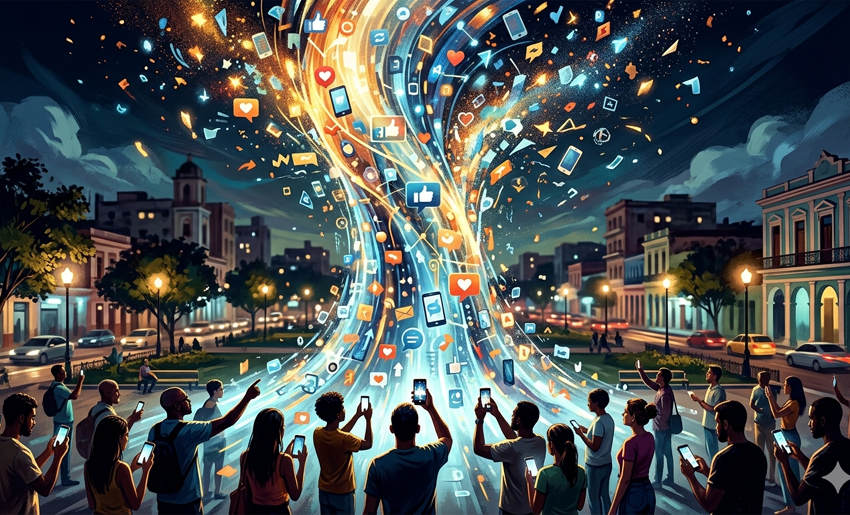
In the contemporary digital ecosystem, virality has become the new yardstick for success. Even though it is often as empty as it is resounding. What floods our screens today and dominates conversations on every corner of Holguin. It will be little more than a blurry memory tomorrow, buried under a new avalanche of notifications. This dynamic raises a necessary question: what are we consuming. Above all, what are we elevating to the altar of popularity?
Also the anatomy of virality is, by definition, capricious. A video, a meme, or a phrase can achieve exponential expansion in a matter of hours. Driven by algorithms that understand not ethics, but retention. The problem lies in the fact that the very ease with which something “explodes” is what guarantees its obsolescence. It is a short-lived vitality; a tinderbox that burns intensely but generates no lasting warmth.
The Triumph of the Inappropriate
It’s worrying to observe how, often, the content that breaks the internet isn’t precisely. That which provides social value or deep reflection. On the contrary, we’re witnessing the rise of:
Empty sensationalism: Unverified stories that appeal to morbid curiosity.
The exposure of vulnerability: Content that ridicules others or violates privacy.
Disinformation: False data that travels faster than the truth because it confirms our biases or fears.
Infographic on virality on the internet: Why is the least appropriate content usually the most shared? The answer lies in primal emotion. Content that generates outrage, easy laughter, or extreme surprise triggers immediate reactions. In the age of the attention economy, the “click” outweighs critical thinking, and visual impact defeats analytical pause.
Reflect before sharing
As a society, and especially through the practice of responsible journalism, it’s up to us to question this inertia. Virality is not synonymous with relevance, nor does the number of views lend credibility to a message.
If something goes viral easily, it’s usually because it was designed to be consumed without thinking.
The current challenge is not just being connected, but being able to discern between the deafening noise of social media and the information that truly nourishes our well-being and social awareness. Tomorrow there will be another trend, another video, and another controversy. Let’s at least find ourselves with our critical thinking sharp enough not to be mere repeaters of a digital mirage.
By: Alvaro Raúl Suárez Leyva

- Putin states that BRICS has generated over 40 percent of global GDP - 12 de September de 2026
- Between the wind of the tenths and bottled art - 12 de September de 2026
- ETECSA Holguin Hosts Science and Technology Forum - 12 de September de 2026