
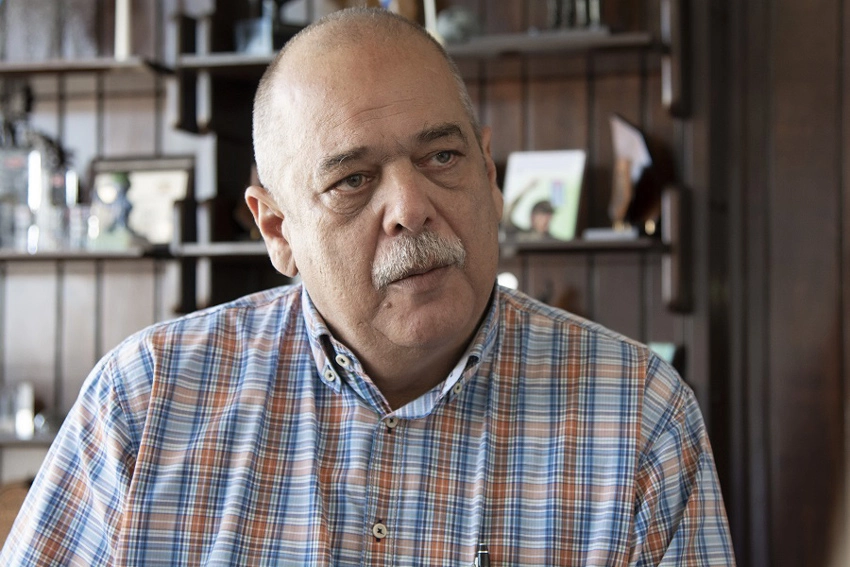
The Minister of Energy and Mines, Vicente de la O Levy, explained how the National Electric System recovery program is being implemented. He stated in official remarks this Thursday.
The Granma weekly newspaper reproduced the explanations given by the energy minister. On the Mesa Redonda program on the CubaVisión channel.
De la O Levy addressed the effects of the U.S. government’s economic, financial, and commercial blockade. And the progress made toward energy sovereignty.
He indicated that by the end of 2025, Cuba had achieved significant progress in the recovery of the National Electric System (SEN). Despite the intensification of the U.S. blockade. Which included the seizure of a ship carrying one million barrels of fuel in December.
As he explained, the country implemented a comprehensive strategy. More than 1,000 megawatts (MW) of distributed generation capacity were recovered. Domestic gas production was increased, key thermoelectric units were repaired. And renewable energy penetration jumped from three to ten percent in a single year.
He stated that the impacts persist and that 2026 will be focused on consolidating the progress made. Introducing energy storage systems, as well as expanding the manufactured gas service.
Moreover he noted that they started from a very complex situation. At the end of 2024, distributed generation had only about 350 MW available out of the nearly 3,000 MW installed. Due to a lack of parts and financing.
In 2025, it was recovered to over 1,000 MW, which proved vital during the hurricane that affected Granma, Guantanamo, Holguin, and Las Tunas provinces. Which were disconnected from the national grid and relied on this distributed generation for power.
He also noted the recovery of thermal power plants. Such as units three and four at the Céspedes plant and unit five at the Renté plant in Santiago de Cuba. Unit four at Céspedes was delayed due to planning errors and maintenance quality issues, but it is now online.
In his extensive address, he referred to the energy blockade imposed by the United States starting on January 29th He emphasized that it was brutal. The last shipment arrived on December 8th, and no more were received until the Russian ship carrying 100,000 tons.
Since January 29th, the possibility of acquiring fuel has been closed. Due to tariffs and the military presence in the Caribbean. Now there is talk of sanctions against entire countries, which discourages any supply.
He argued that the Government Program has 62 detailed actions, month by month, which are evaluated weekly.
In 2026, the goal is not only to grow, but to consolidate and sustain what has been recovered. Today we have 1,114 MW of distributed generation available. We will continue increasing gas and oil production. We have already stopped the decline and are growing, he emphasized.
The major development is the incorporation of energy storage systems: the resources are already in Cuba, in the installation phase.
We have also resumed the program for manufactured cooking gas in Havana, which had been halted due to a gas shortage. The goal is to add 25,000 new customers. Which reduces electricity demand, the minister stated.
Also the minister mentioned that the priority is to maintain thermoelectric plants with Cuban crude oil, because without that fuel we would face a total blackout.
He pointed out the importance of solar energy, which lacks the necessary battery storage to be stable. He added that solar power fluctuates, generating variations in frequency, voltage, and consumption.
Batteries stabilize the energy. There are four large sites in Cuba, totaling 200 MW. Ready for when we have 3,000 MW of renewable energy. The batteries are already in the country.
He concluded, regarding the stages for total energy sovereignty. That the first phase is to reach 24 percent renewable energy by 2030.
Furthermore the second phase is to reach 40 percent by 2035. Which would eliminate fuel imports, saving more than one million tons annually.
The third stage, by 2050, is total sovereignty with 100 percent renewable energy. Cuba has enormous potential in forest biomass, hydroelectric, wind, and even tidal power. This year, the installation of the towers for the Herradura 1 wind farm begins, he concluded.
With information from Prensa Latina

- Putin states that BRICS has generated over 40 percent of global GDP - 12 de September de 2026
- Between the wind of the tenths and bottled art - 12 de September de 2026
- ETECSA Holguin Hosts Science and Technology Forum - 12 de September de 2026